

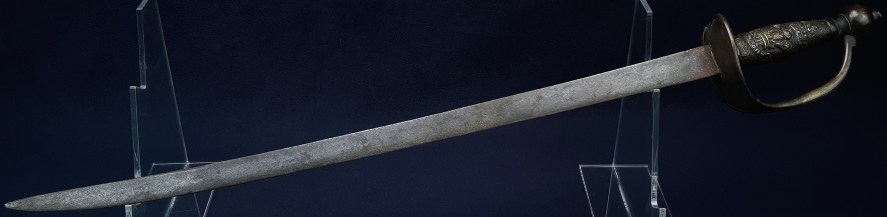
English Circa 1750 Infantry Hanger of the Royal Welch Fuziliers aka Royal Welsh Fusiliers
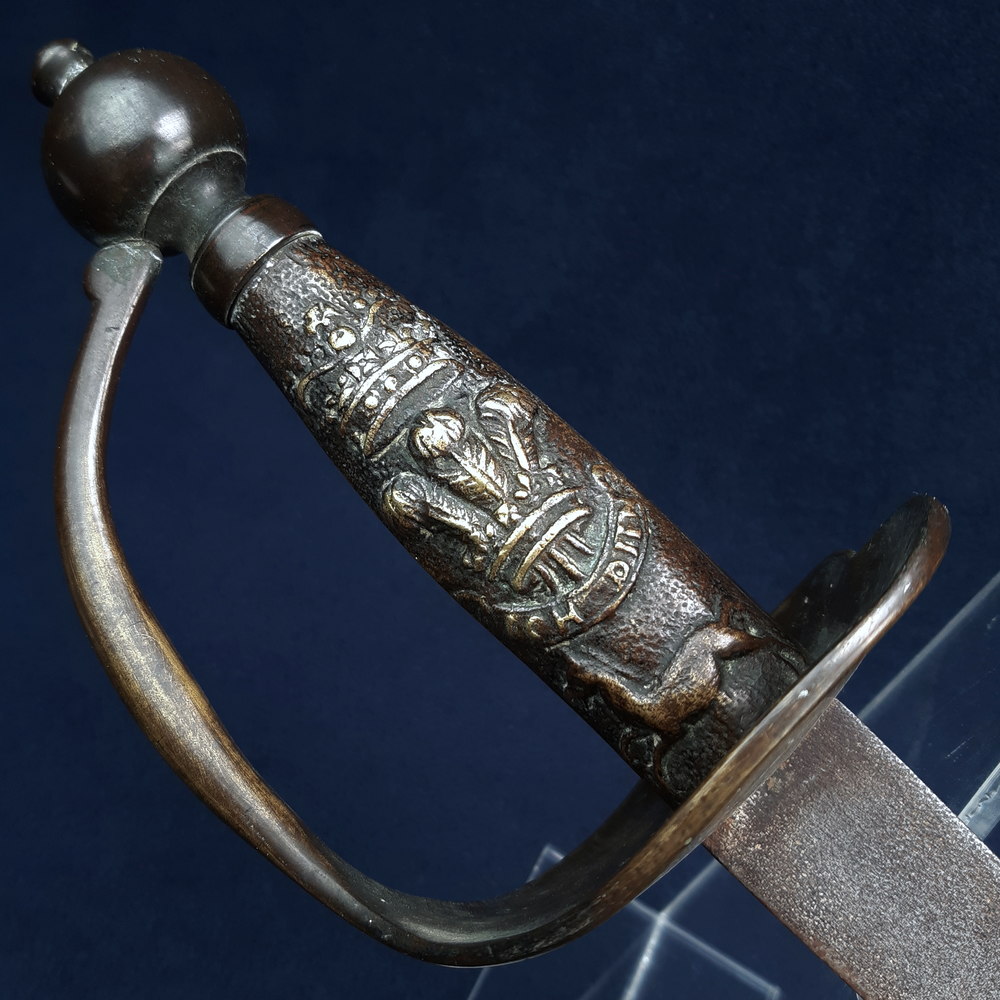
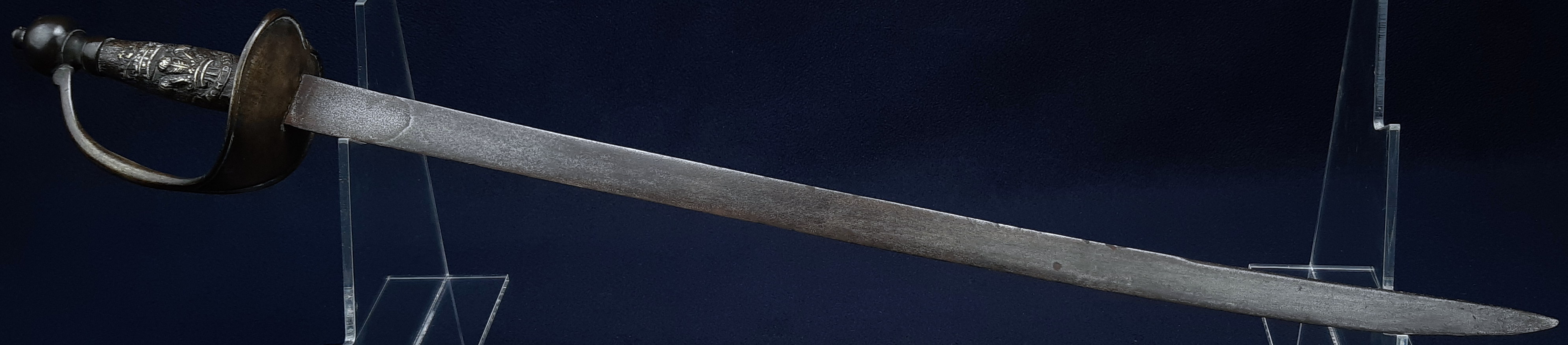
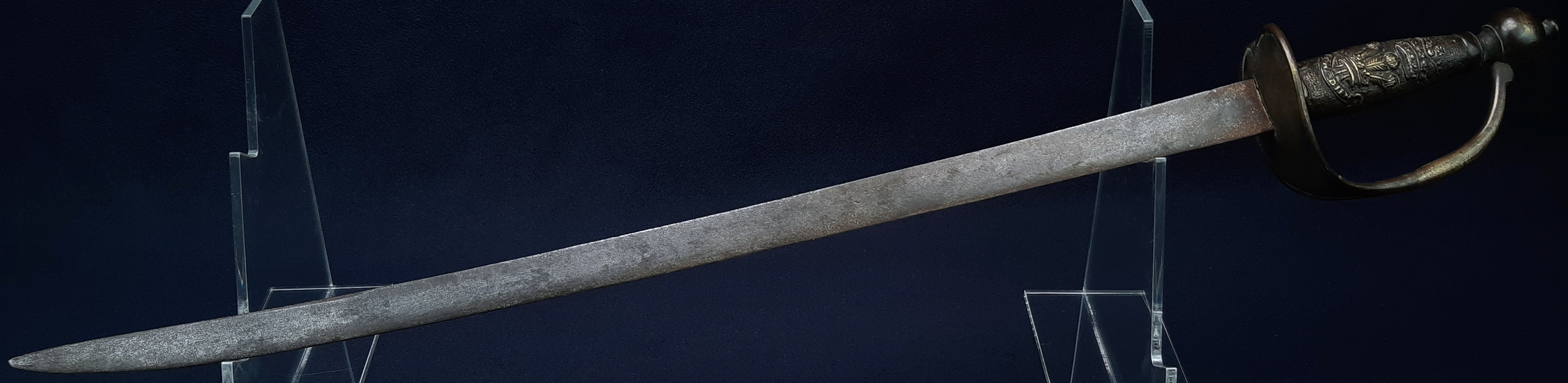
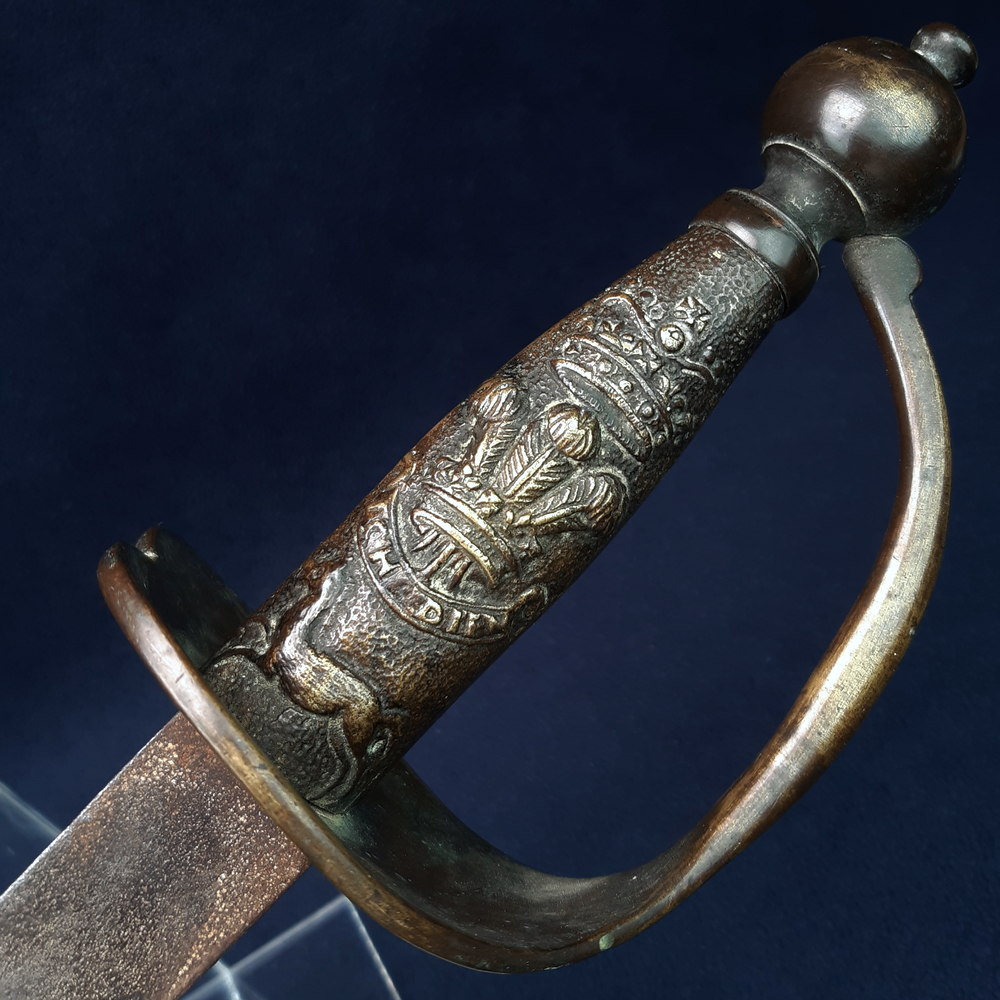
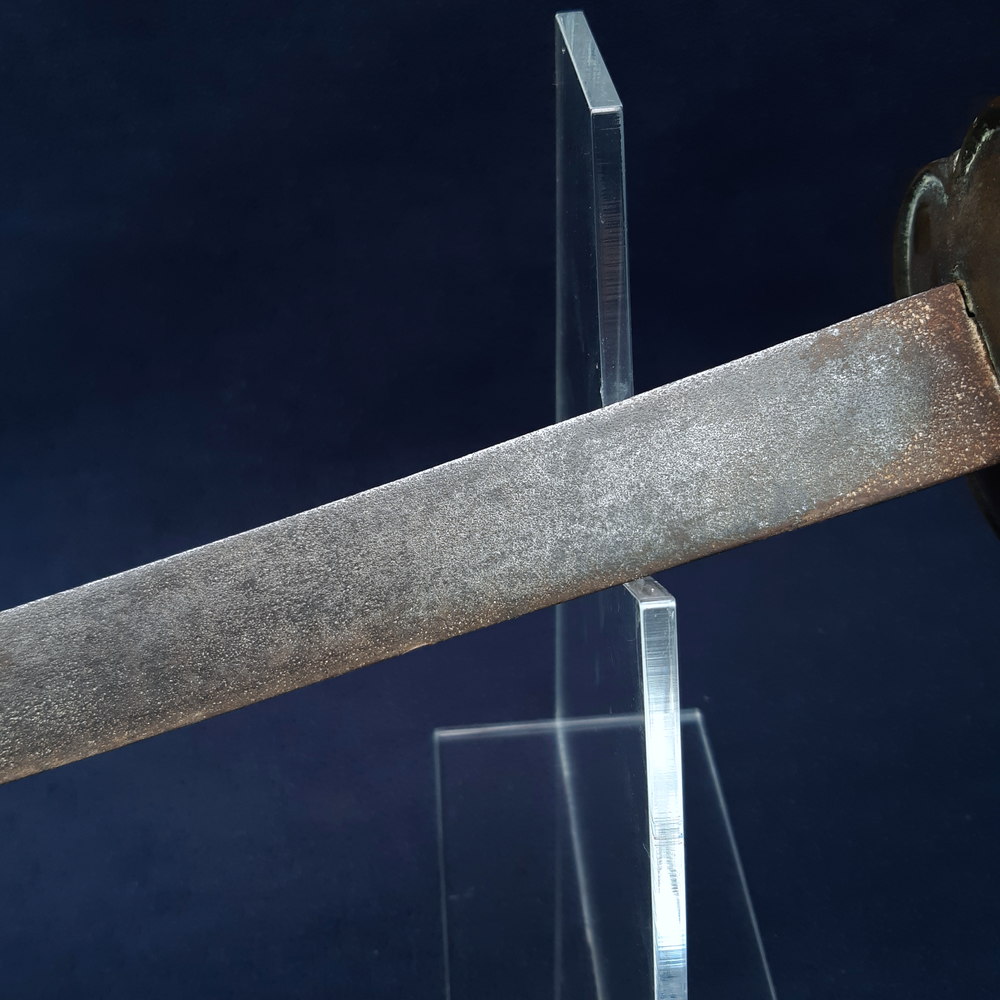
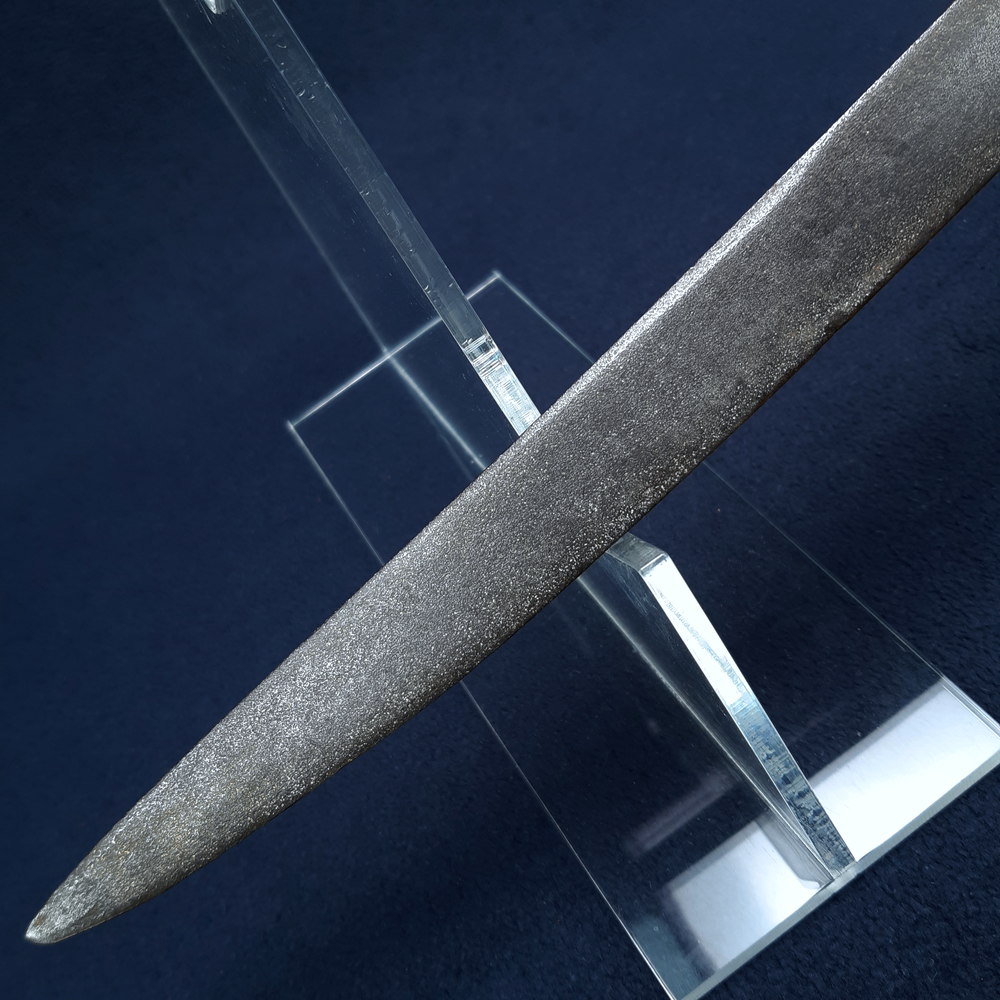
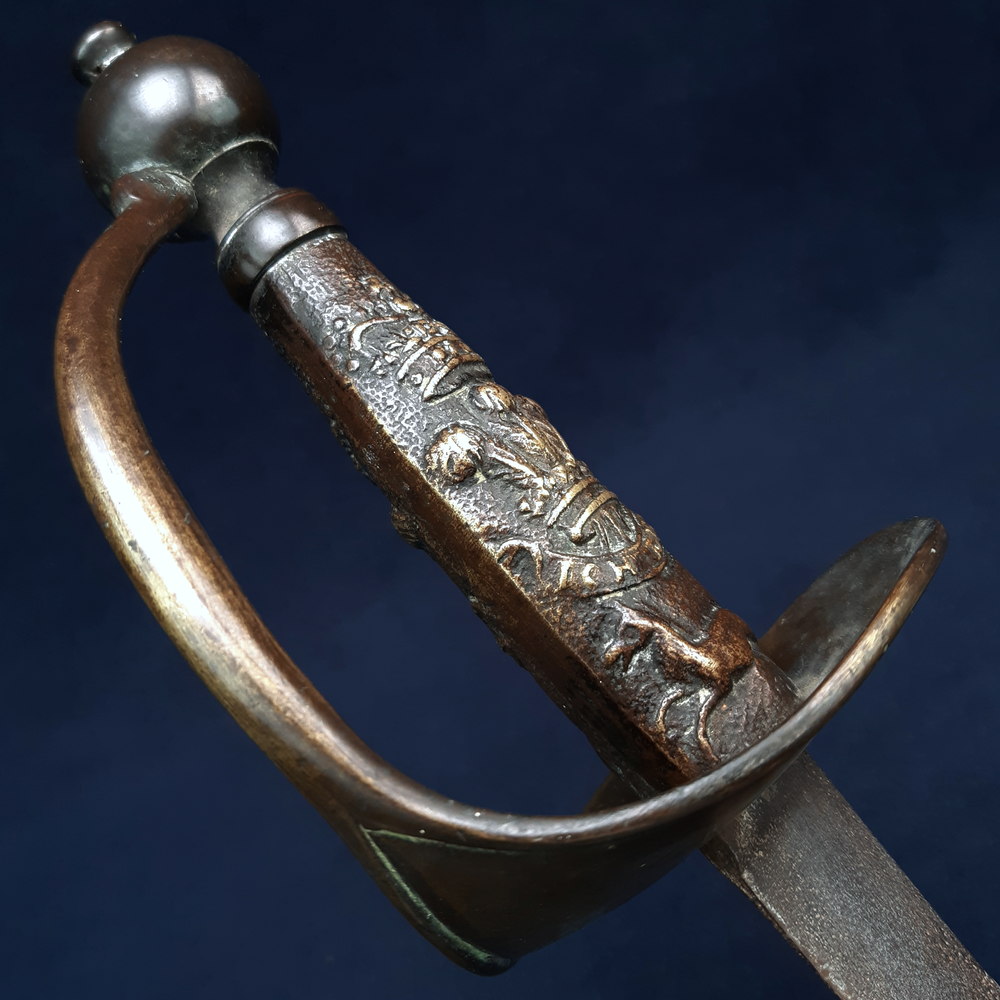
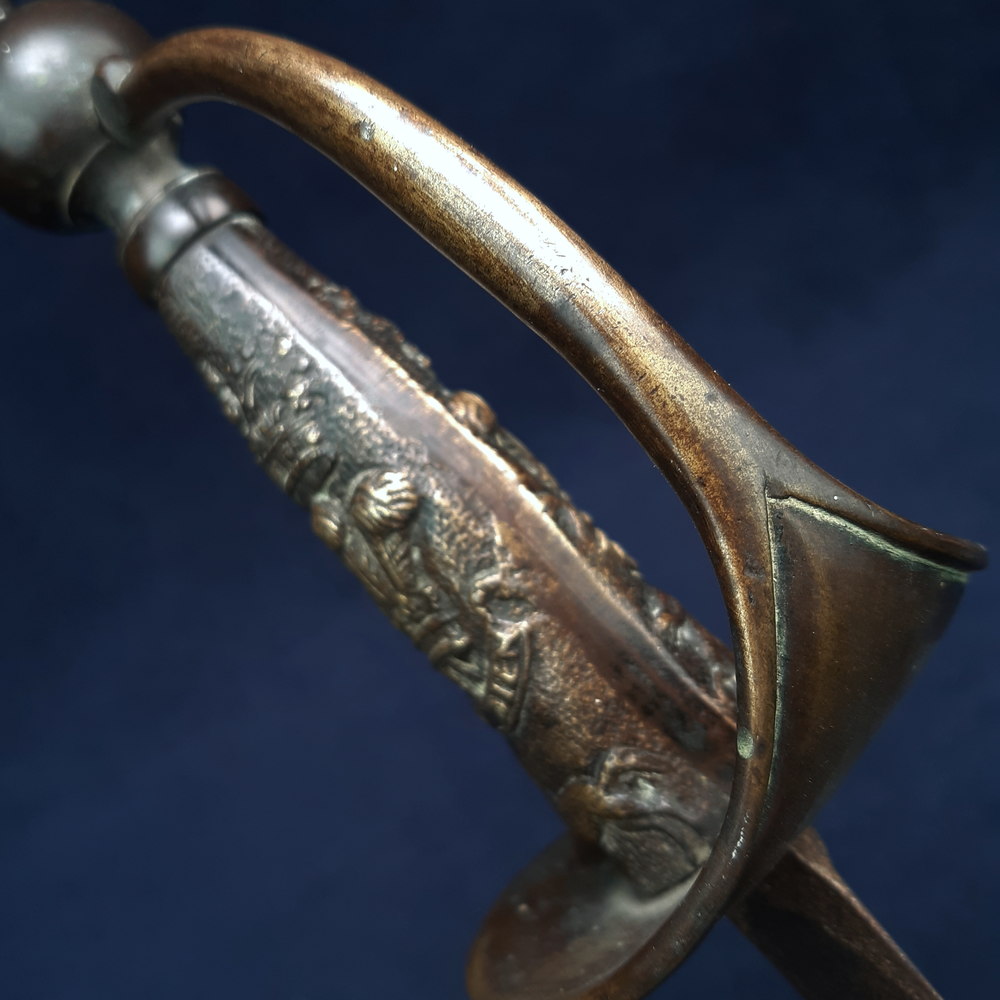
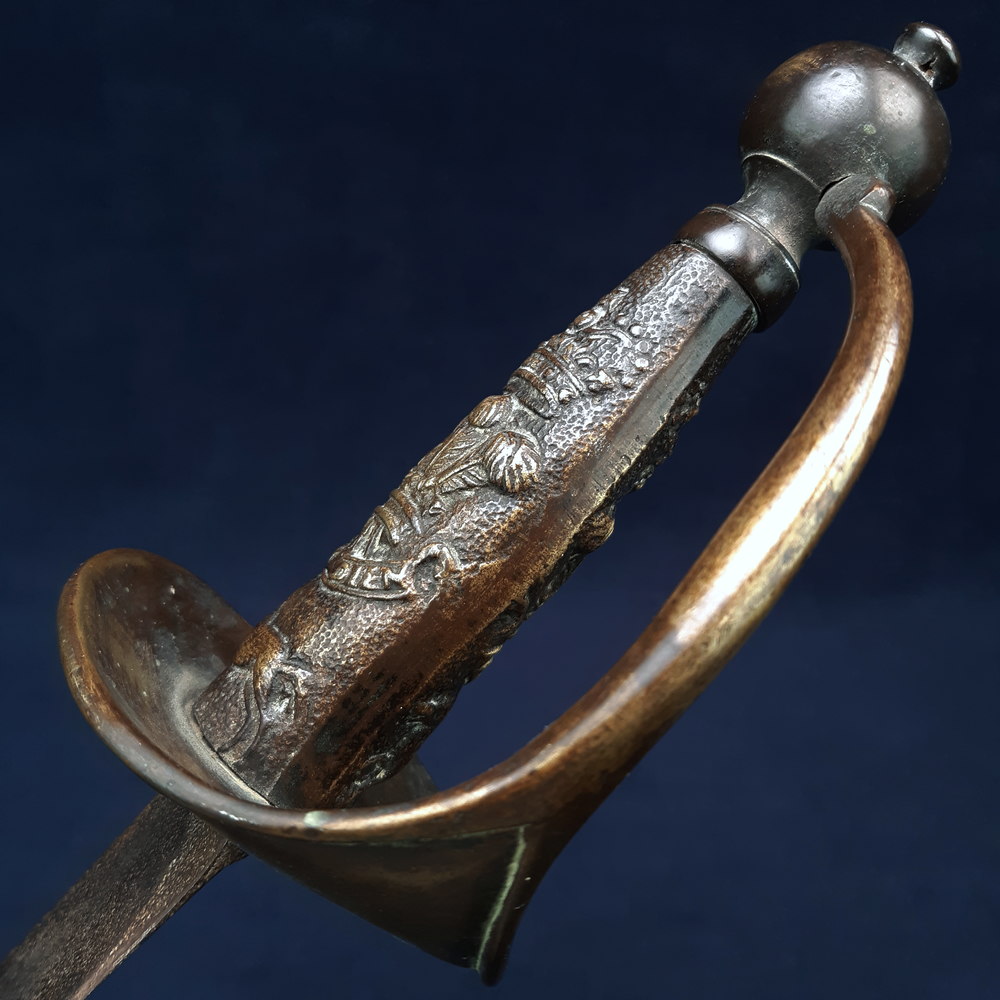
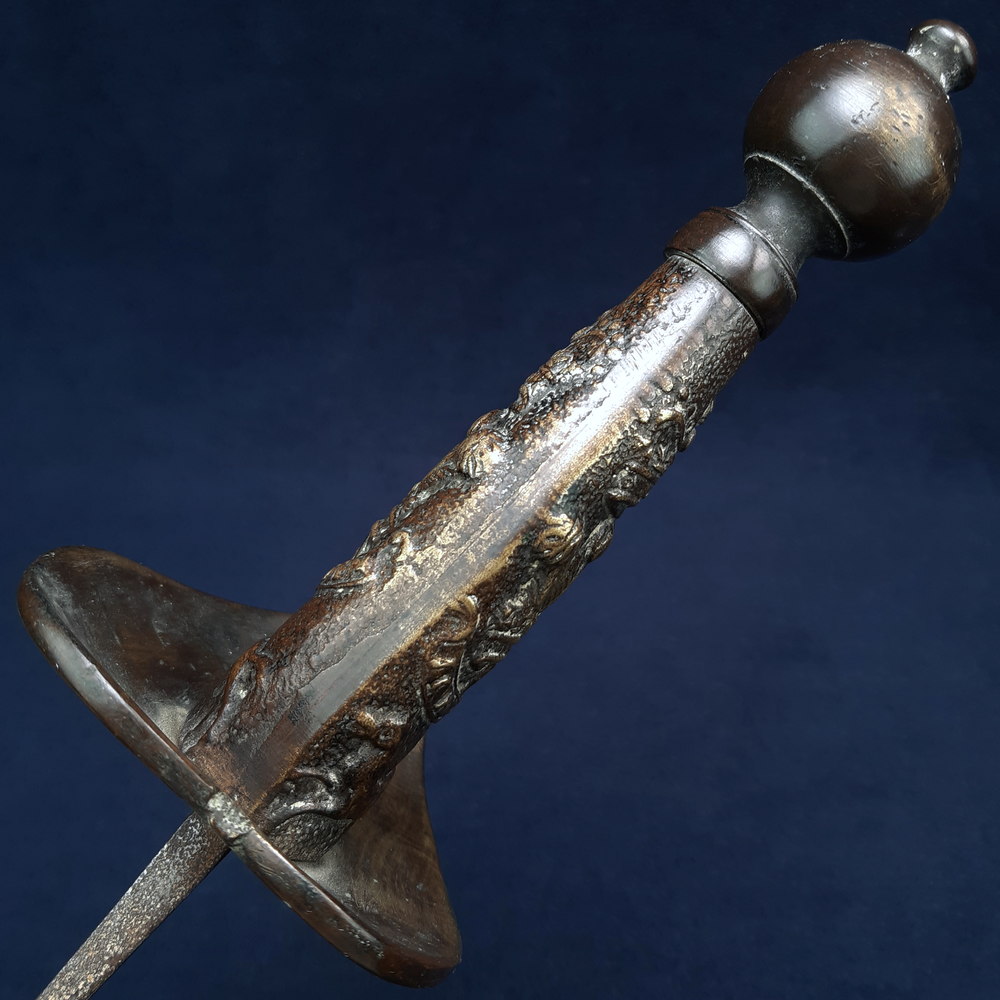
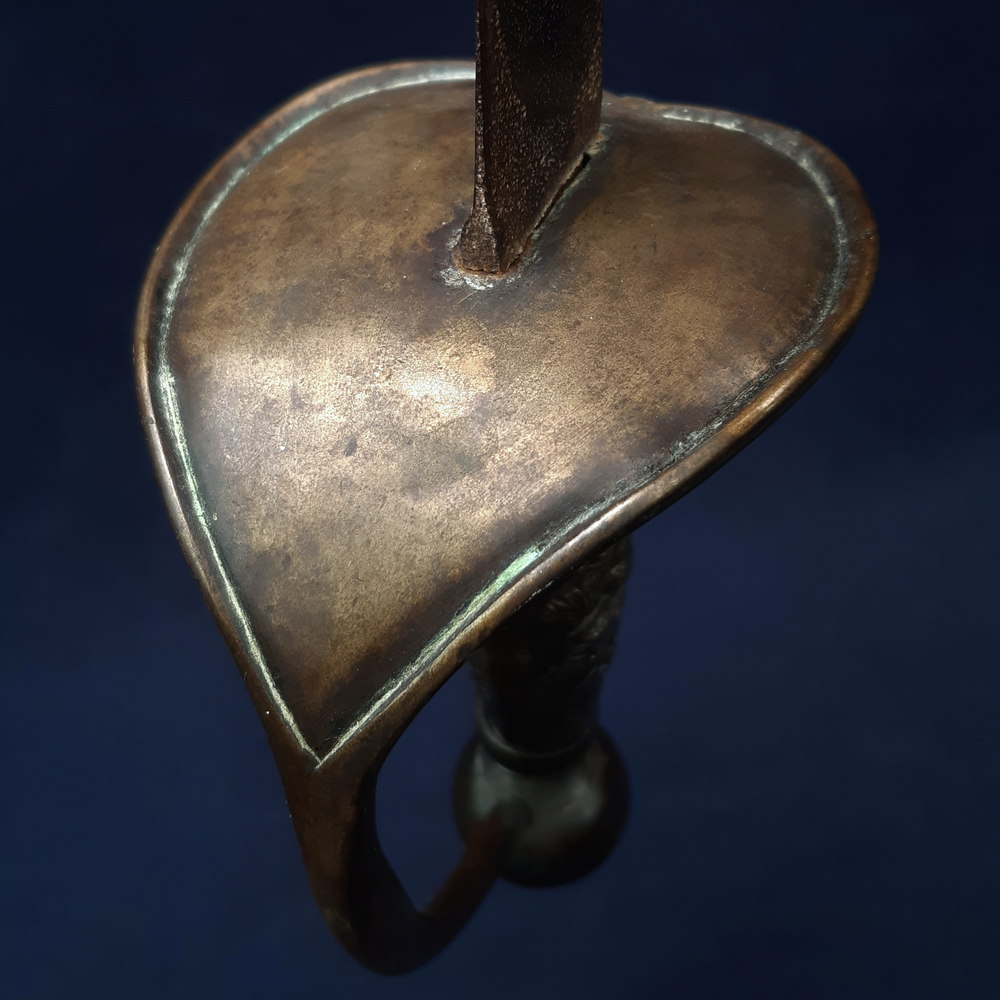
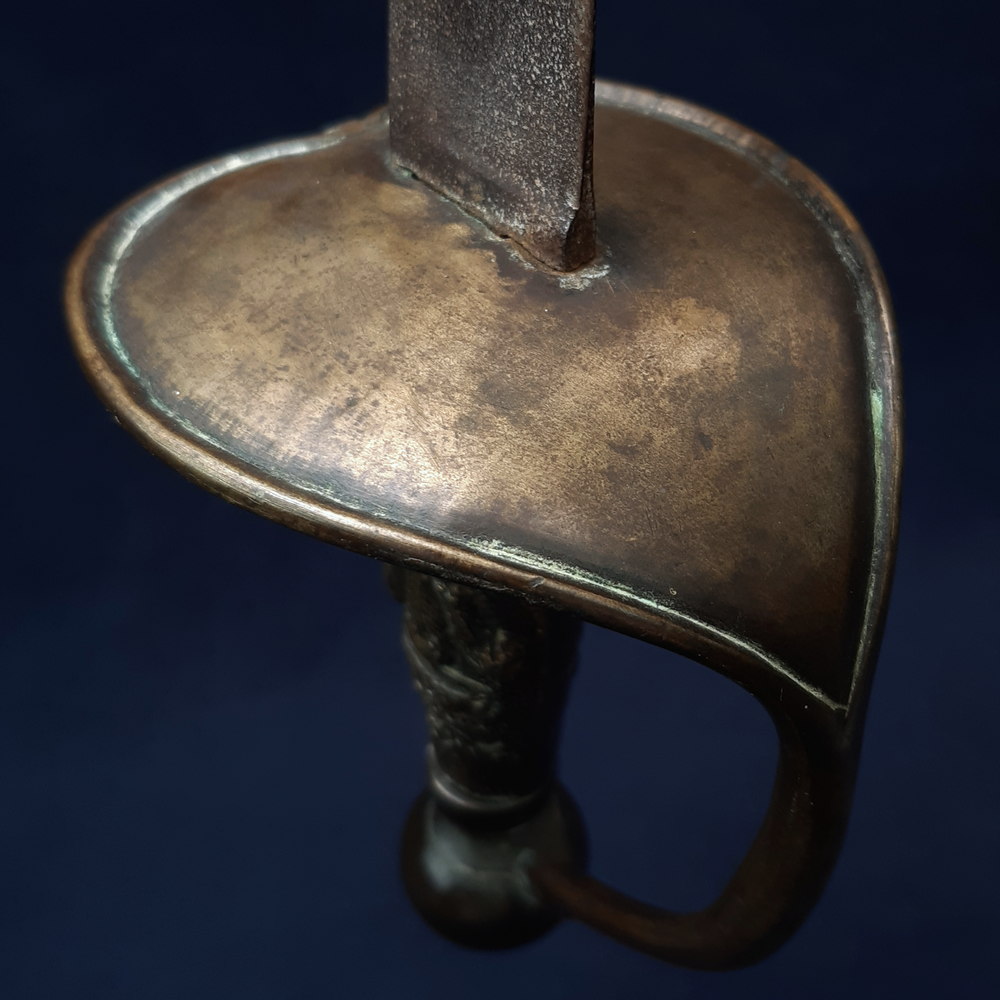
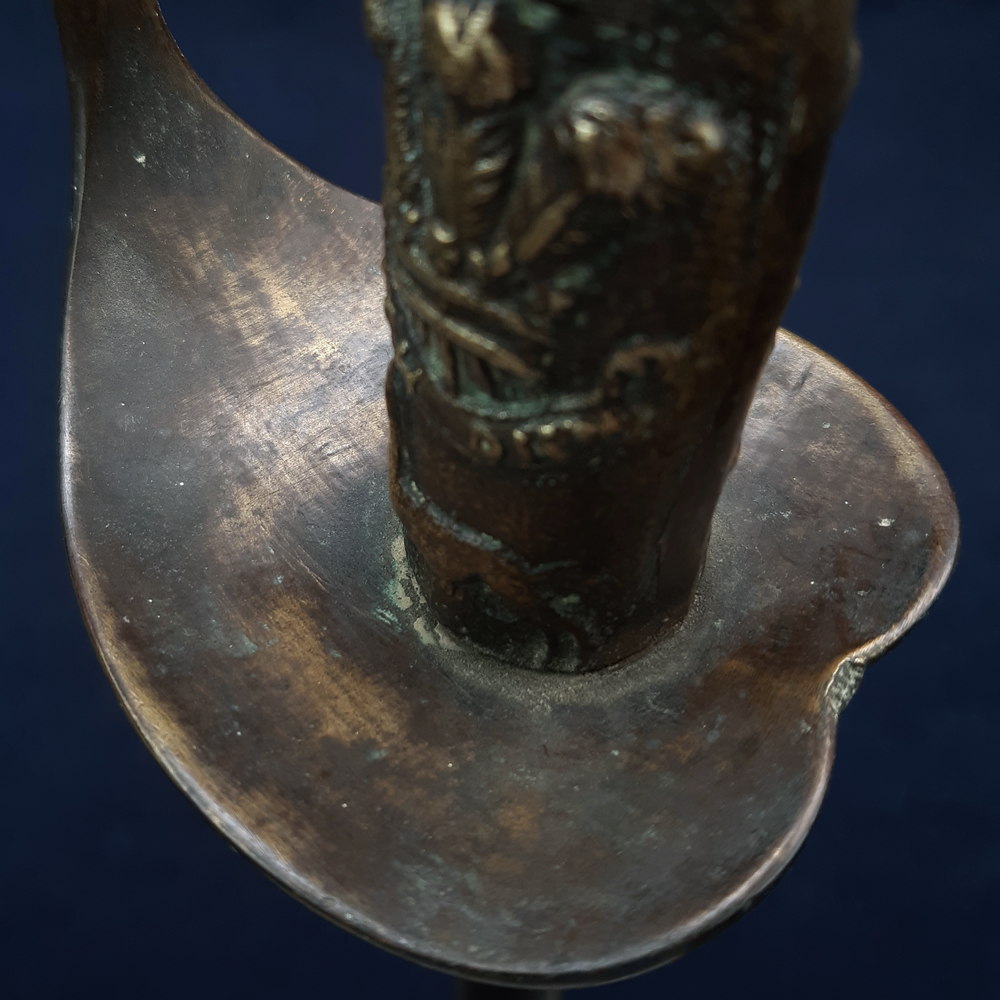
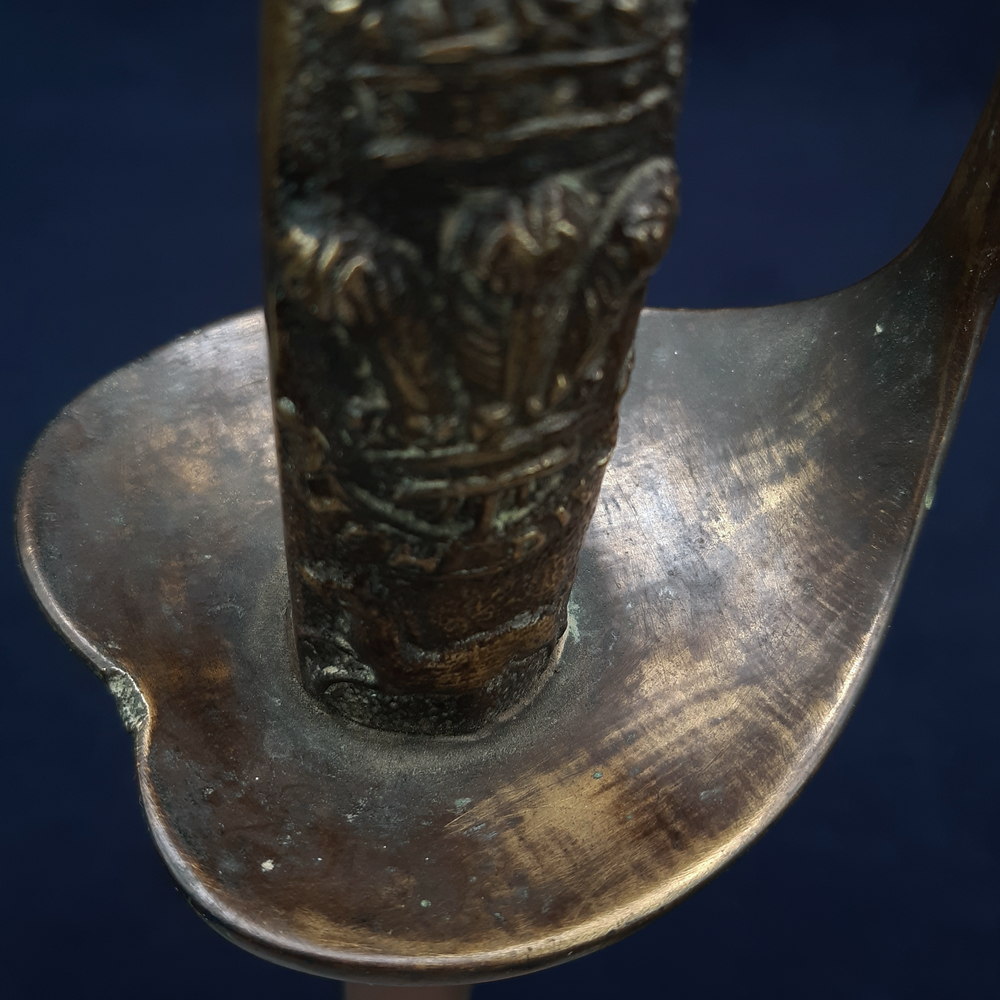
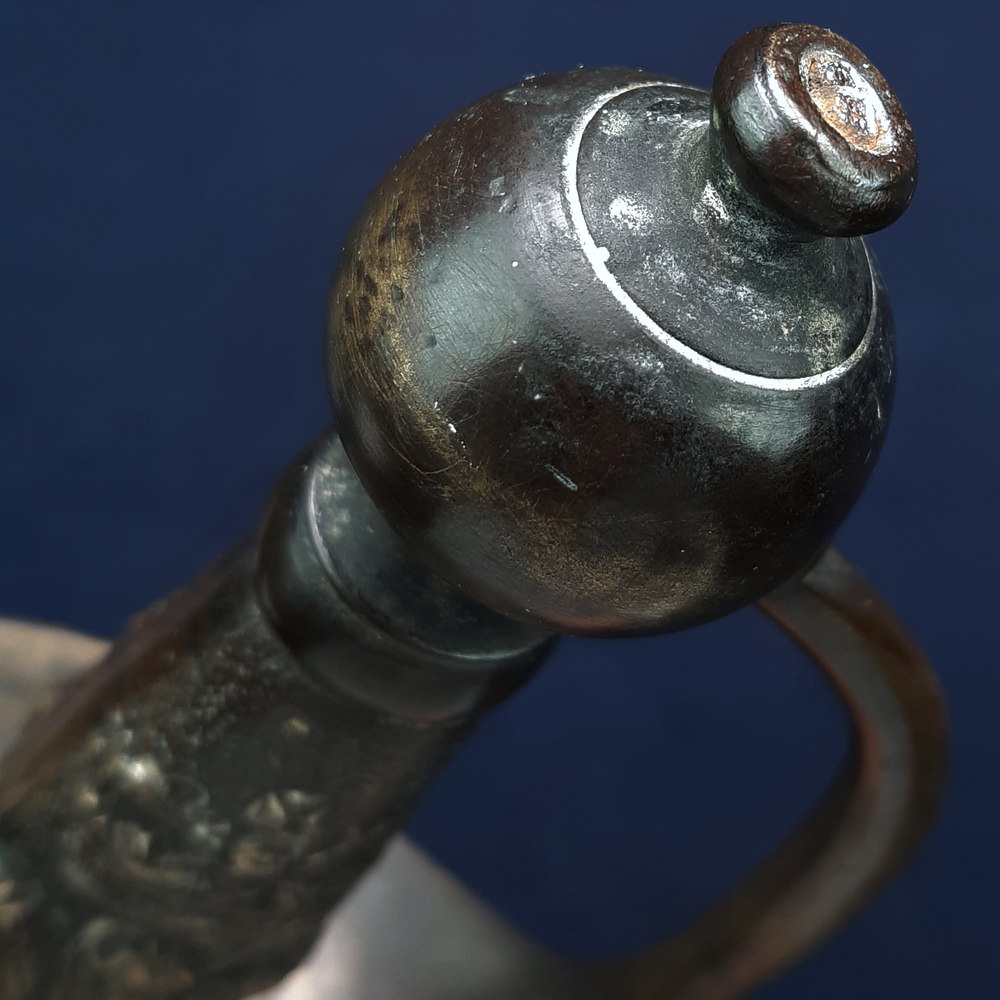
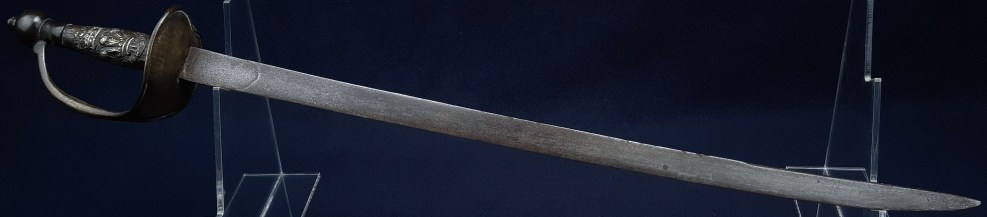
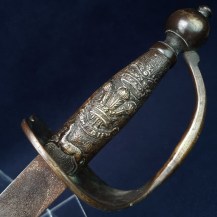
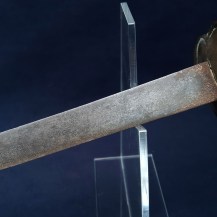
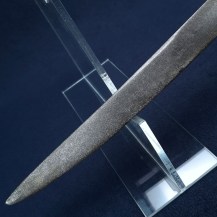
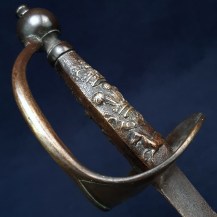
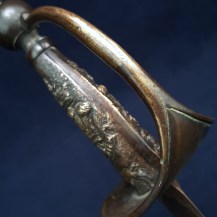
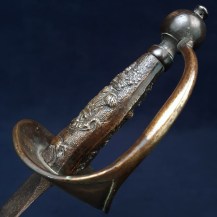
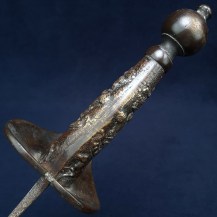
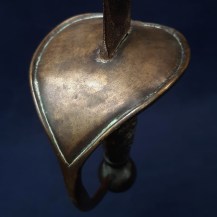
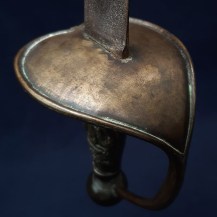
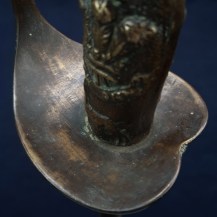
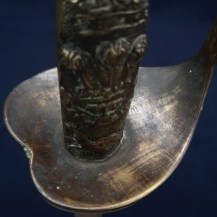
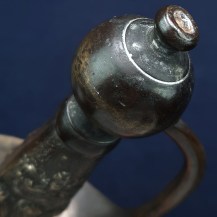
Slightly curved unfullered hanger blade with hatchet point and false edge. Cast brass heart-shaped guard, slightly wider on the right as held, with thickened edge and simple knucklebow. Round pommel with tang button. Rare and distinctive regimental cast brass grip consisting of two identical plates fused over a wood core (core not visible). No scabbard. Blade 24½ inches (62.2cm) in length, its false edge 7¼ inches (18.4cm) in length, the sword 30¾ inches (77.4cm) overall.
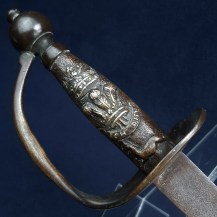
The brass grip is cast on each side with three badges. Firstly, the royal crown. Below this the badge of the Prince of Wales, being three feathers within a coronet and the motto ‘ICH DIEN’ (I Serve) within a scroll. Below this, the white horse of Hanover. The rest of the grip’s surface has a stippled texture.
These badges refer specifically to the Royal Welch Fuziliers / Fuzileers. This regiment is also known as the Royal Welsh Fusiliers: the more archaic spellings were used for many years until modernised in 1881, then the spelling ‘Welch’ was restored again in 1920 creating a third version. For consistency with the period of this sword I will refer to them here as the ‘Royal Welch Fuziliers’ unless quoting.
Originally founded in 1689 as Lord Herbert's Regiment of Foot, this was one of three regiments picked to become Fuziliers in 1702, equipped with fusils (light muskets) and tasked with protection of the artillery. The regiment’s valour in the War of the Spanish Succession earned it the ‘Royal’ prefix, Queen Anne granting it the title of ‘Royal Regiment of Welch Fuzilieers’ in 1713. King George I granted it the title ‘His Royal Highness The Prince of Wales's Own Regiment of Welch Fuzilieers’ in 1714 and authorised the Prince of Wales’s badge to be placed on their regimental colours. The regiment was then awarded the badge of the White Horse of Hanover in 1743 by King George II for service at the battle of Dettingen.
Standardised unit numbering was introduced in 1751 making it the 23rd Foot. It fought in the Seven Years' War of 1756-63, then was sent to North America in 1775 on the outbreak of the American Revolutionary War. Its reputation as an elite fighting unit was fulfilled as it fought in nearly every campaign of the war, including the Battles of Lexington and Concord (April 1775), the Battle of Bunker Hill (June 1775), the New York and New Jersey Campaigns (1776) including the Battle of Long Island, the Philadelphia Campaign (1777) including the Battle of Brandywine, Battle of Germantown, and capture of Philadelphia, the Battle of Monmouth (1778), the Southern Campaign (1780–1781), and finally the Siege of Yorktown (Sept-Oct 1781).
At Yorktown most notably of all, the depleted ranks of the Royal Welch found themselves trapped in an isolated forward fortification along the river, which they defended successfully against three intense assaults by larger French and American forces before Lieutenant-General Cornwallis surrendered. The site is known today as the Fusilier Redoubt. Refusing to allow their regiment’s colours to be lost, an officer managed to smuggle them away wrapped around his waist under his coat, making them the only British regiment to preserve their colours despite the surrender.
In the 18th Century colonels of regiments typically controlled procurement of equipment for their men, although market availability naturally affected their choices. In this rare case, rather than order a generic wood or brass grip for the standard infantryman’s hanger the procurer for the Royal Welch ordered a custom grip that incorporated the regiment’s badges as ornament. It would have been a serious statement of regimental pride for even the private soldiers to carry bespoke equipment.
These hangers are well documented because a quantity of 18th century arms of the Royal Welch Fuziliers came to be held at Flixton Hall in Suffolk, home of the prominent Adair family. The arms were acquired c1760 by William Adair (1700-1783) who was an ‘army agent’ working for the regiment. As mentioned colonels had to handle procurement for their regiments, this also extended to other financial affairs including supply and payroll. These administrative tasks were typically delegated to a civilian ‘agent’ with full power of attorney, freeing up the colonel for military duties.
It would therefore have been Mr Adair who actually ordered these hangers (these being classed as ‘accoutrements’ not supplied by the Ordnance) with the approval of the colonel at the time, his close friend General John Huske. Adair served as an agent for many years for multiple regiments and would have been ideally placed to acquire obsolete or surplus arms from regimental armouries. He trained up his nephew Alexander in the same business who continued until the Napoleonic period.
The Royal Welch Fuziliers’ swords were hung on the walls of Flixton in ornamental arrangements, along with muskets, bayonets, pistols and spontoons, a rare example of a contemporaneous group of a single regiment’s arms left relatively intact and untouched. The house and contents passed down the generations until the death of Sir Robert Shafto Adair in 1949. His son, the decorated tank commander Major General Sir Allan Shafto Adair, GCVO, CB, DSO, MC, JP, DL, faced sizeable death duties on the estate.
He was forced to sell the Hall, and while seeking to dispose of its contents came into contact with antique arms expert, collector & dealer William Keith Neil, who came to view its arms collection on the 12th October 1950. Neil had previously worked for the Ministry of Economic Warfare during WW2 which tasked him with selling antique firearms donated to the British government, mainly from country houses, in the United States to raise funds for the war effort. Post-war he acted as a private agent in much the same role, at that time hunting for arms suitable to furnish the historic Powder Magazine at Colonial Williamsburg in Virginia, a historic site and former state capital converted into the world's largest living-history museum of early America. Flixton was a treasure trove: Neil bought it all on the spot and excitedly informed his clients. With regard to the swords he wrote:
“No. I. photograph shows the hilt of an infantry hanger c. 1742. It has the correct curved blade, cast brass hilt with brass grip embossed with the arms of the regiment, The Royal Welsh Fuziliers… I have been most fortunate in buying a complete trophy of these from one of the oldest families in England connected with the Army. These arms have been in their possession for over 200 years and to have found a complete “run” of such attractive ones as these is really more than I had hoped… I have twenty six all told of these swords all exactly alike… 21 are perfect, nine actually have their original leather scabbards. Of the remaining five three have had the quillon broken off, and two have lost the tips of their blades.”
He emphasized that these were “more than just specimens, but swords that had seen actual service”.
Due to the regiment’s connection to American history Colonial Williamsburg was eager to acquire the group. Purchase of the swords was completed in 1953. The museum bought all 26 infantry hangers offered by Neil and today houses 24, all examples matching this one. One was stolen in the 1960s and one was exchanged with the George C Neumann Collection at Valley Forge National Historical Park. An example at Williamsburg (object number 1953-501-A) is viewable online here. It is the opinion of Colonial Williamsburg that ‘While it is not known exactly when the Regiment acquired these swords, they were in use during the French & Indian and Revolutionary war period.’
Arms researcher Erik Goldstein has published essays and a book going into significant detail on Flixton, its history and its contents – see 18th Century Weapons of the Royal Welsh Fuziliers from Flixton Hall, Thomas Publications, 2002, and Infantry hangers of the Royal Welch Fusiliers, 1742-1784, in Man At Arms magazine Vol. 20, no. 6 (December 1998), p. 18-23.
Hangers from the Royal Welch rarely come on the market since very few are in private hands. They would always have been rare as a unique regimental variation and the group held at Flixton seems to have been a large proportion of the surviving total. Some, perhaps even most, of those in private hands today might have quietly exited Flixton via Mr. Neil, as Goldstein writes (2002 p50-51):
“It is clear, however, that not all of the Flixton weapons went to Williamsburg. Muskets from the group remained in Neil’s own collection and others found their way into other collections. The Royal Armouries and some of Neil’s contemporaries… obtained specimens. Although it has not been proven, it is also thought that a majority of the few brass hilted Royal Welsh Fuzilier infantry hangers known to be in private hands were part of the Flixton Hall collection too.”
From studying its displays Goldstein estimates there were “30 or so” hangers at the Hall at the time Neil visited, with more present in earlier eras but destroyed in a major fire in 1846.
There is one other significant possible source of RWF hangers, dating back to their defence of Fort St Philip on Minorca in 1756. Men of the 1st Battalion formed a working party outside the main fort which was surprised by a French attack. The French were beaten back but the regiment lost a great deal of equipment from their quarters. Regimental records note that “most of the men lost their knapsacks, waistbelts, pouches, swords etc.” (quoted Goldstein 2002 p106). An inspection in February 1757 noted that they were “Wanting 662 swords… The working men the night of the attack lost all of their pouches and almost all of their waistbelts and swords.” (ibid.) These seem to have been replaced by the time of another inspection in September 1757. Probably a large order was made to both equip the new 2nd Battalion and replenish the 1st at the same time.
Because of this loss there could be up to 662 RWF hangers of what we might call the ‘first generation’ in the wild, taken as equipment or trophies by the French. No great hoard of these has been found however. Goldstein notes a single RWF hanger found in France in the 1990s, with a slightly different grip casting and a more dished hilt compared to all other known examples (including this one) with the tantalizing possibility that it is from the captured group, but it stands alone.
For previously sold examples see Lot 0152 sold at Bruneau and Co Auctions on April 9th 2022, an identical infantry hanger to this one which came from the personal collection of Erik Goldstein, and also Lot 182 sold at Antony Cribb auctions on 2nd July 2024, this being an even rarer version made for the regiment’s grenadier company, with an identical grip but a different hilt.
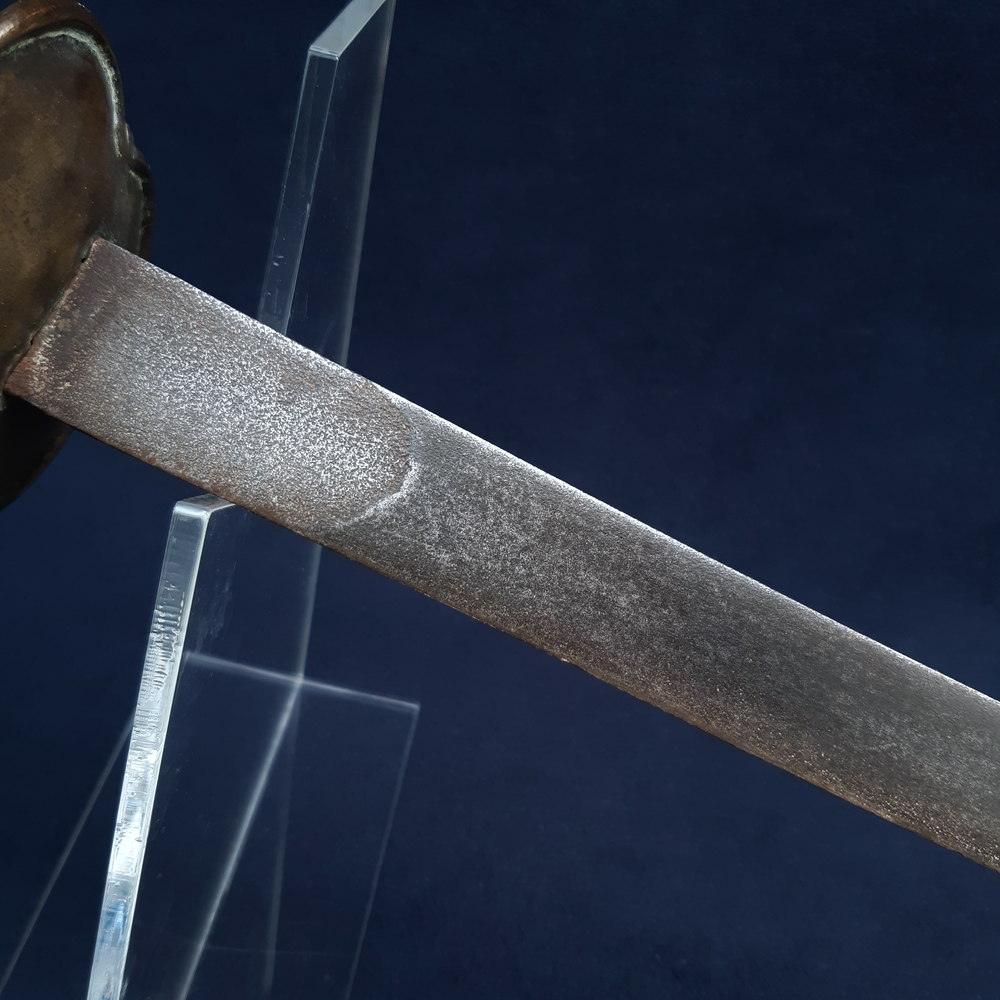
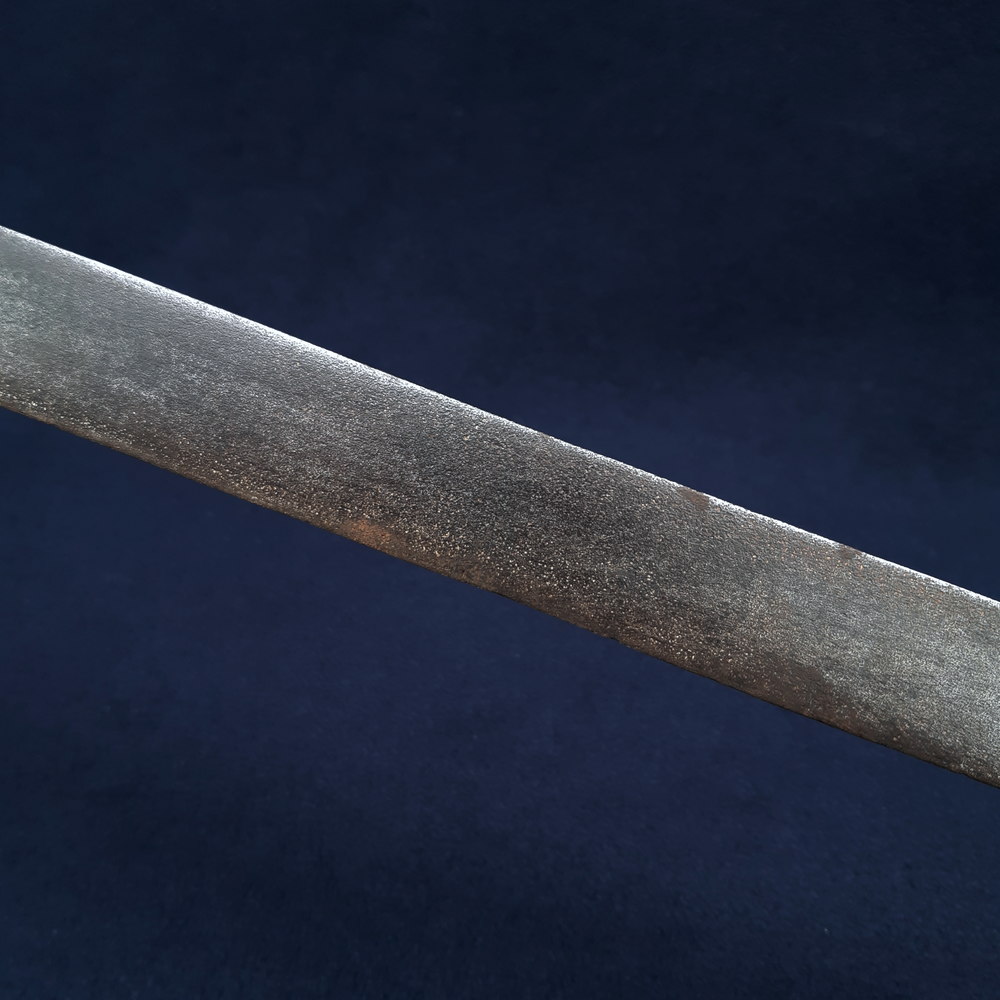
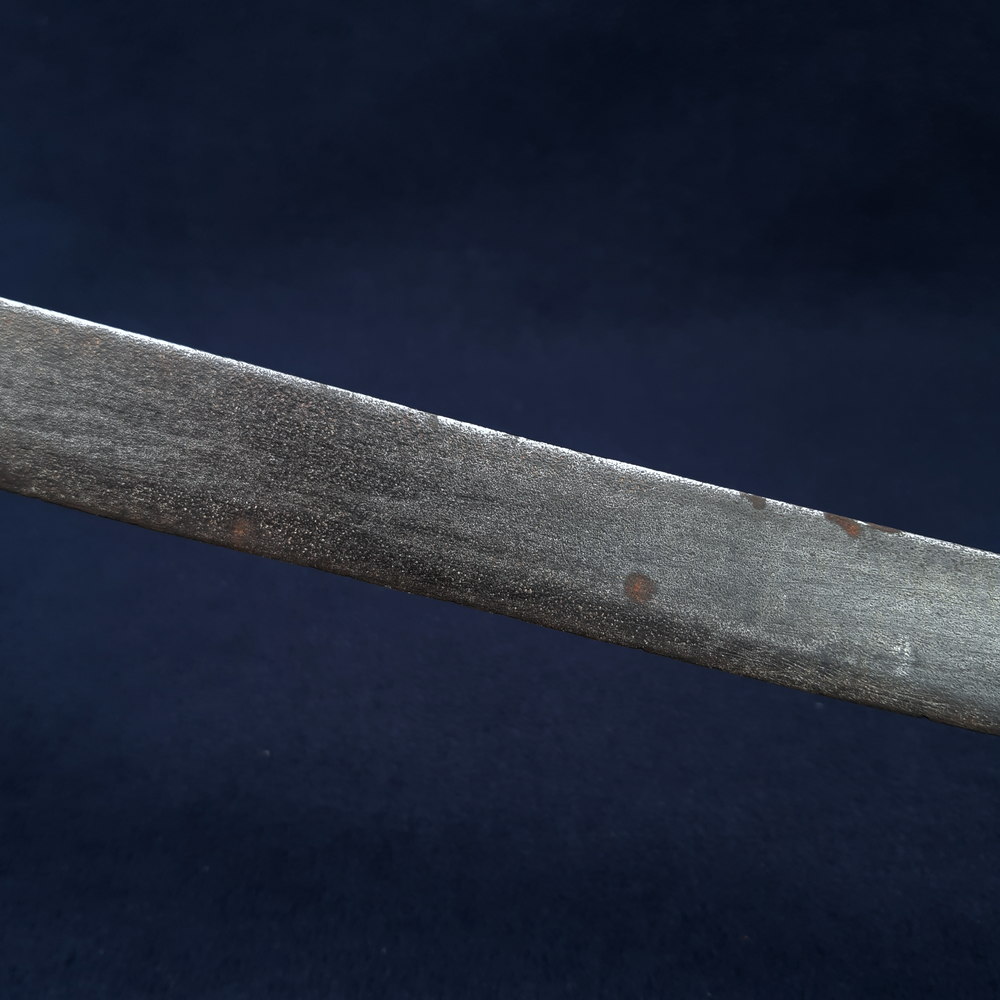
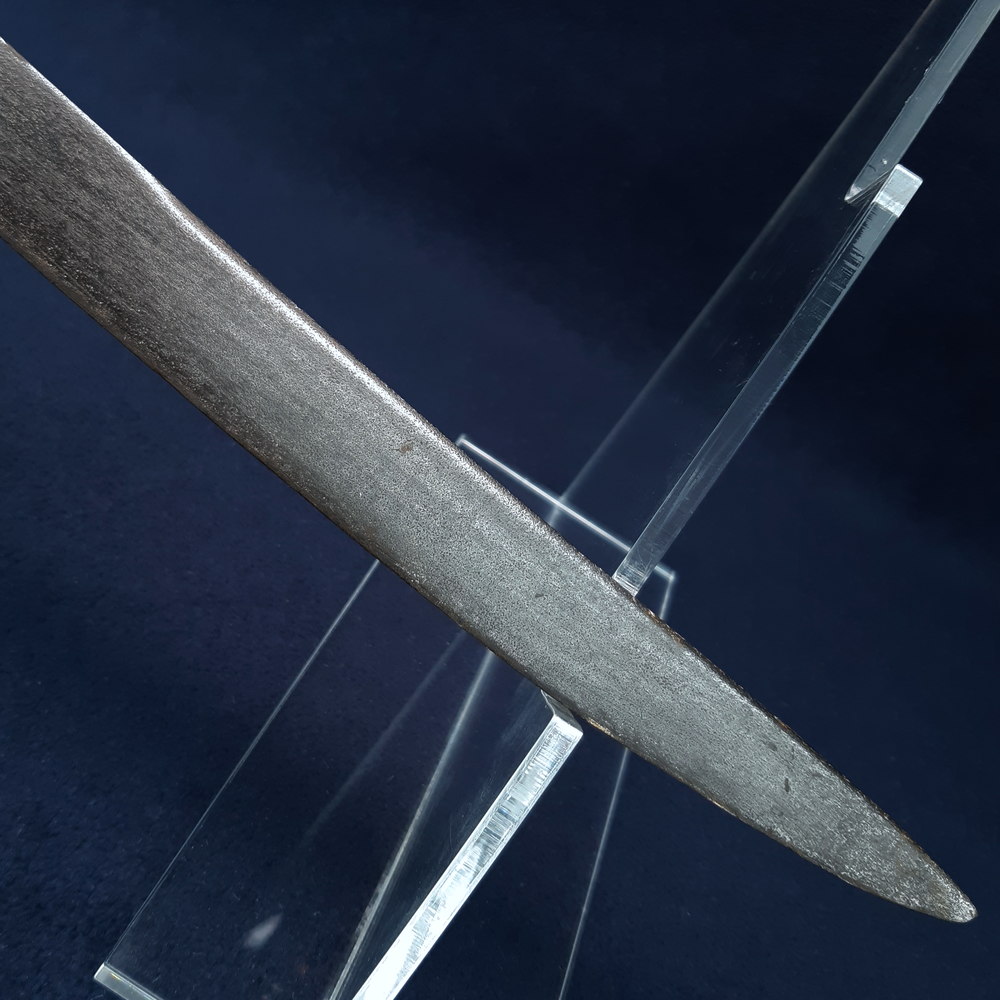
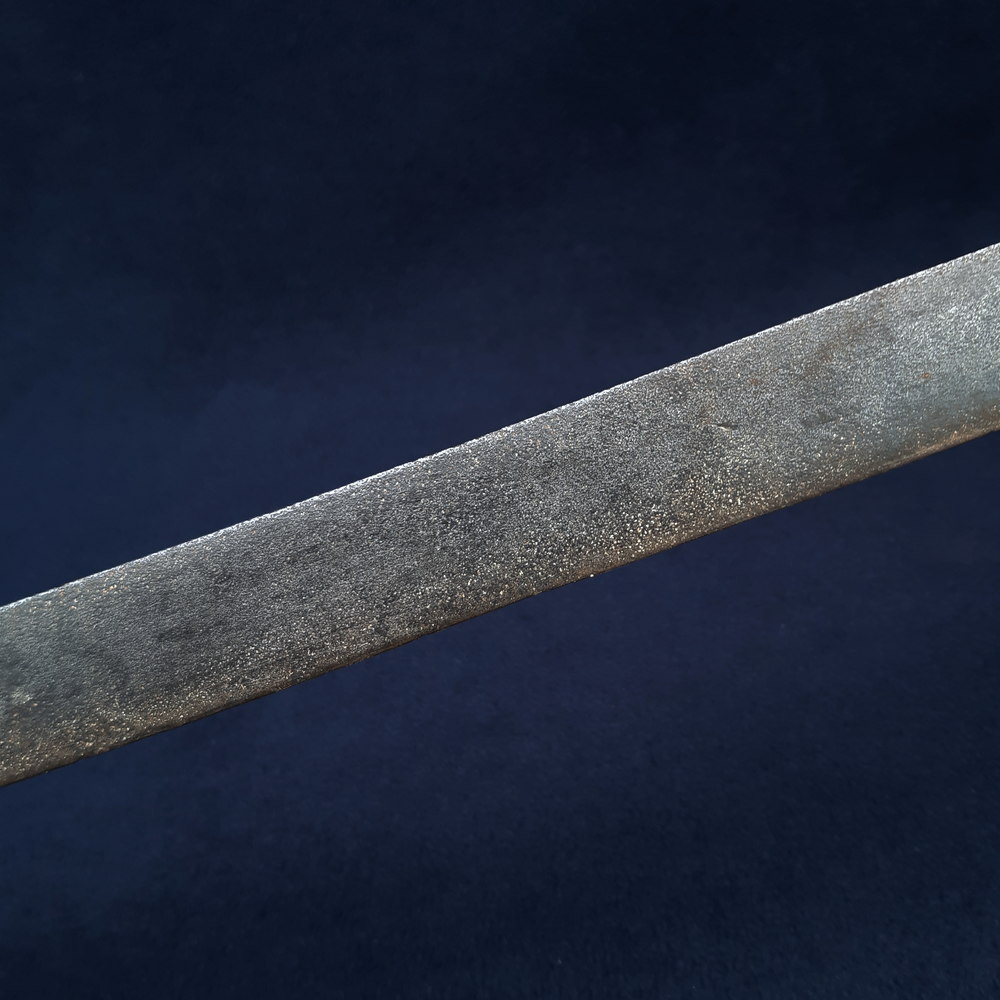
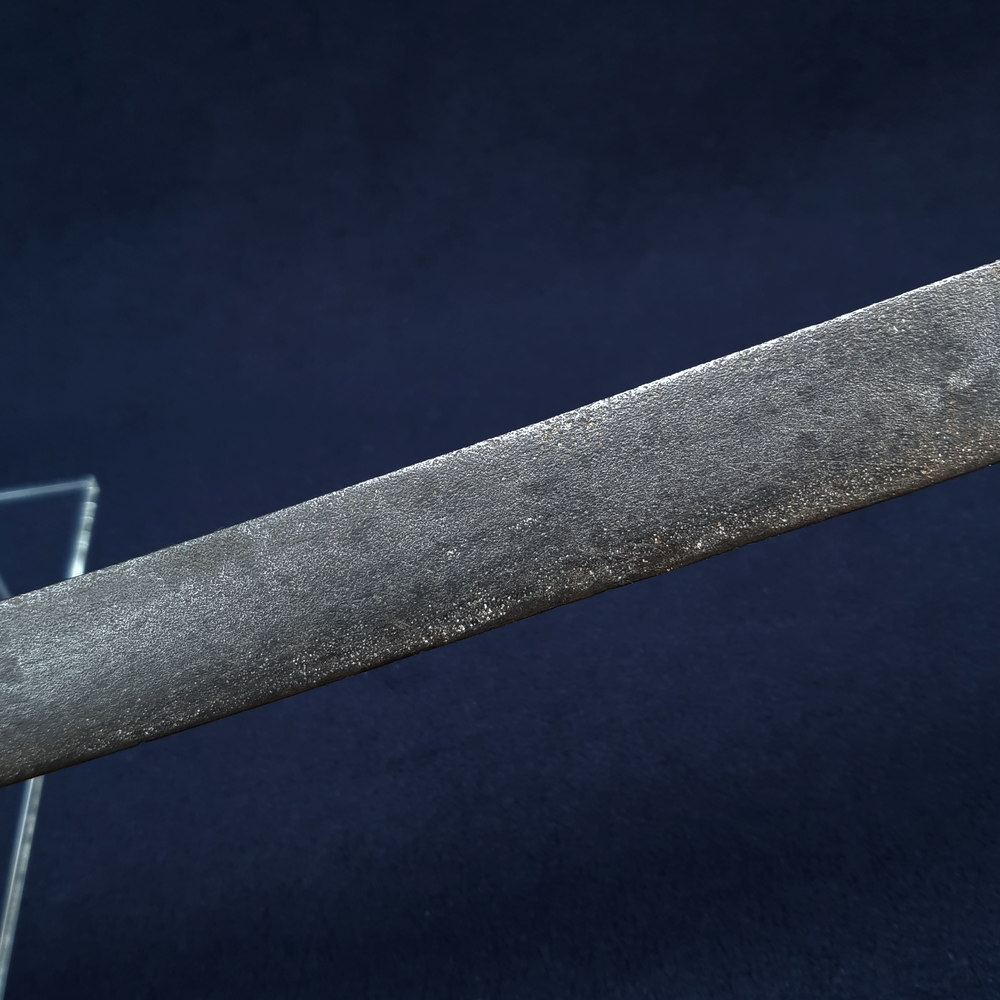
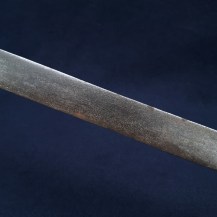
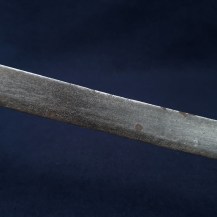
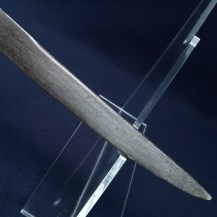
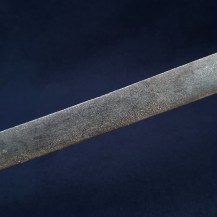
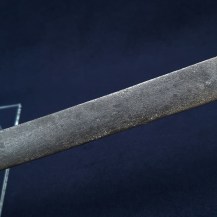
The blade is bent slightly to the left along its length. Its finish is darkly patinated with speckled pitting, spots of moderate pitting and rust which I have aimed to stabilise. Its tip is slightly rounded with evidence of repointing. Its true edge is sharp with what look like ground-out nicks in places, suggesting repeated resharpening. The false edge is blunt.
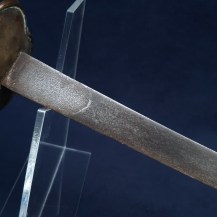
Like many other swords of the period the blade has a low carbon tang and shoulder, forge welded to a higher carbon steel blade, and the differential aging of the two materials can be seen clearly at the transition point, about 2¼ inches from the shoulder on the right face and ¼ of an inch on the left.
There is some movement to the hilt and the grip which will both rotate slightly, although the blade remains well peened with no movement relative to the pommel. The quillon has been lost. The brass of the hilt, grip and pommel is heavily patinated with a lighter finish on raised surfaces such as the grip designs, the pommel is very dark. Some verdigris and/or old polish in the crevice at the edge of the hilt.
