
British WW1 1908 Pattern Cavalry Trooper’s Sword with Field Camouflage Paint, Dated 1916
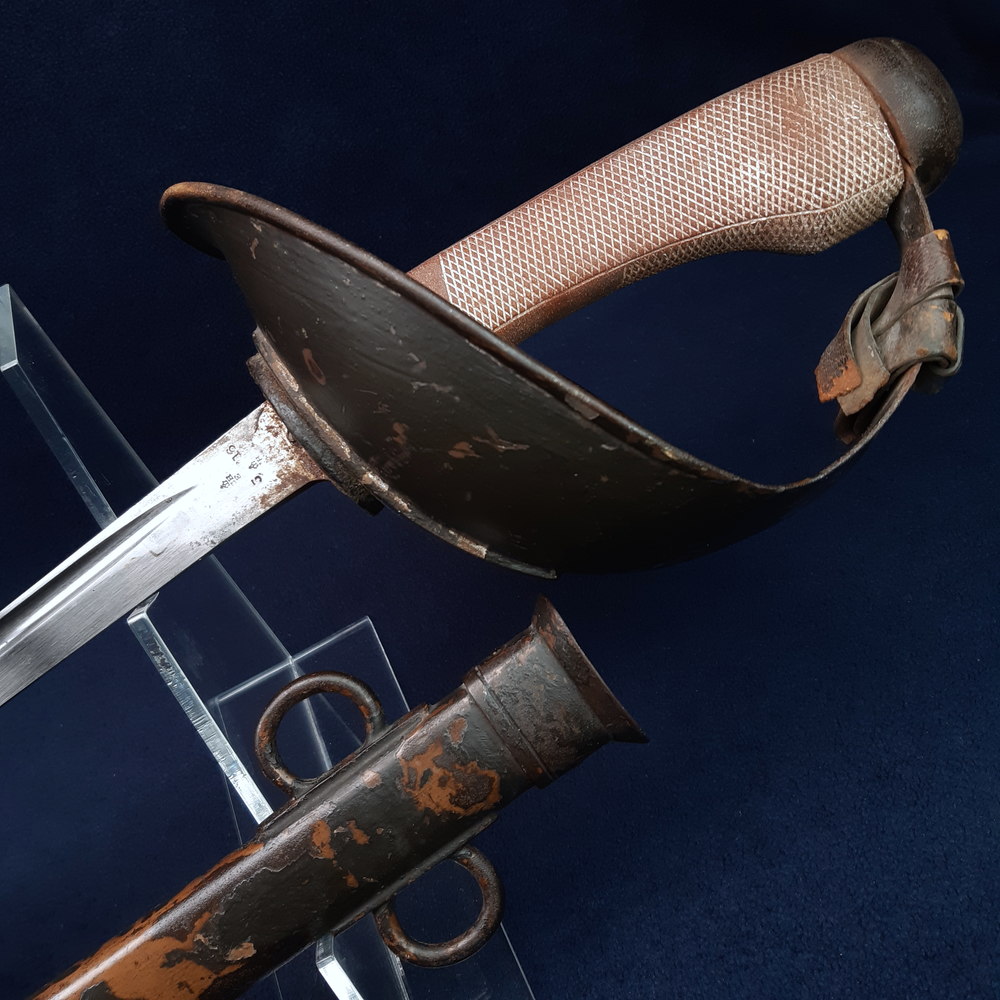


Straight single-fullered blade with spear point, steel basket hilt. Brown leather washer, chequered brown plastic grip. Smooth oval steel pommel. Brown leather sword knot. Steel scabbard with fixed opposed hanging rings. Blade 34¾ inches in length past the washer, the sword 42½ inches overall.
The blade is stamped at the ricasso on one side with a broad arrow War Department stores mark, ‘S.B & NLD’ indicating that it was manufactured by Sanderson Brothers & Newbould, a crown inspection mark with ‘E’ for Enfield and an ‘X’ indicating that the blade passed a manufacturer’s bending test. It is stamped on the other side with the manufacture date ‘3 16’ for March 1916, and two further crown inspection marks with ‘E’. The spine of the blade is stamped ‘P 08’ indicating the pattern.
The spine side of the throat piece is stamped with ‘WSC’ indicating that it was manufactured by the Wilkinson Sword Company. There may be other stamps on the guard and scabbard, such as on the inside of the guard (there are some small protrusions on the outside that suggest there may be a unit mark) and the spine of the main section of the scabbard, but the multiple layers of paint applied to it have obscured these areas. The top layer in particular was applied thickly and will have pooled in depressions like stampings.
Paint was often applied to cavalry trooper’s swords during the First World War as camouflage, and to reduce reflection off the polished metal which could give away a unit’s position. This was often removed after the conflict to return swords to parade condition, so examples with intact field paint are relatively rare and may show a fair amount of wear from their usage. Painting does not seem to have been done preemptively or according to a central plan – rather it was done ad hoc by deployed soldiers themselves. The odds of a camouflaged sword having been carried on a campaign are therefore very high.
Several colours of paint can be found, although only one seems to have been applied at a time, with no patterning. The colour chosen generally matches the terrain of the theatre in which a unit served but was probably also dependent on availability. This example appears to have originally been painted khaki which would be appropriate for an arid environment, which has then been overpainted with a very dark green suitable for a more temperate one. Some wear has occurred to the paint layers leaving a mottled appearance that shows both colours, as well as bare steel in places where the paint has been completely lost.
Sanderson Brothers and Newbould was established in 1776 as Naylor and Sanderson, a steelmaker and cutlery manufacturer based in Sheffield. Naylor retired in the 1820s after which his business partners, the four brothers Sanderson, took over full control of the business. They operated multiple sites at Newhall Road and the Attercliffe Steelworks and in 1835 acquired the Don Glassworks to convert it to a steelworks, with 180 crucible furnaces on that site alone by 1872, then adding state of the art gas furnaces in 1873.
Sanderson and Newbould described itself as ‘Manufacturers of steel saws, small tools, etc.’ It does not appear to have made swords until around the time of the First World War, although it took War Office contracts to produce 1907 Pattern bayonets for the Lee Enfield at some point before 1911. During WW1 the bayonet manufacturing facilities at Enfield were moved to Sheffield and it is thought that they were reinstalled at one of Sanderson’s facilities, making it the second largest bayonet manufacturer after Wilkinson.
Multiple different models of sword have been recorded with Sanderson’s mark, from standard issue cavalry trooper’s swords to officer’s swords that would have been sold individually – but always WW1 era models. A number of manufacturers stepped in to produce swords during the war but Sanderson appears to have capable of doing so at some scale.
After WW1 the firm returned to its usual business of steel, files and sawblades. After WW2 the famous ‘Stalingrad Sword’ was rolled into shape there from Sanderson’s steel before being sent to Wilkinson Sword for finishing. The firm merged with fellow Sheffield steelmaker Kayser Ellison and Co Ltd in 1960 to form Sanderson Kayser, which ceased trading around 1997.
The blade is excellent, retaining its bright finish with only tiny spots of light patination. Its edge has been sharpened with just one tiny nick near the end of the fuller, no tip damage beside some very light scratching near it. A tiny band of brown residue sits at the very base of the blade against the washer – I am unsure if this is rust or some paint overspill. It seems to move quite readily to be rust, so I have opted to leave it alone.
The aforementioned camouflage paint has been applied to the inside and outside of the guard, most of the washer and the exterior of the scabbard. The inside of the scabbard mouthpiece is unpainted - it has some patination and residue that may be spots of the khaki paint. Wherever the paint has completely worn away, e.g. the edges of the guard, the exposed steel has a dark patina and light speckled pitting, suggesting there has been no more recent loss of paint. A few specks of white paint to the outside of the guard, probably incidental. The pommel has lost almost all its paint, with moderate pitting and dark patination overall.
The strap and acorn of the sword knot has been lost, leaving only a short surviving section tied onto the hilt. The metal beneath this is heavily patinated. The plastic grip has some deliberate scoring to the backstrap area. The plastic is very dry-feeling, a little faded in tone with some surface-level cracking (sun damage?), but is solid in the hand. Rust and some encrustation to the ferrule.
The scabbard is free of dents. Like the guard it shows very dark black patination in areas where the paint has worn, including the faces of the throat piece, the fixed rings, the leading and trailing edges, particularly in the lower section, and the chape end.
