
British Metropolitan Police Sword of ‘Thames River Police’ Type, Circa 1855
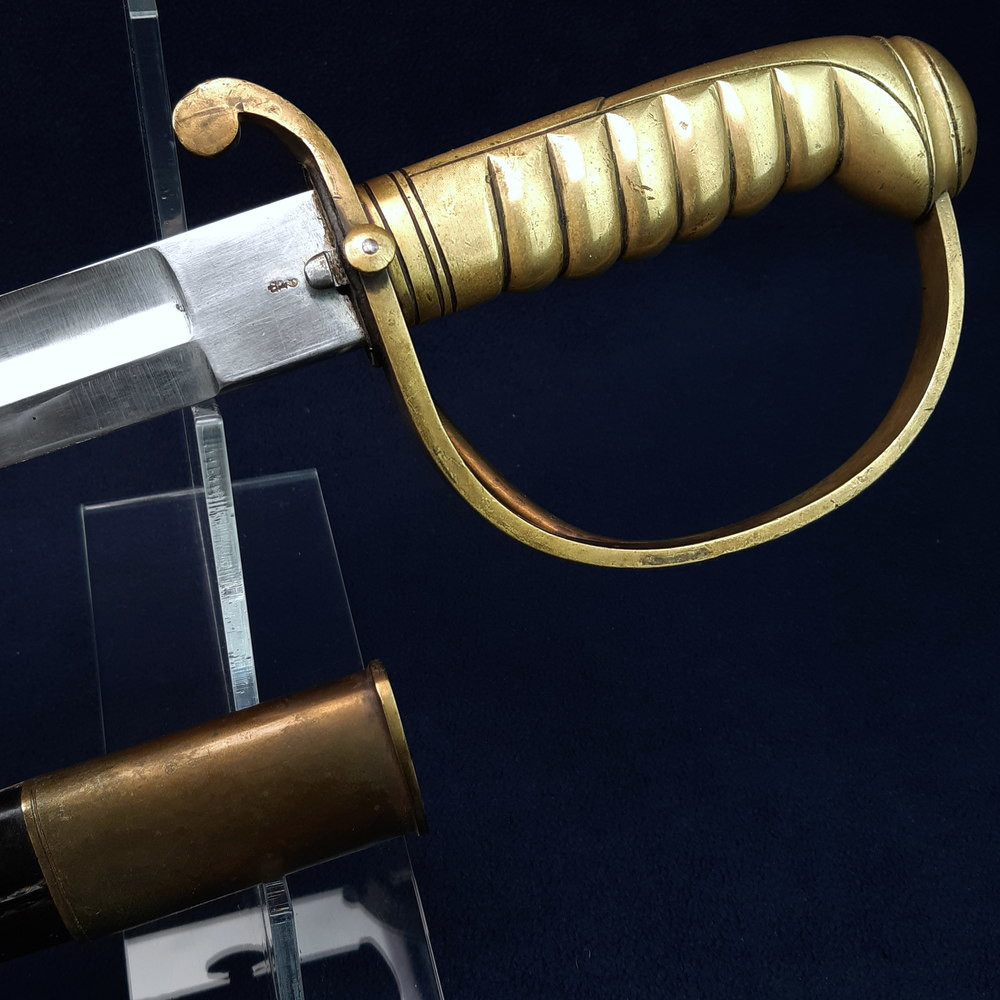


Curved spear pointed blade with false edge and single fuller running almost to the point. Brass D-shaped hilt with forward curving comma-shaped quillon, knucklebow and single side bar. Inset steel leaf spring locking mechanism with round brass button to actuate. Black leather washer, one-piece ribbed brass grip with simulated ferrule, backstrap and oval pommel cap. Scabbard of black leather over wood core with brass fittings at the throat and chape, both with incised lines, the throat piece with oval frog stud. Blade 26 7/8 inches in length past the washer, 1.23 inches wide at the shoulder, the sword 32¼ inches overall.
The blade is stamped at the ricasso on one side next to the leaf spring with a crown inspection mark, suggesting government procurement.
Short swords, similar to the earlier infantry hanger, were issued to British police and prison warders in the Victorian period. This particular model, scarcer than most, is usually referred to as the ‘Thames River Police’ sword (or cutlass), although they were also standard issue for the Metropolitan Police.
The Thames River Police was London’s first police force: formed in 1798 as the ‘Marine Police’ with private funding from merchants, it became publicly funded under its new name with the passage of the Marine Police Bill in July 1800. It was armed from the start with pistols and swords, as there was considerable opposition to the mission of its 50 officers to prevent theft of river-borne cargo by the more than 33,000 dockworkers, not to mention organized gangs of river pirates.
Inspired in large part by the TRP, the Metropolitan Police Service was founded in 1829 as London’s urban police force. It then absorbed the TRP in 1839 which became its ‘Thames Division’. This became the ‘Marine Support Unit’ in 2001 and the ‘Marine Policing Unit’ in 2008. It still polices the river to this day and is still headquartered at its original site, Wapping Police Station.
Some have assumed that these swords were carried by the TRP from its inception, possibly designed just for them, and that the Metropolitan Police then adopted the design from them in 1829, but I am very sceptical that this design could date back to 1798 or even 1829. To me the style of these swords is definitely Victorian, sharing features with designs like the Army Hospital Corps orderly’s sword (introduced c1855-60) and Victorian coastguard swords. I have yet to see a sword of this type that does not include a sprung locking catch, a feature introduced to British police swords in around 1850 to prevent an officer’s sword being drawn by an assailant and used against him – an early form of what is now called weapon retention.
If this is the case then these swords may be misnamed, as the Thames River Police no longer existed under that name by the time they were issued. They were actually rolled out to the whole Metropolitan Police, including the by-then Thames Division, some time in the 1850s, and while some did reach those river policemen most would have been held by other London coppers.
Two examples are at the National Maritime Museum: one (WPN1390) of unknown origin but long in their collection, bears an old tag reading 'Cutlass, Constable's - Metropolitan Police Pattern 24.10.1871'. The other (WPN1391) was donated to the NMM by the Wapping Police Station Museum, which holds further examples in its collection of artefacts from the whole history of that unit. At the time of donation it ‘was described as a River Police cutlass’ – which might even be the point of origin of the whole confusion. The NMM for its part states that both swords were made in 1854-55, and that it is inaccurate to refer to them as cutlasses.
The blade is bright with a quite high polish, some very light polishing marks and a few spots of light patination. A couple of tiny nicks to the edge, which is unsharpened, no tip damage. The brass parts of the hilt have an even light patina with a few scattered speckles of darker. A few small dents to the outside of the quillon and one to the corner of the blade just beneath the quillon. The locking mechanism functions and will retain the sword nicely in the scabbard, no issues with sheathing and drawing.
The throat and chape pieces of the scabbard have moderate patination and light staining in places, with the frog stud brighter due to rubbing. A few very small dents to the chape piece. The stitching of the scabbard is all intact, some patches of loss to its leather towards the chape, exposing the wood core in places.
