
British 1908 Pattern Cavalry Trooper’s Sword of the Inns of Court Regiment “The Devil’s Own”
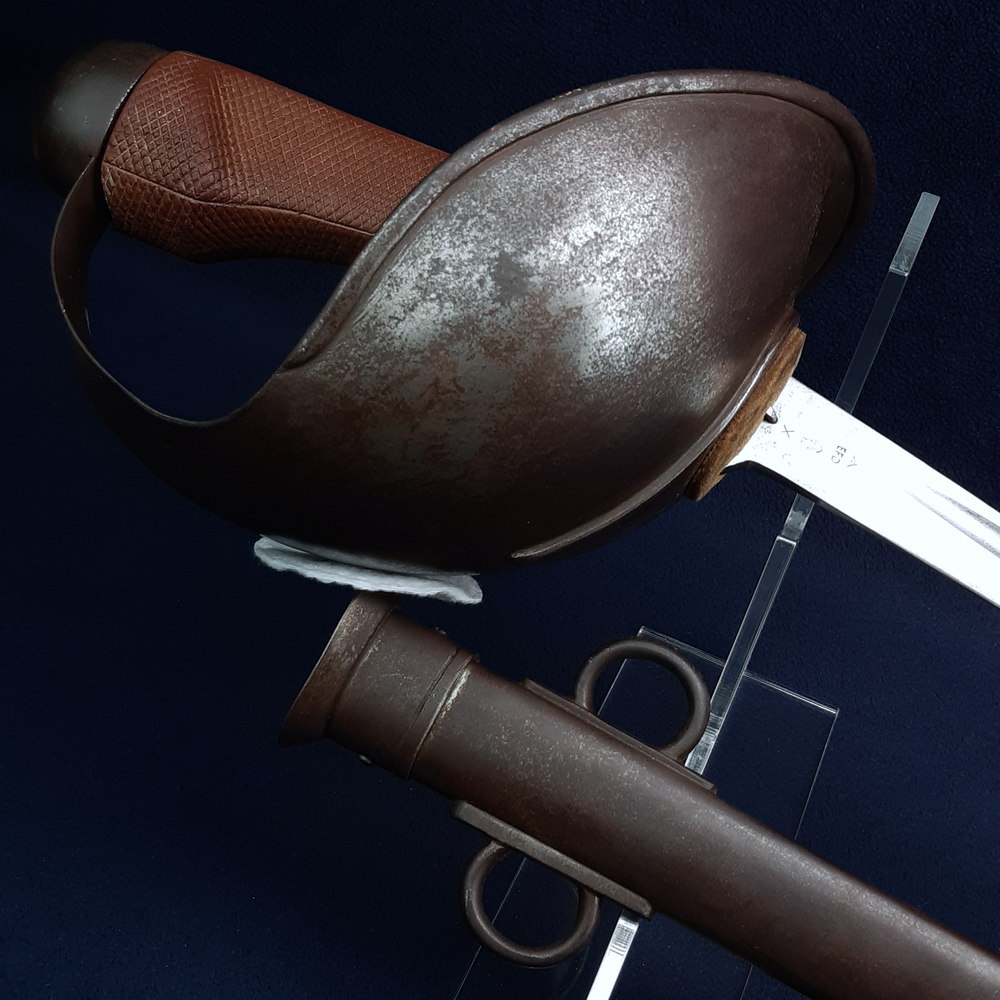
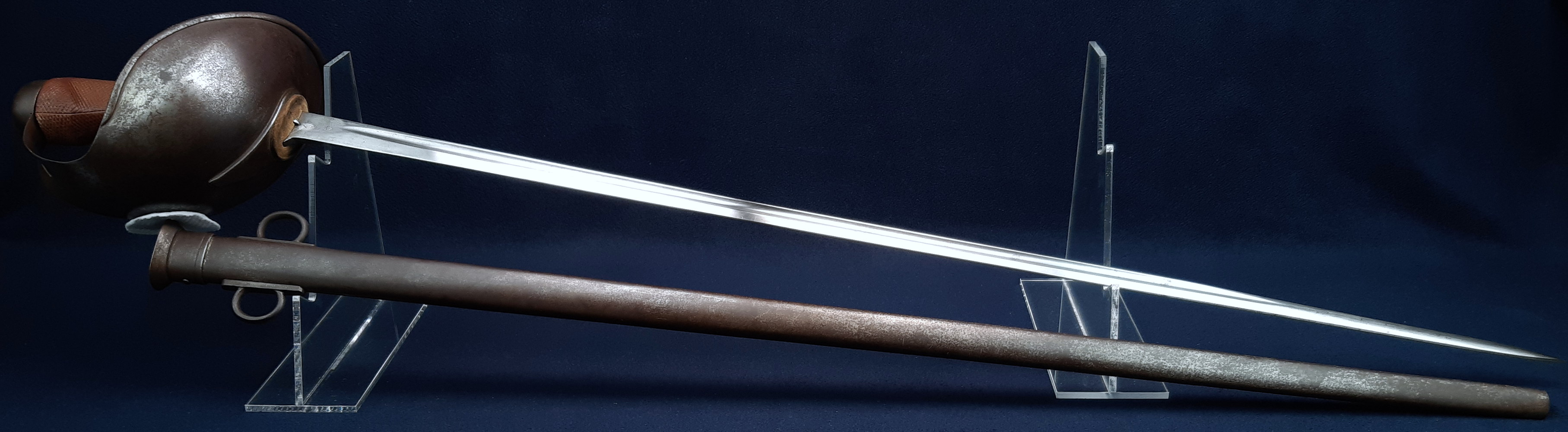
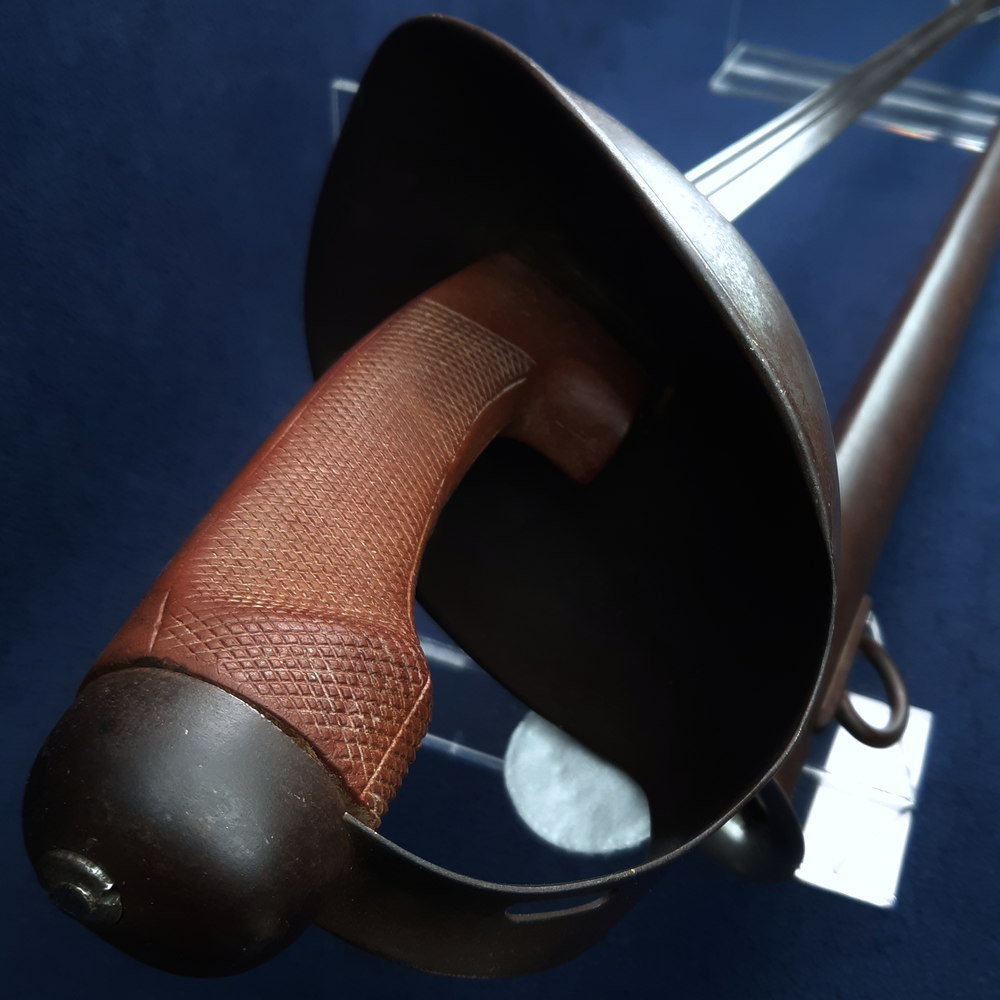
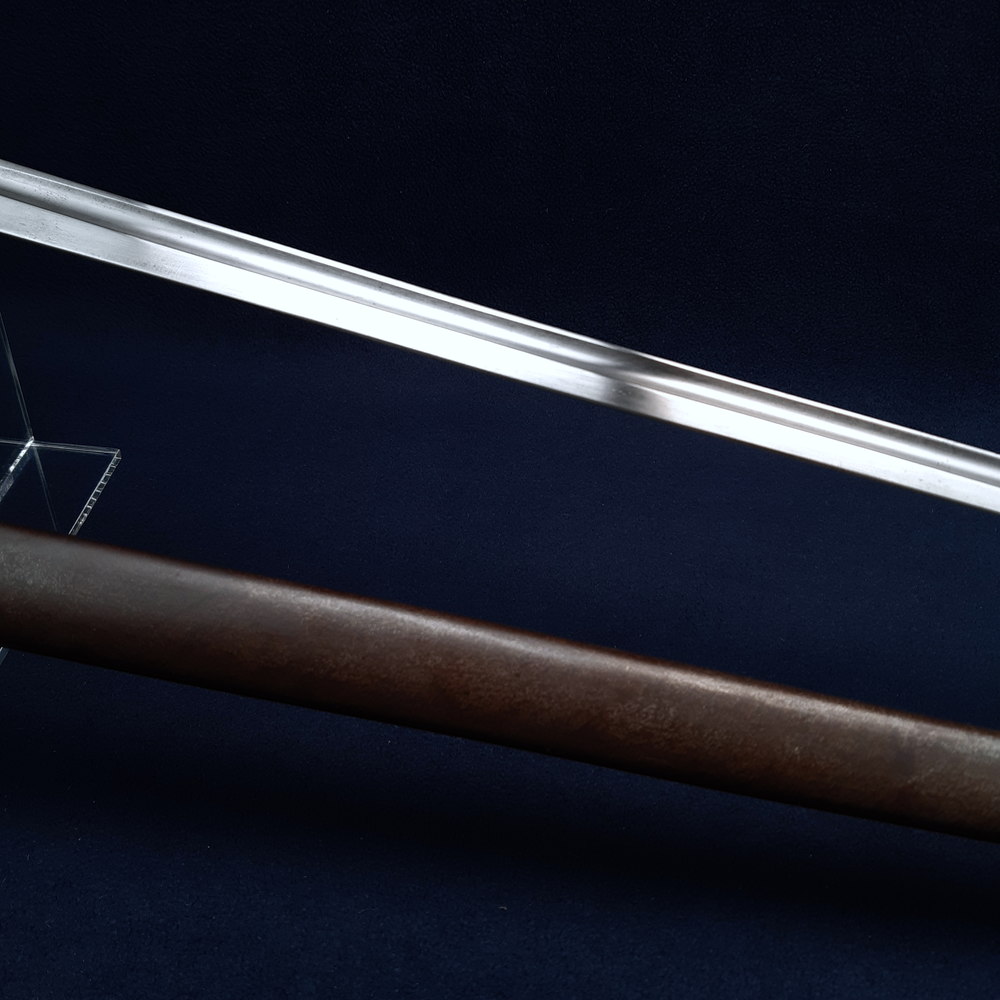
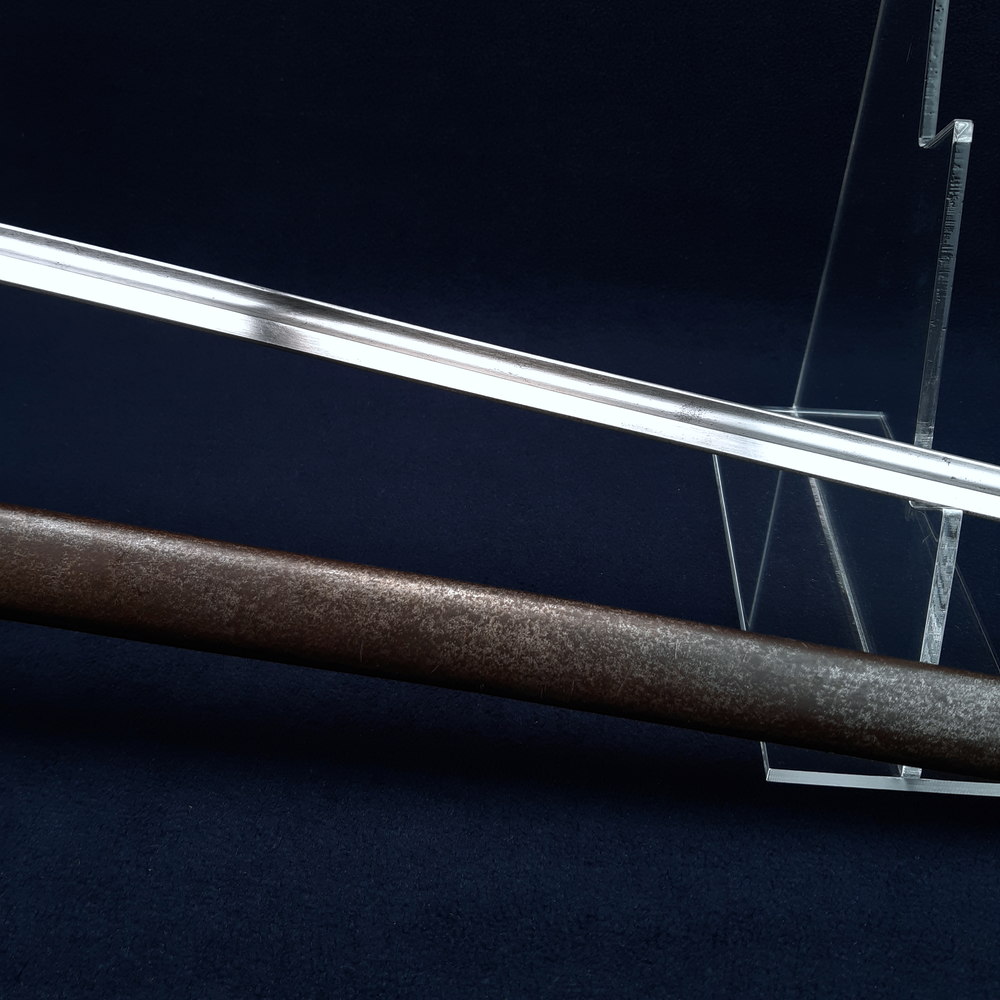
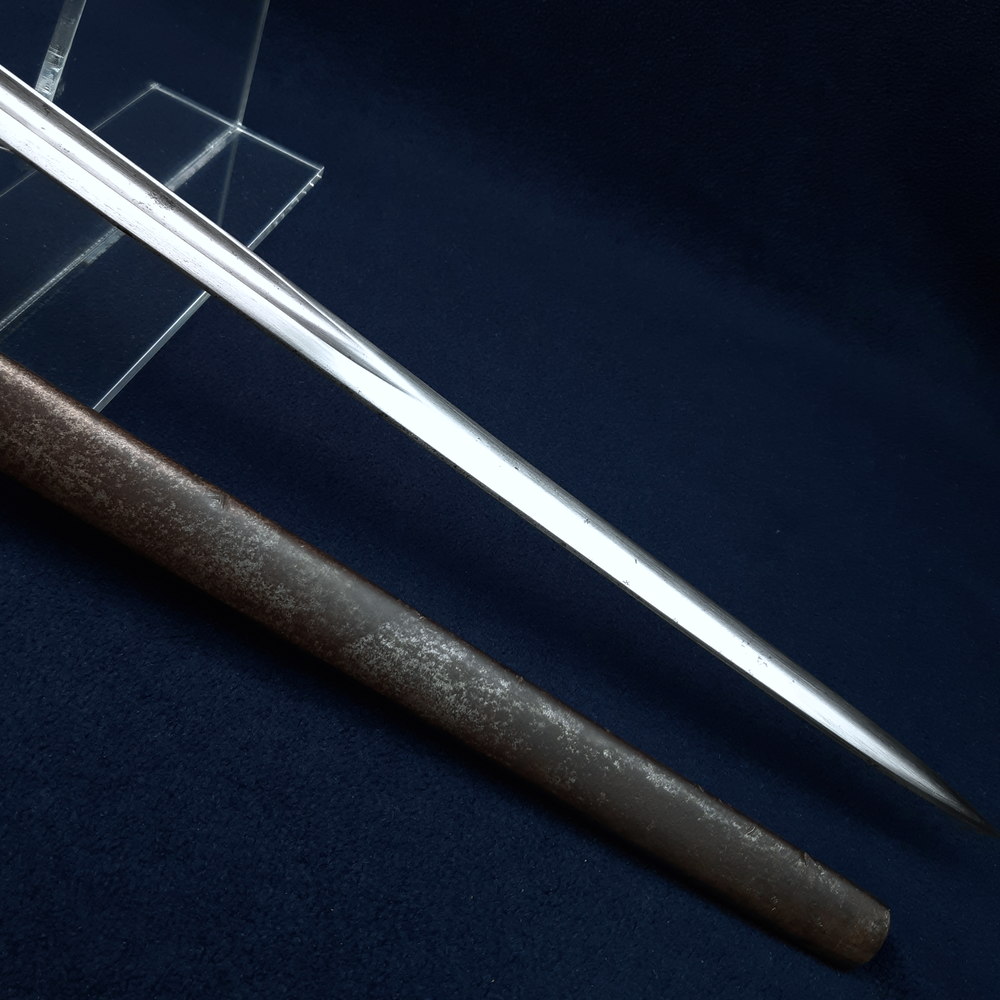
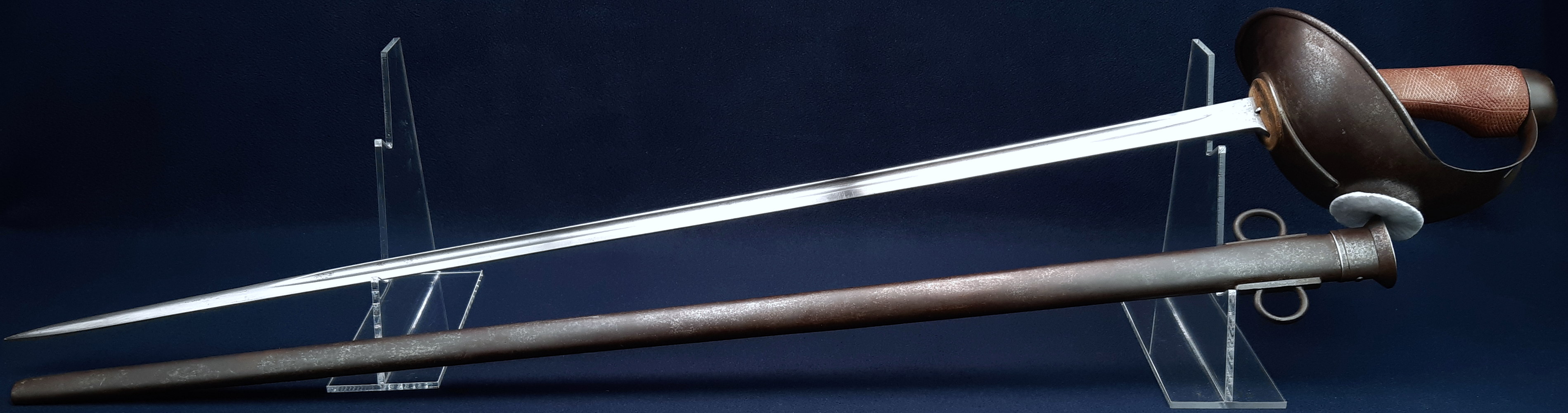
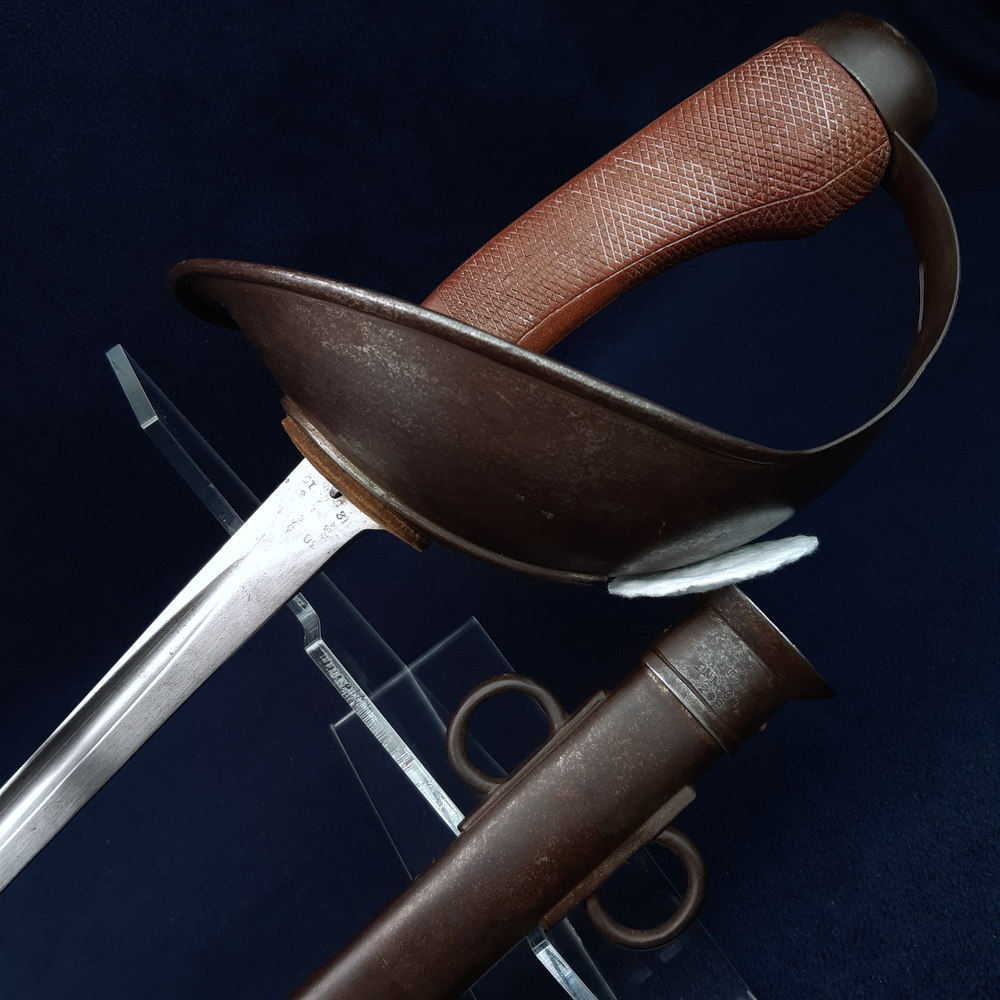
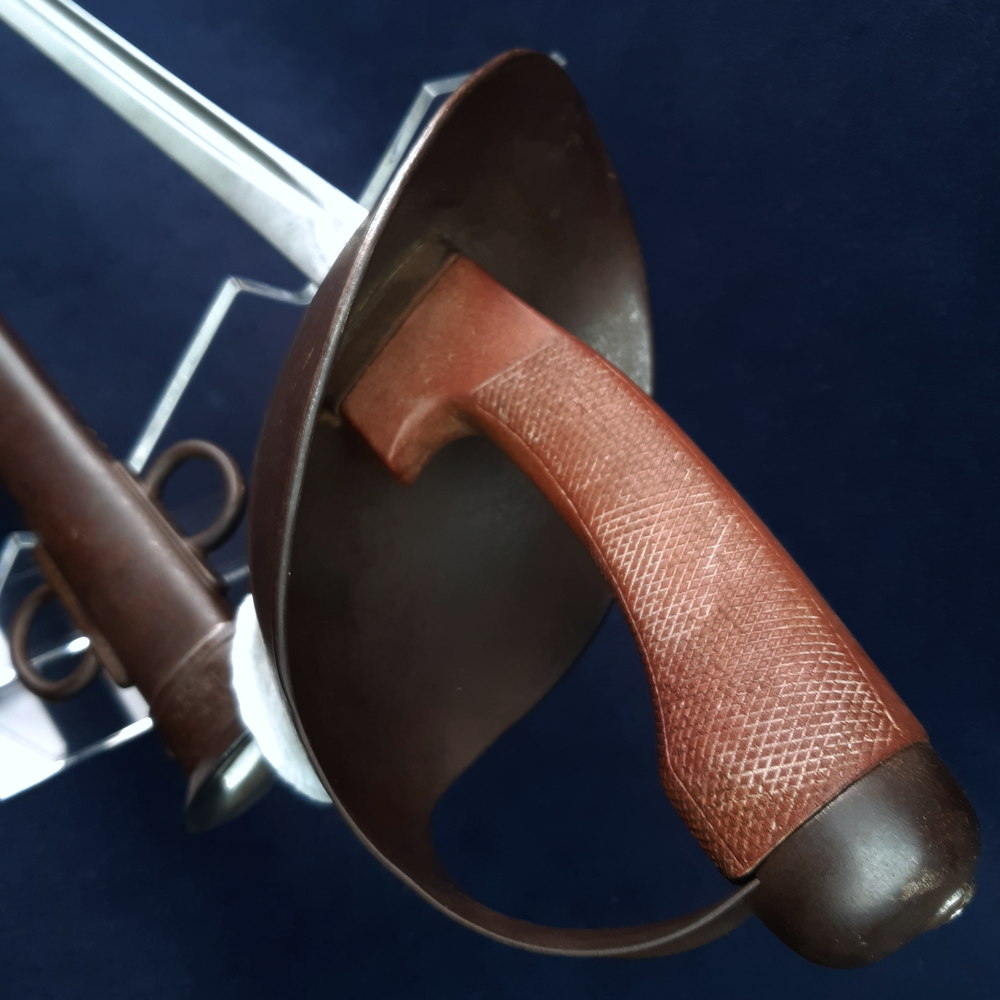
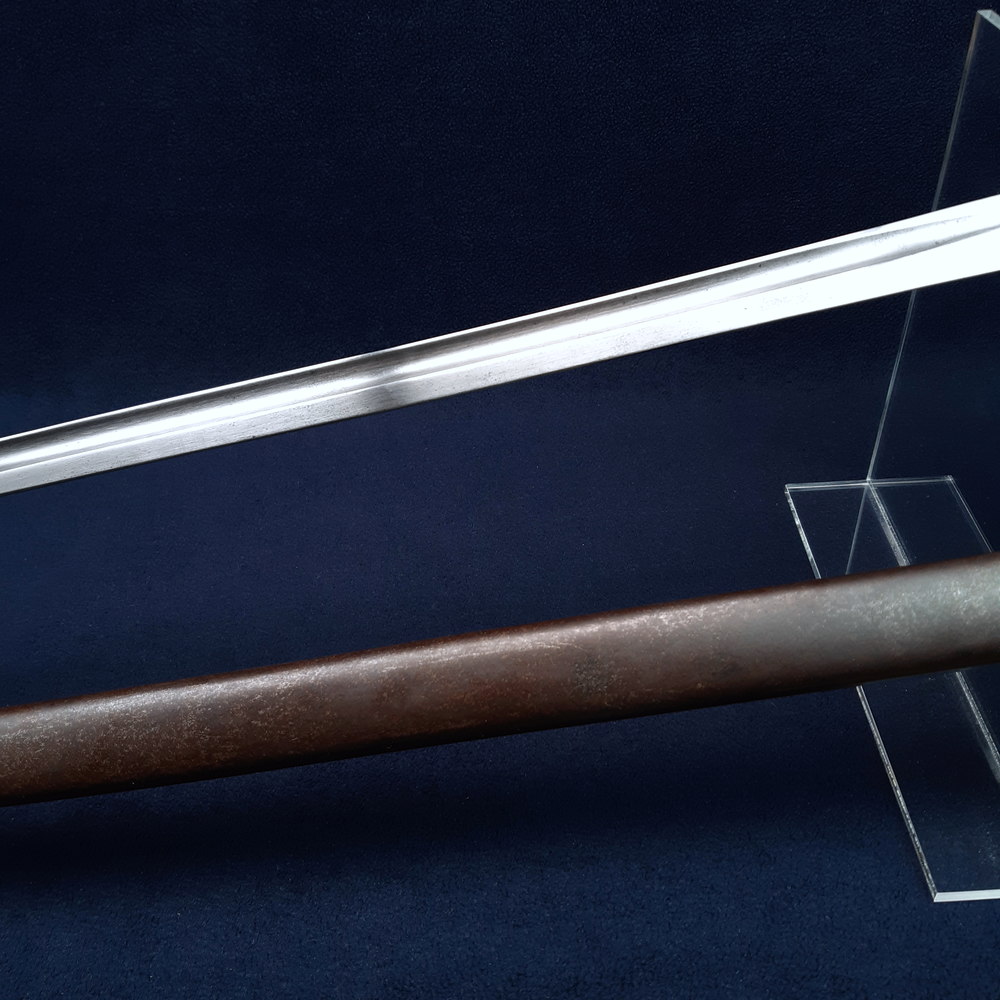
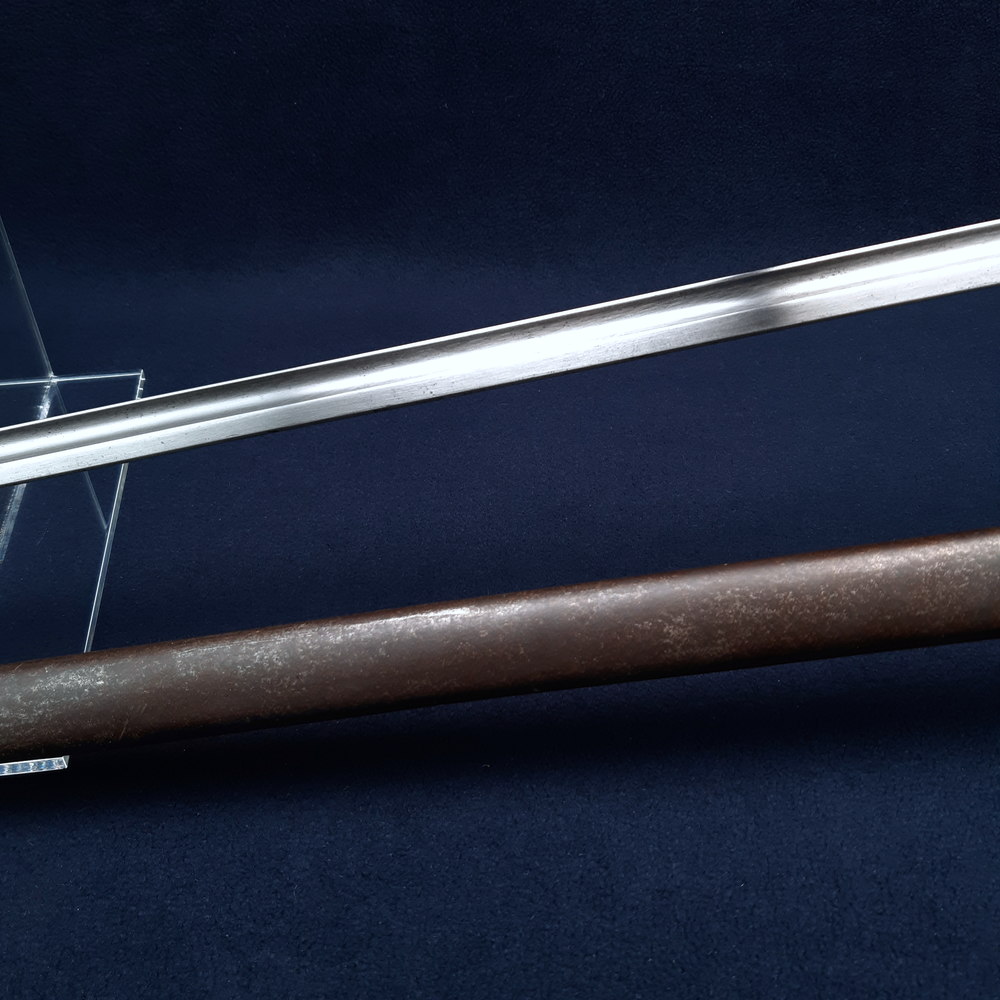
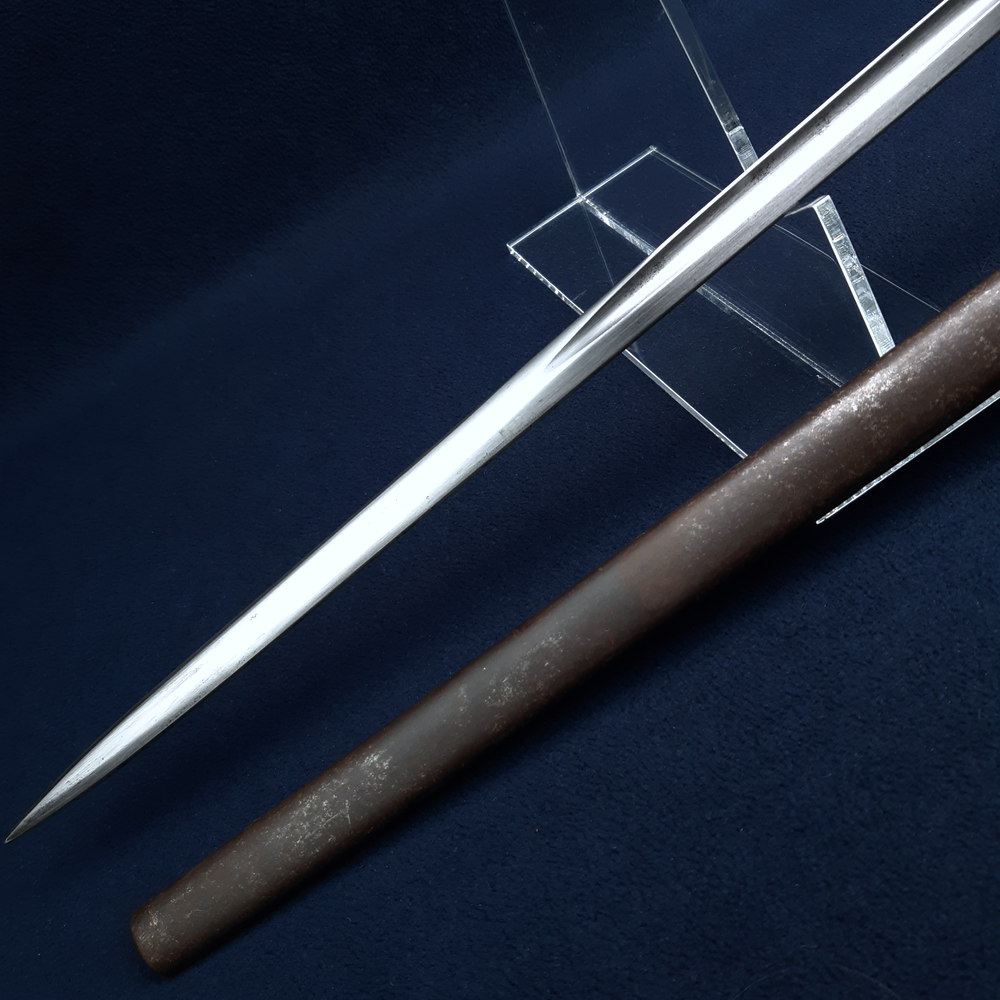
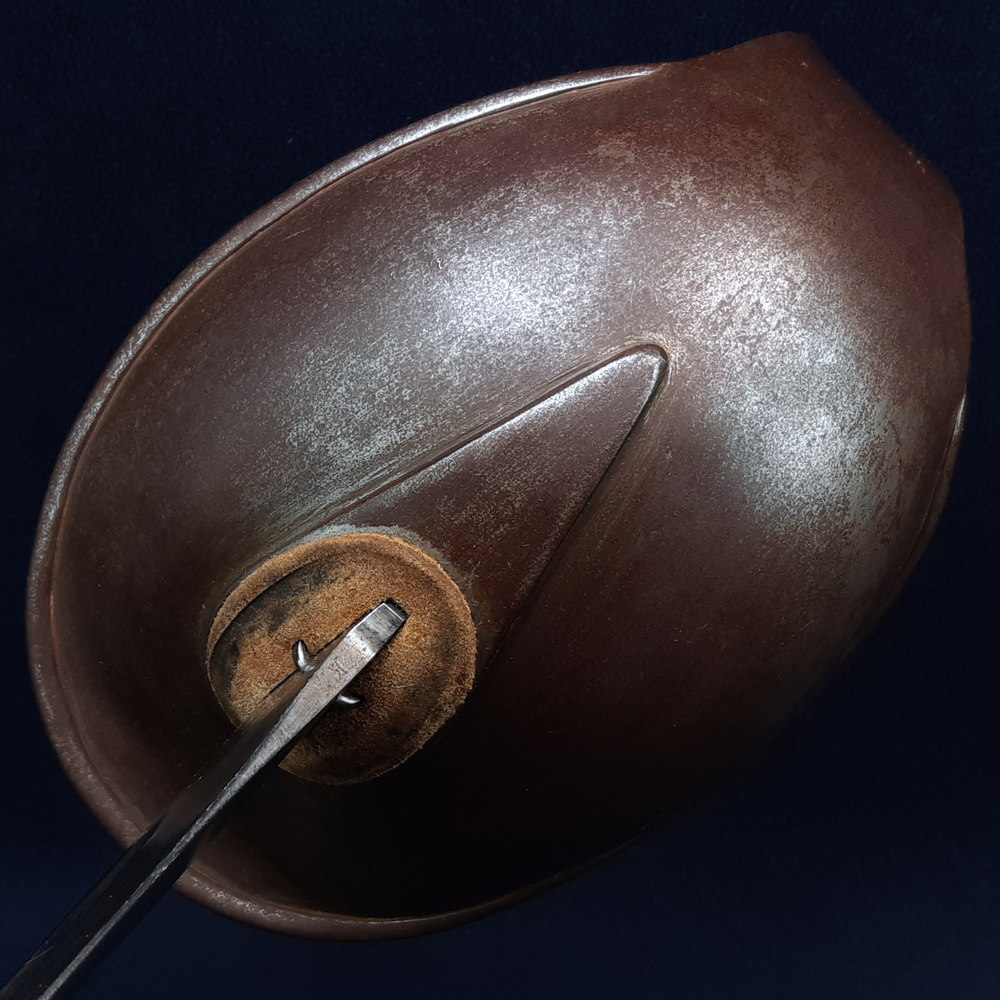
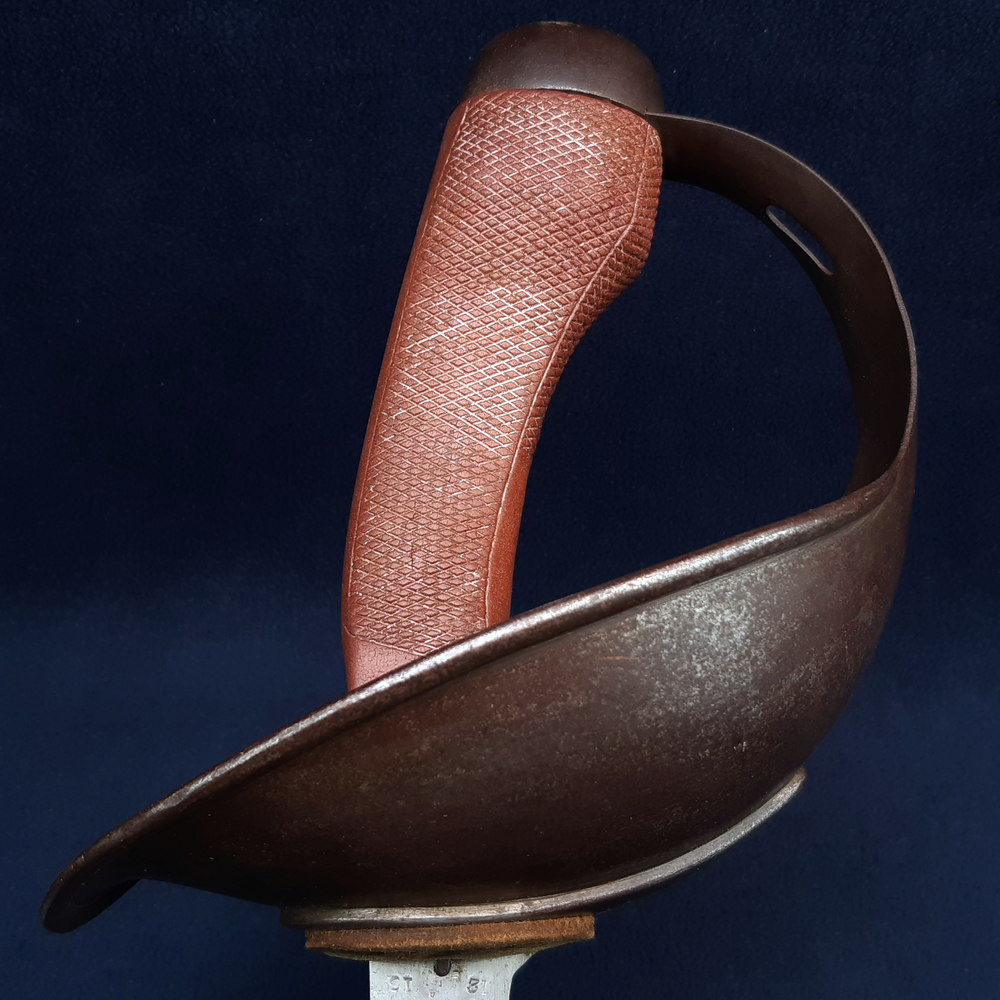
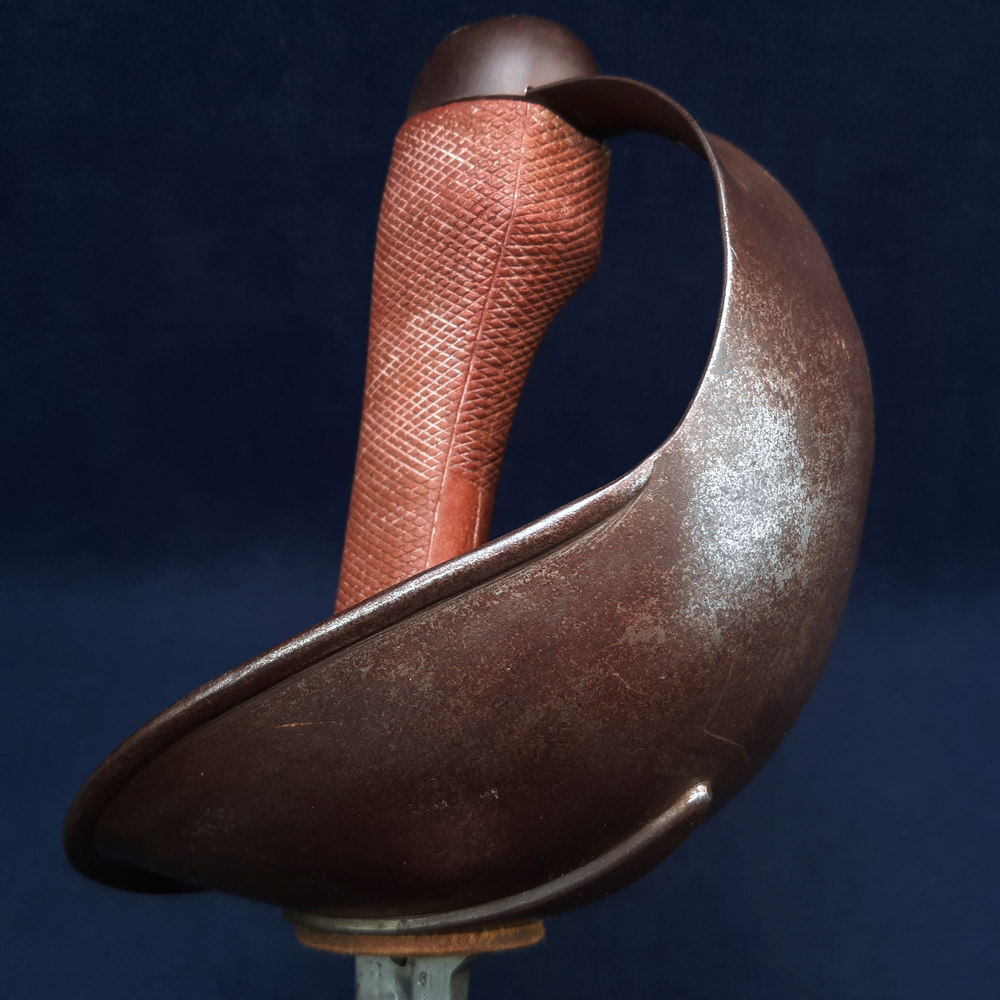
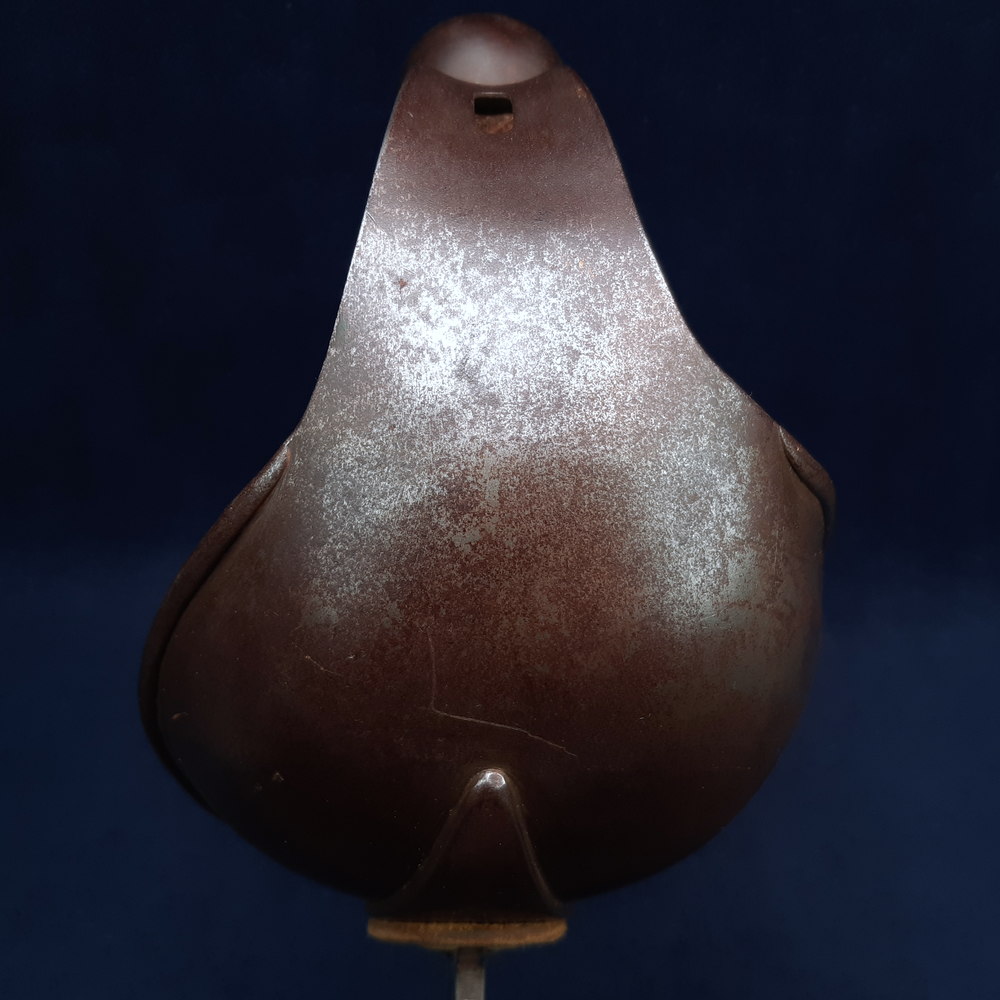
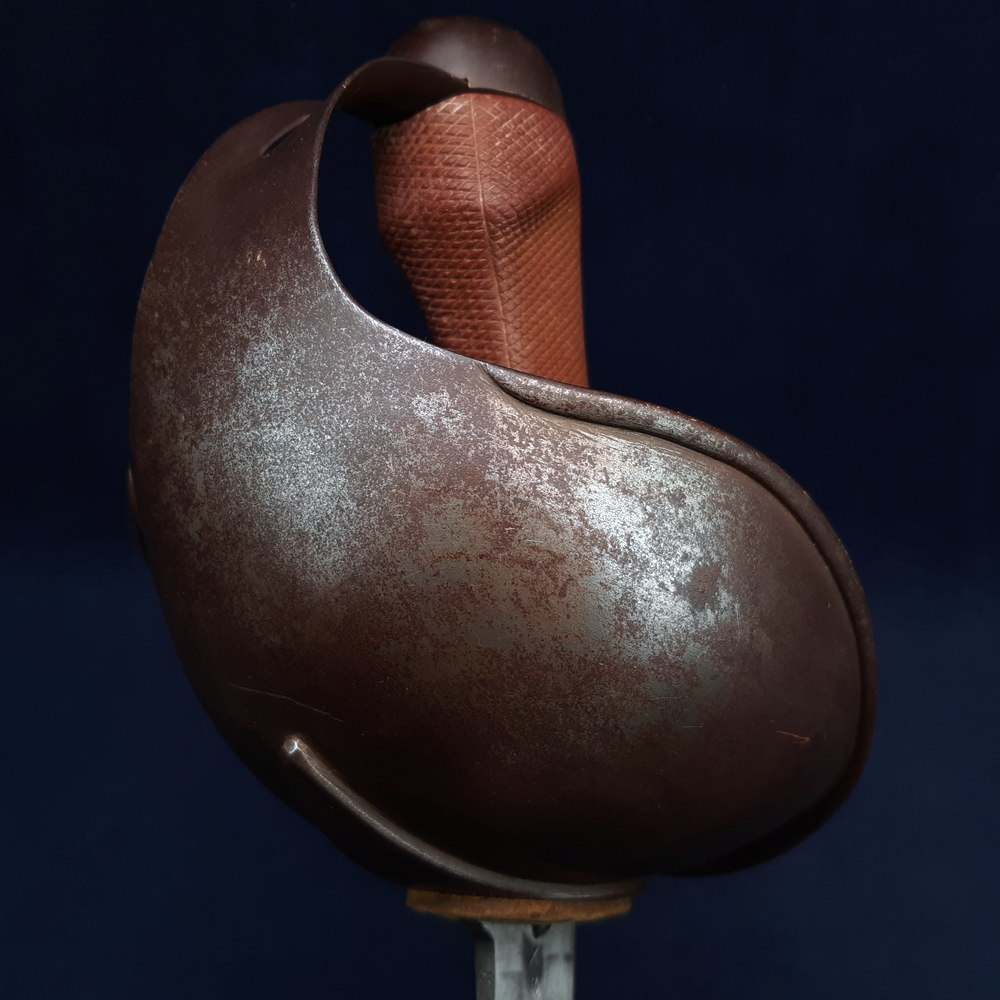
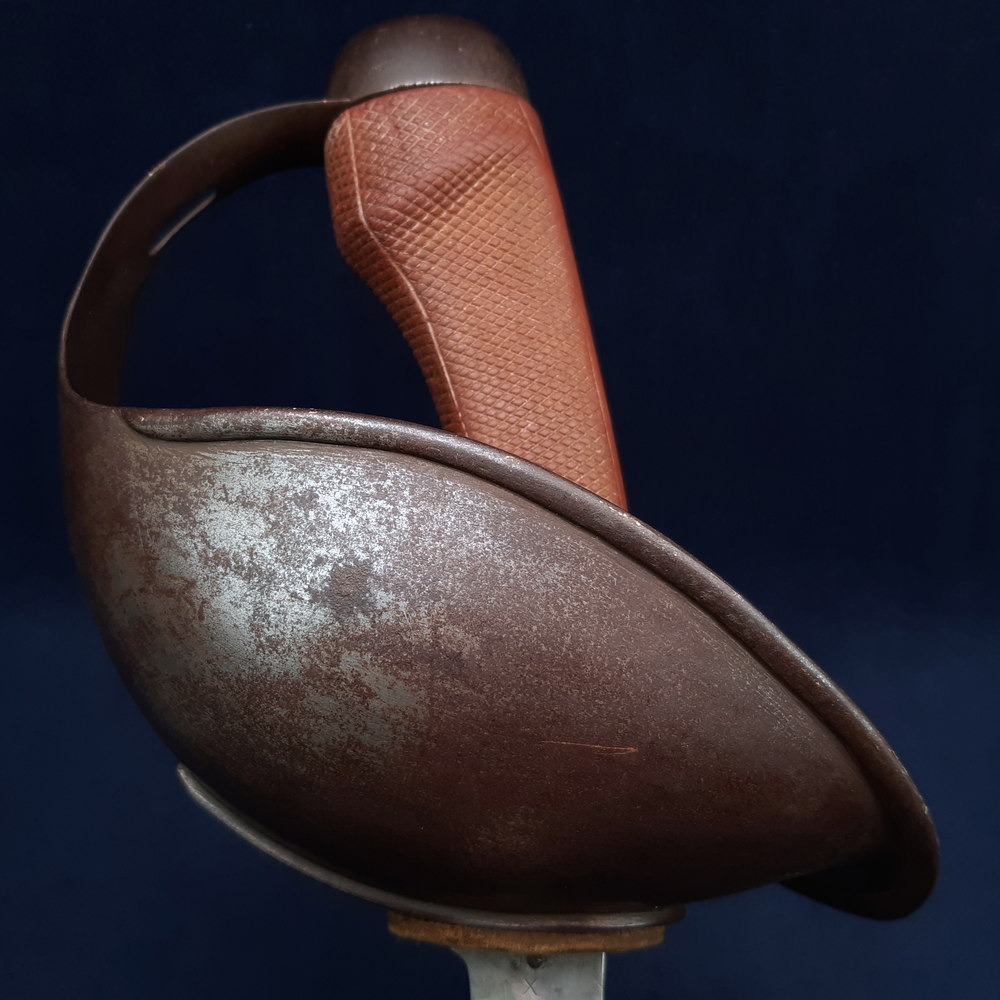
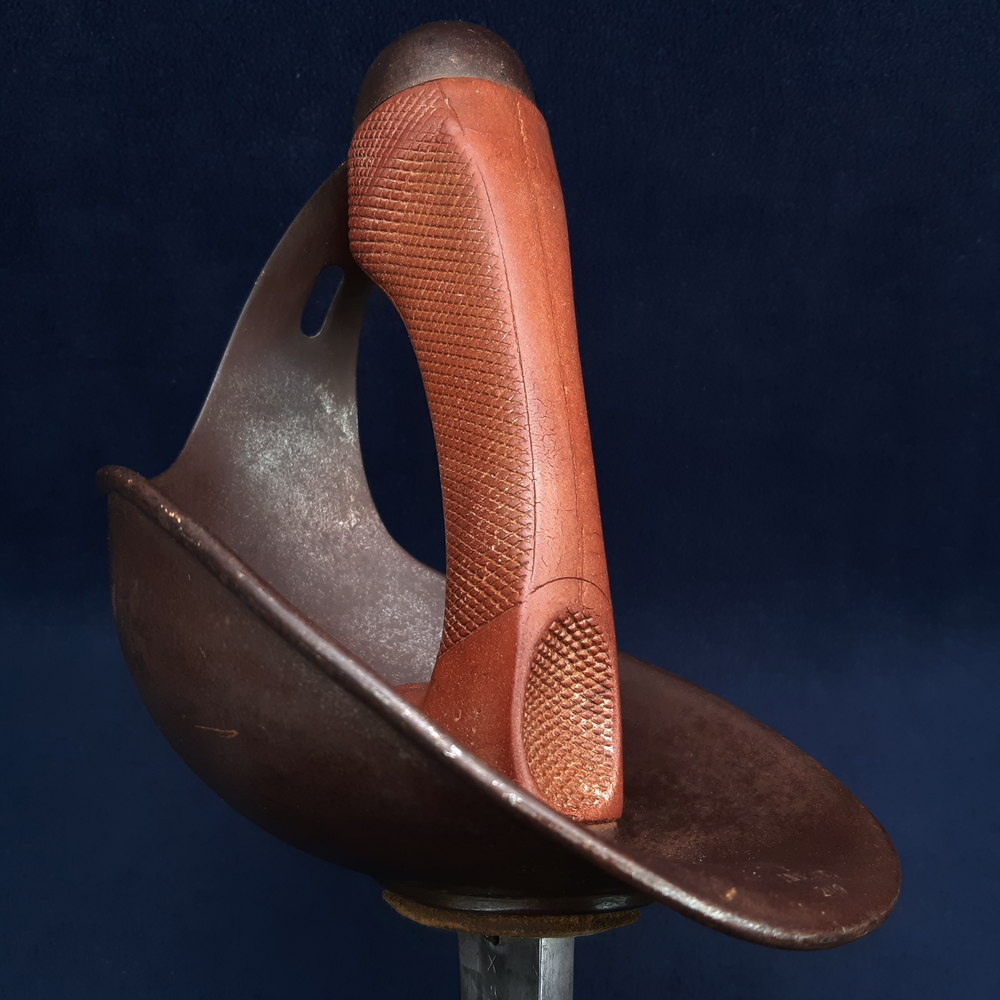
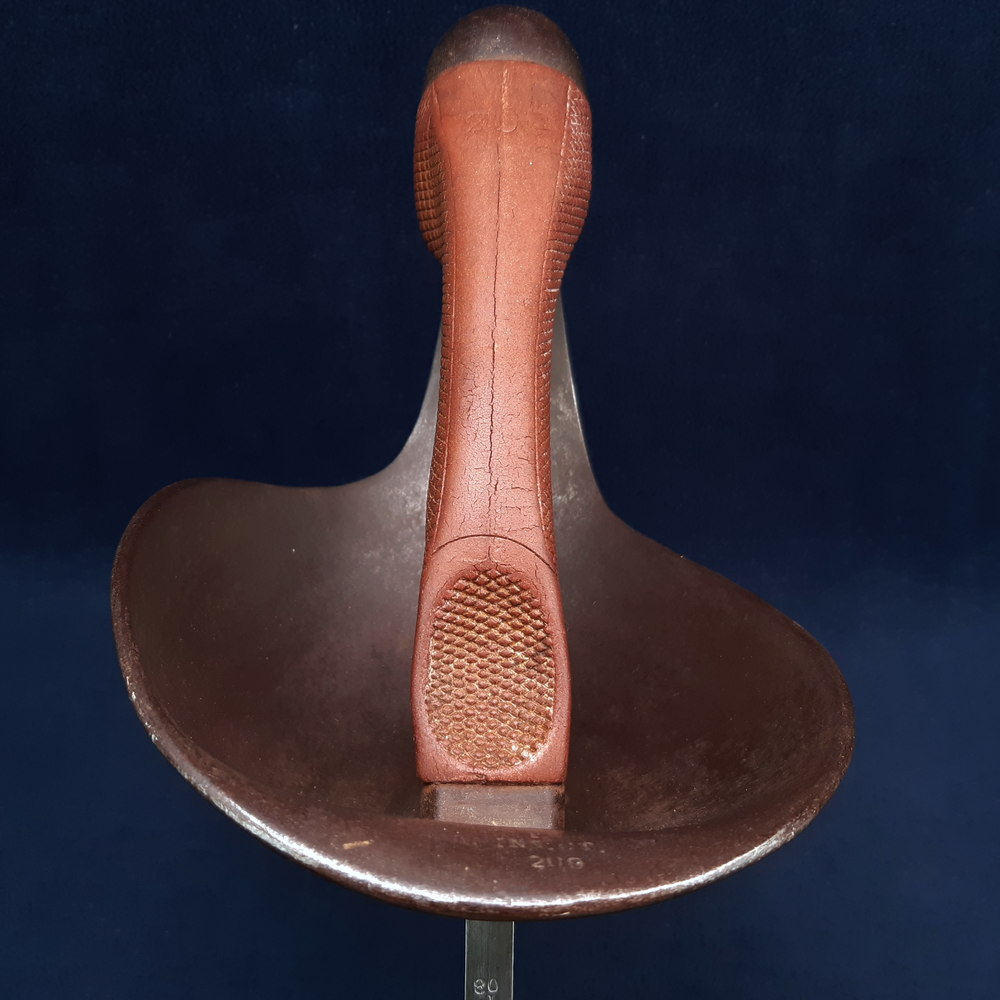
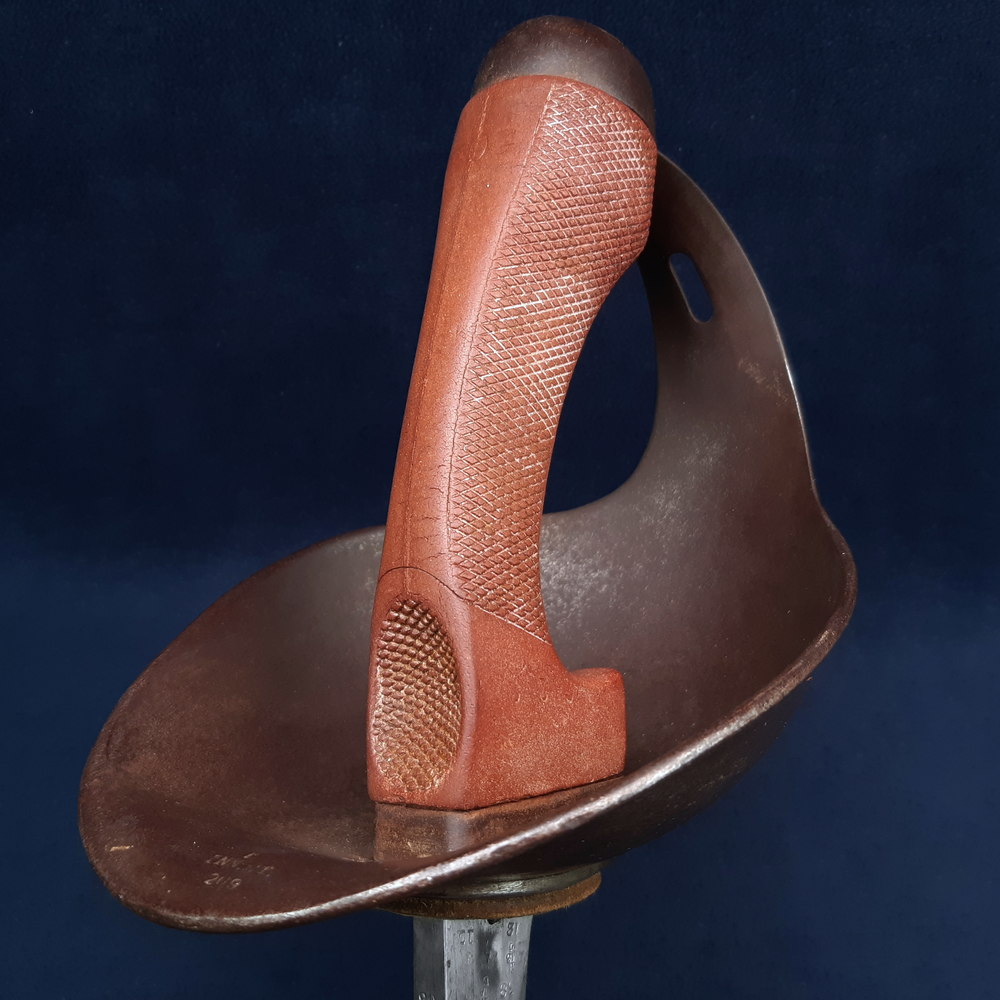
Straight single-fullered blade with spear point, steel basket hilt. Brown leather washer, chequered plastic grip. Smooth oval steel pommel. Steel scabbard with fixed opposed hanging rings. Blade 34¾ inches in length past the washer, the sword 42½ inches overall.
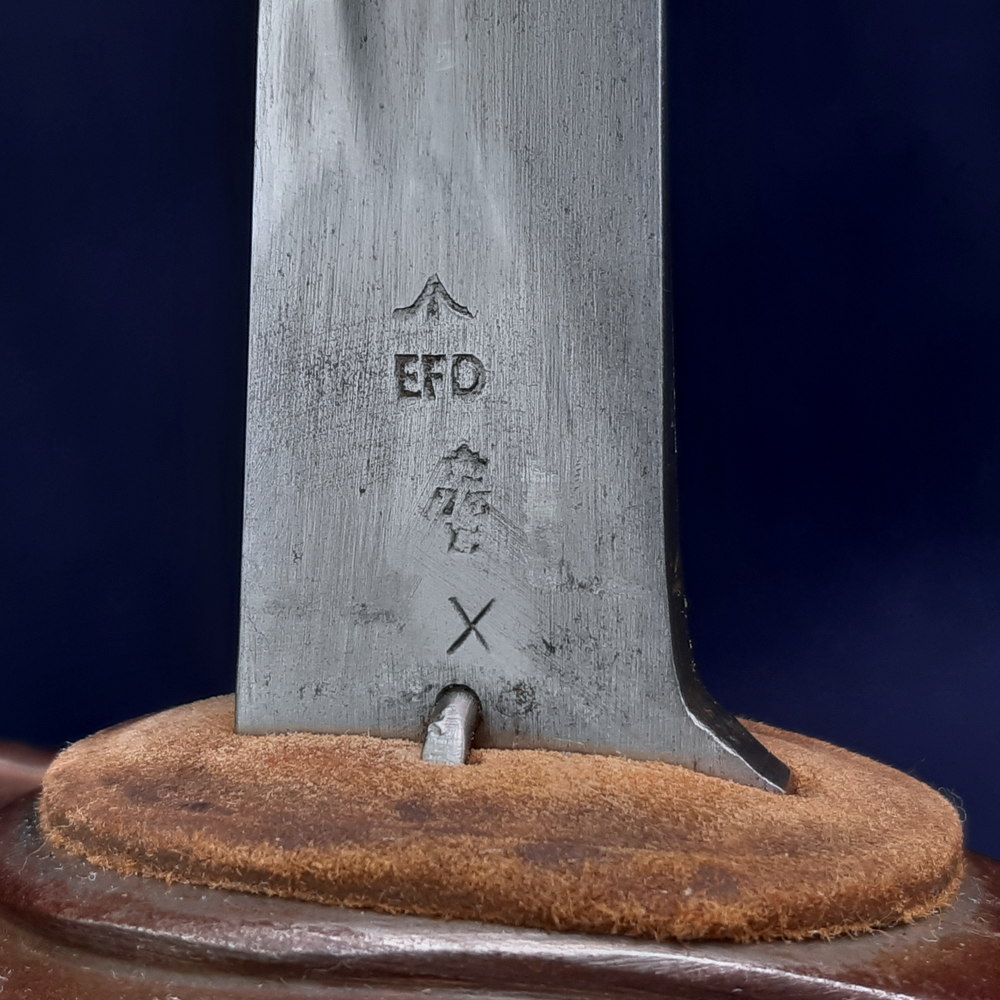
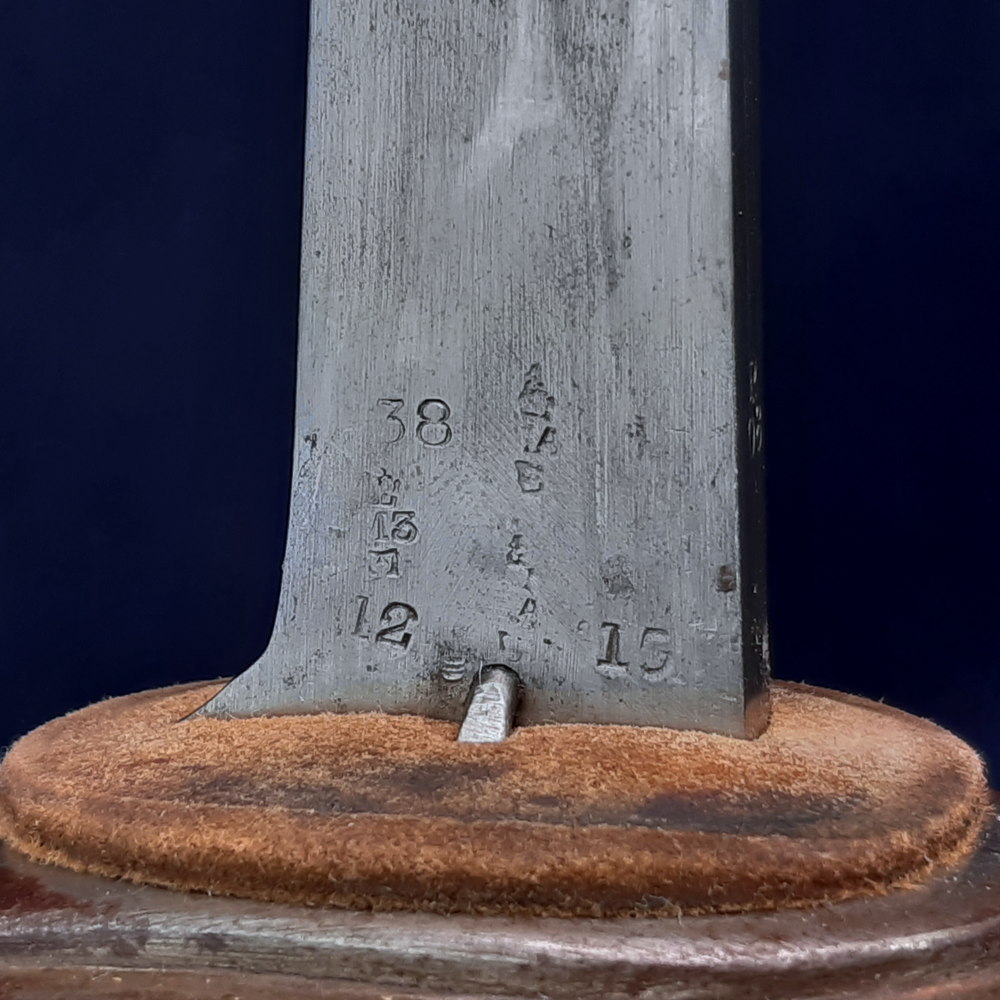
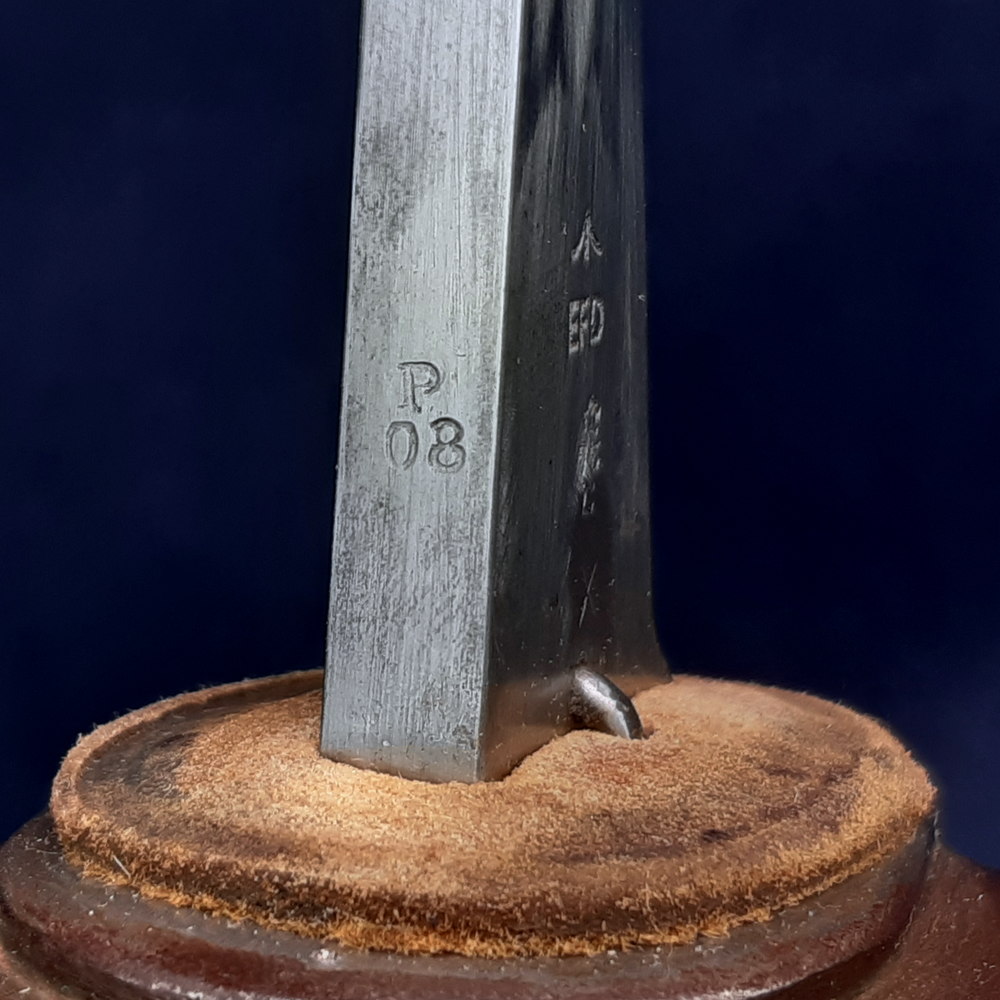
The blade is stamped at the ricasso on one side with a broad arrow War Department stores mark, ‘EFD’ indicating that it was manufactured by the Royal Small Arms Factory at Enfield, a crown inspection mark with ‘E’ for Enfield and an ‘X’ indicating that the blade passed a manufacturer’s bending test. It is stamped on the other side with the manufacture date ‘12 15’ for December 1915, a reissue stamp ’38 for 1938, and three further crown inspection marks with ‘E’. The spine of the blade is stamped ‘P 08’ indicating the pattern.
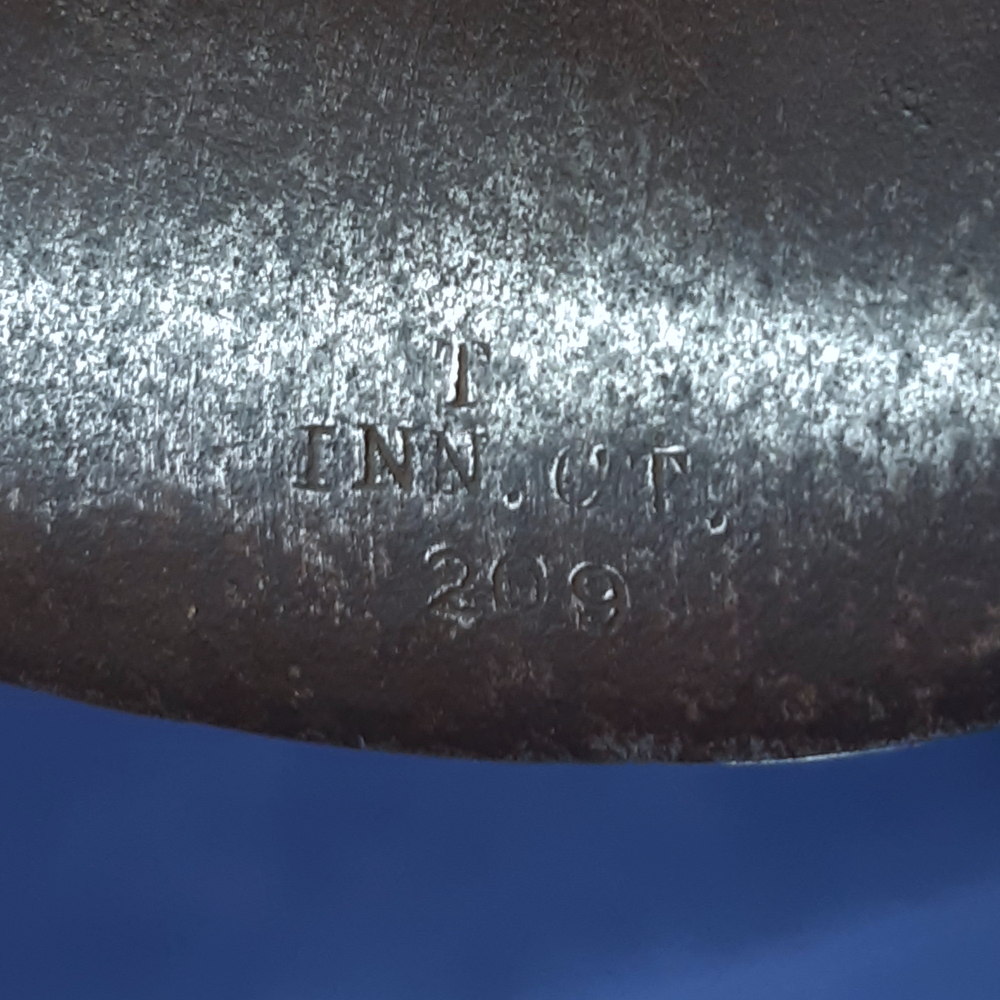
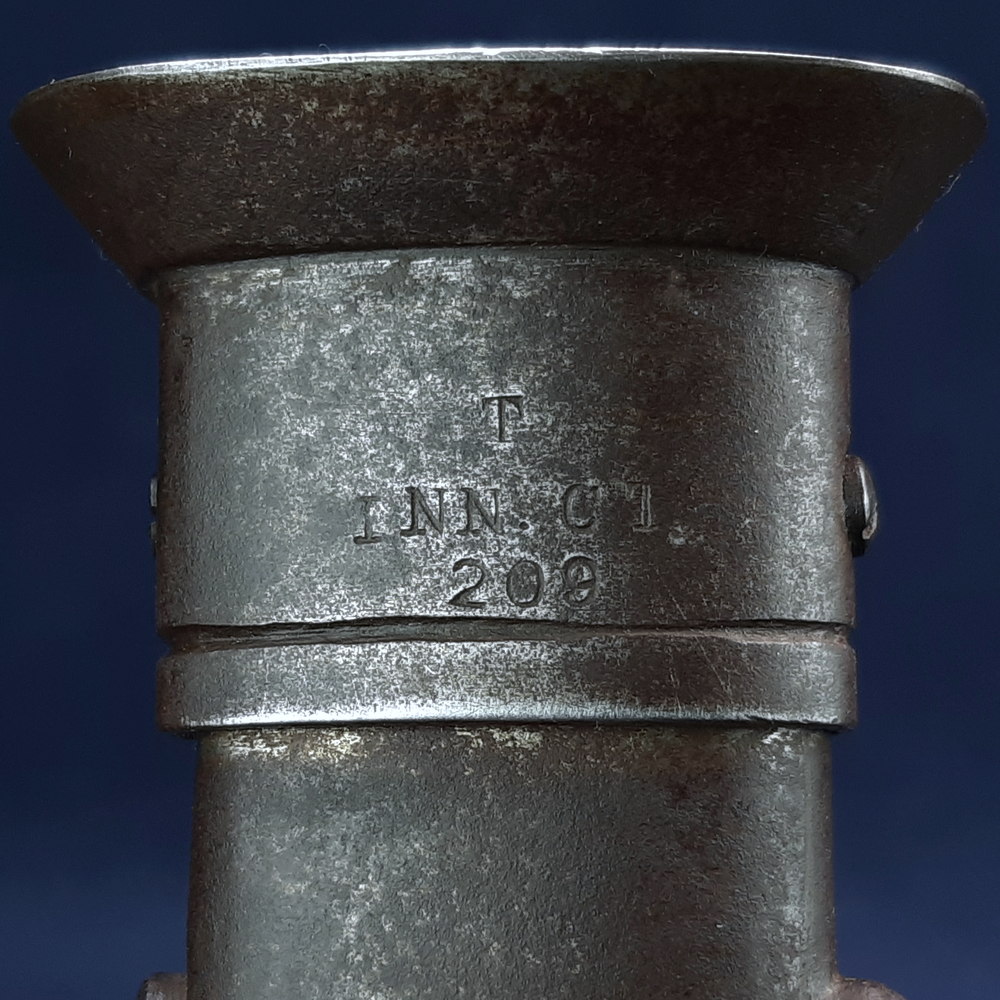
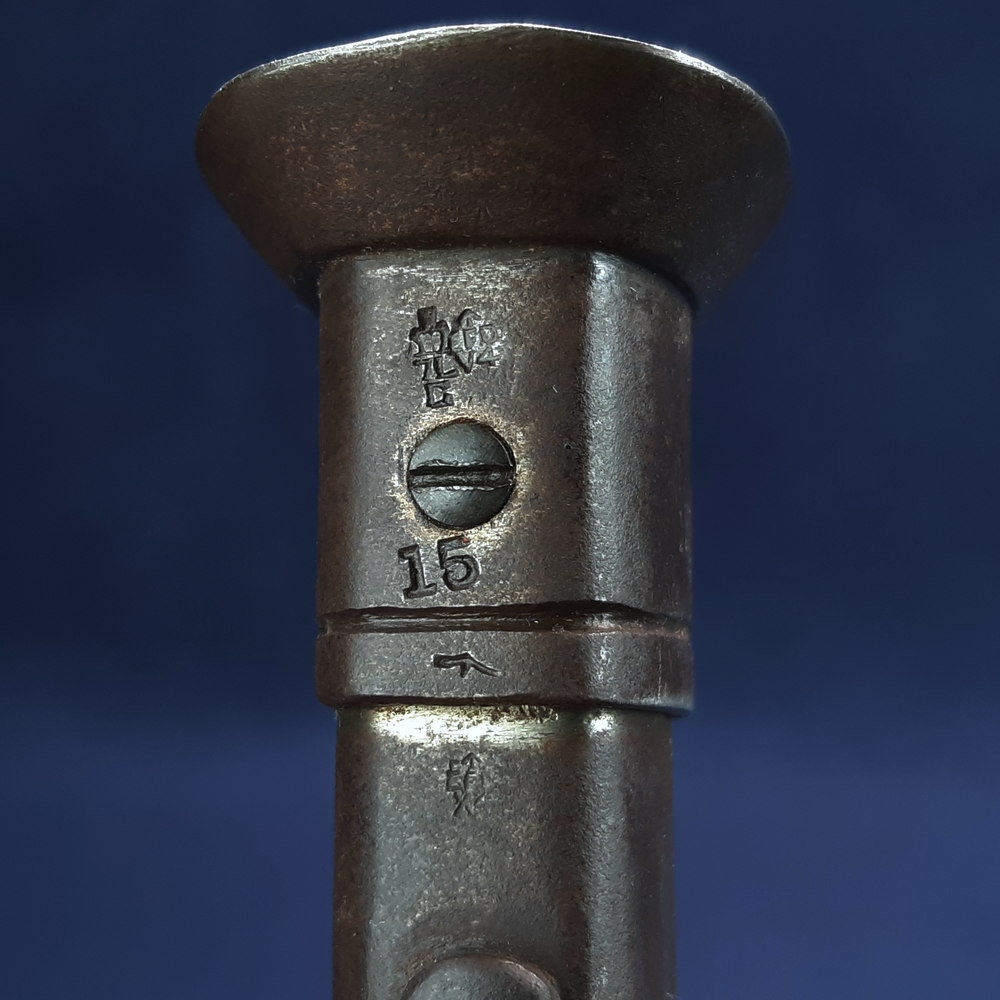
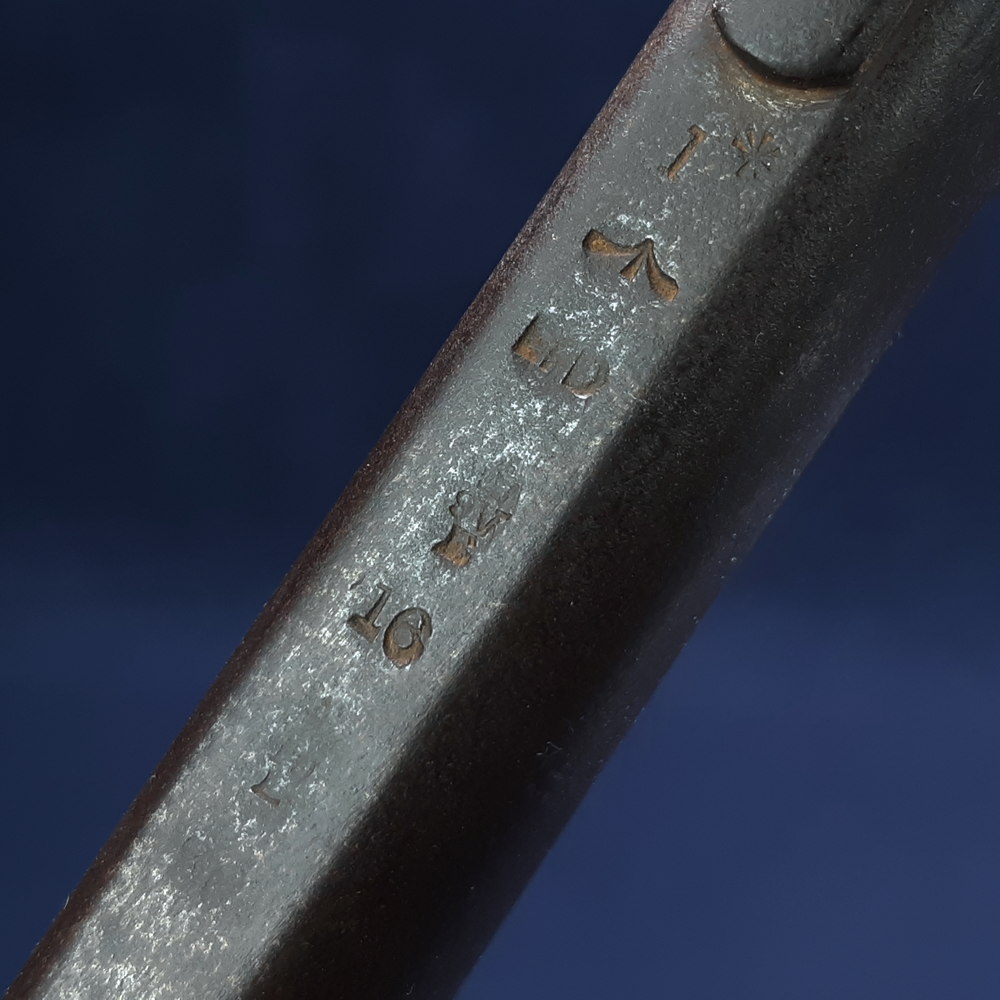
The inside of the guard is stamped with ‘T’ over ‘INN. CT.’ over ‘209’. This indicates that it was weapon number 209 issued to the Inns of Court Regiment, a regiment in the Territorial Force. The throat piece of the scabbard is identically stamped on one side with the same unit, indicating sword and scabbard are an original pair. The spine side of the throat piece is stamped with a broad arrow, an indistinct mark and the date ’15 indicating that it was also manufactured in 1915. The spine of the main section of the scabbard is stamped with I* (an Indian stores mark), another broad arrow, the manufacturer’s mark ‘EFD’, the manufacture date ’16, two more crown inspection marks with ‘E’, and a faint reissue stamp ’38.
The four Inns of Court are ancient institutions and their involvement with the military dates back at least to 1584, when lawyers pledged to join the Trained Bands (an early militia force descended from and still mostly modelled on the Anglo-Saxon fyrd system) and defend Queen Elizabeth from the threat of Spain, which culminated in the attack of the Spanish Armada in 1588. The lawyers mobilized temporary regiments for many similar occasions due to conflict or civil disorder, including the Civil War, Jacobite Rebellion, Gordon Riots and Napoleonic Wars.
During the last of these the Law Association Volunteers, a unit recruited from and funded by the Inner Temple, Middle Temple and Lincoln’s Inn, drilled before King George III at a royal review in Hyde Park in 1803. Impressed with their bearing and in high spirits, the king enquired who the men were. “They are all lawyers, sire” responded Lord David Erskine, their commander (himself of Lincoln’s Inn). “What, what?” exclaimed the king. “All lawyers, all lawyers? Call them the Devil’s Own, call them the Devil's Own!”
In 1859 fear of another invasion produced a nationwide ‘Volunteer Movement’ of newly established rifle corps. The Inns of Court revived their volunteering tradition with the establishment of the 23rd Middlesex (Inns of Court) Rifle Volunteer Corps. King George’s nickname stuck and despite the passage of years the unit held on to the unofficial title of ‘The Devil’s Own’. Unlike previous units this battalion of part-time volunteers did not disband when tensions cooled: one recruit, L.D. Powles, who joined in the early 1860s, recalled that the unit was popular:
“…pretty nearly all the able-bodied men at the bar enlisted, and every afternoon Queen’s Counsel and others in large practise and well advanced in middle life were to be seen drilling in Lincoln’s Inn or Temple Gardens.”
In 1881 it was attached to the Rifle Brigade as their 2nd Volunteer Battalion. Its first detachment of mounted infantry was formed in 1888. It was reduced in size and attached to the 4th Middlesex Rifle Volunteers in 1891, and made its first combat deployment in 1899 when it contributed 30 mounted infantry and 10 cyclists to the City Imperial Volunteers for service in the Boer War.
It was reorganized as a full battalion again in 1908 as part of the new Territorial Force. It was initially to be the 27th Battalion of the London Regiment, but the lawyers complained that in light of their long history they should have received a lower number. The unit was permitted to retain its traditional title and soon after in 1909 became an independent officer training regiment, the Inns of Court Officers' Training Corps (I.C.O.T.C.). This was composed of three companies of infantry and for the first time a squadron of cavalry, converted from the previous company of mounted infantry.
One of the key distinctions between the two was that mounted infantry did not carry swords, but cavalry did – however the regimental history suggests that at the outbreak of WW1 the regiment did not actually retain its own horses, probably due to lack of stable facilities – for riding training the squadron used a riding school on Wimbledon Common and the Worcester Park Polo Ground. Nor, apparently, did it have swords in store.
During WW1 the regiment expanded rapidly, establishing a camp at Berkhamsted in September 1914 for lack of space in London. Its cavalry squadron remained separate with the job of training up officers for the necessary skills for cavalry regiments. They got to work converting a disused brewery in Berkhamsted into a stables and housing block, although their horses did not arrive until October and the regimental history suggests that they were not delivered of swords and saddlery until later that winter. Groups of recruits for the cavalry squadron would be sent from the regiment’s depot at Stone Buildings when there was space and trained in the surrounding countryside.
As the war progressed fighting became more static and many cavalry units were dismounted, leading to diminished need for cavalry-trained officers. The cavalry squadron was moved to Maresfield Park in Sussex and attached to the 13th Reserve Regiment of Cavalry in December 1916, then to Tidworth in February 1917 when the 13th was merged into the 5th RRC, allowing it to train on Salisbury Plain for the remainder of the war. More than 1,100 officer trainees passed through the cavalry squadron during the war, the ICOTC as a whole training more than 11,000.
The last men were demobilized from the cavalry squadron in January 1919, and the regiment was reformed in 1920 with two companies of infantry and one squadron of cavalry.
This sword must have been issued to the cavalry squadron at some point after its production in 1915. Whether it was one of the swords used for training during the war or was issued to the regiment later is difficult to say, although it was certainly in use in the year 1938 as indicated by its reissue stamps (these usually indicate some form of inspection, refurbishment or modification took place).
The Corps became the Inns of Court Regiment in 1932. Its infantry companies were converted to light tank units in 1937 and the cavalry squadron was disbanded in 1940 leaving the regiment a fully armoured unit with no further use for swords. It fought in WW2 as an armoured car unit with the 9th and later 11th Armoured Divisions.
It absorbed the single remaining squadron of the Northamptonshire Yeomanry in 1956. It was amalgamated with The City of London Yeomanry (Rough Riders) in 1961 to form the Inns of Court & City Yeomanry. The IC&CY was broken into parts in 1968: some of its personnel transferred to the Royal Signals, forming 68 (Inns of Court and City Yeomanry) Signal Squadron, and its regimental band transferred to the new Royal Yeomanry Regiment, while retaining its historic link and title from the IC&CY. The old unit itself was not actually disbanded but reduced to a cadre and used as the basis for a squadron of the Home Service Force – these were home defence units which recruited from retired volunteers with previous military service in any branch of the Armed Forces, a sort of updated Home Guard intended to guard key strategic points in the event of an attack on the UK. The Home Service Force was disbanded after the 1994 Defence Review.
The present-day descendants of the Inns of Court Regiment are therefore 68 (Inns of Court & City Yeomanry) Signal Squadron, and the band of the Royal Yeomanry.
The blade is excellent, bright and clean with no edge damage, slight chipping to the tip, and only a couple of small patches of light patination. It has probably been preserved by the good seal between the washer and scabbard, note the bright steel on the inside of the scabbard mouthpiece. All of the exposed metal parts (the scabbard, guard, ferrule and pommel) by contrast have a mottled dark patina. A couple of scratches to the outside of the guard. The plastic grips have some surface-level cracking along the backstrap area but remain solid in the hand. The scabbard has a few light scratches and a number of light dents to the edges of its lower section, consistent with knocking against objects while carried. These do not interfere with sheathing and drawing.
