







British Victorian Royal Horse Guards Post-1832 Officer’s Sword with ‘Continental’ Hilt of Cornet George William Plukenett Woodroffe, Dated 1862 by Wilkinson
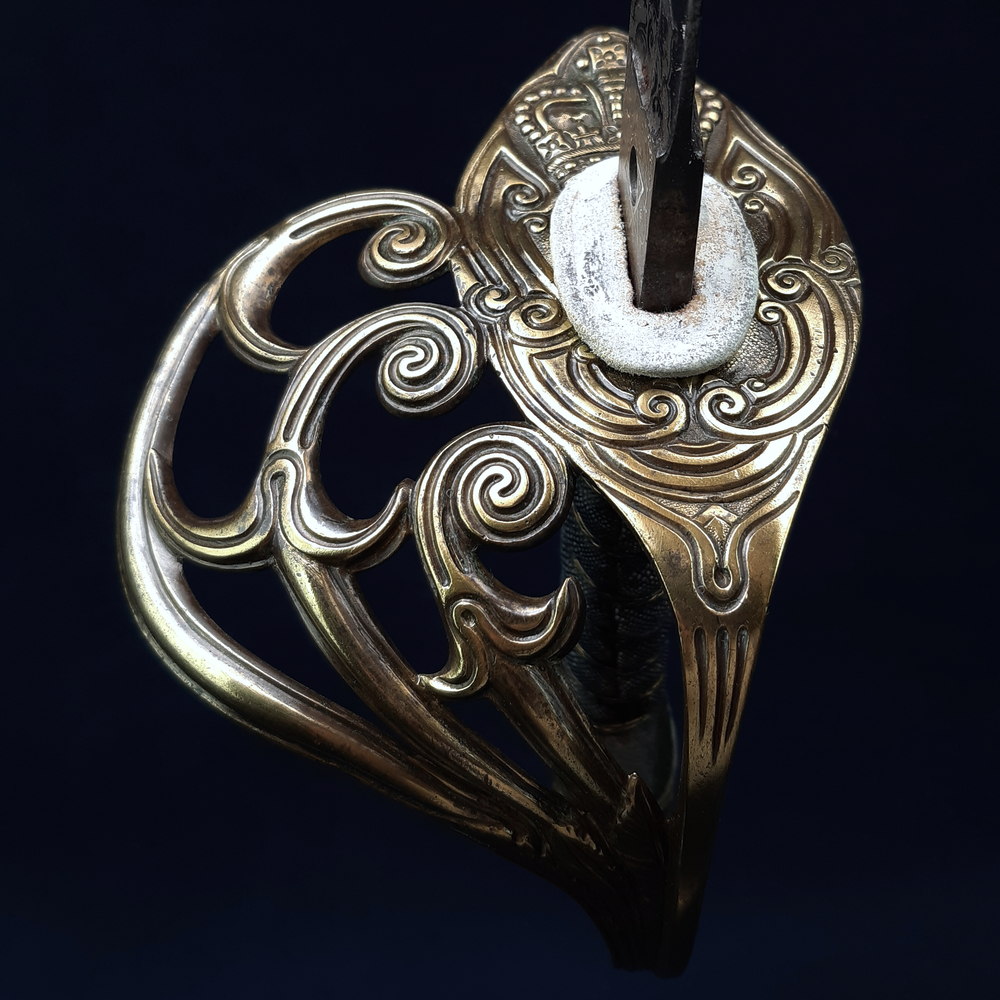
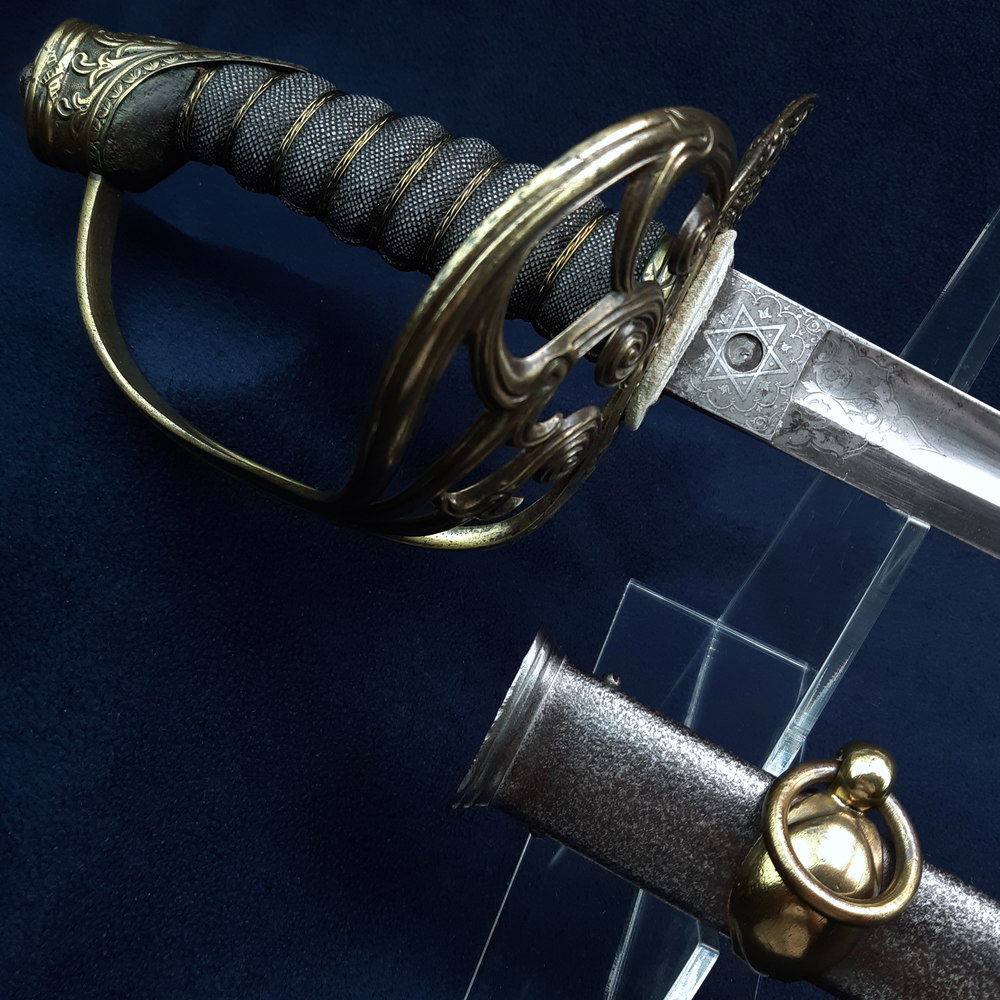
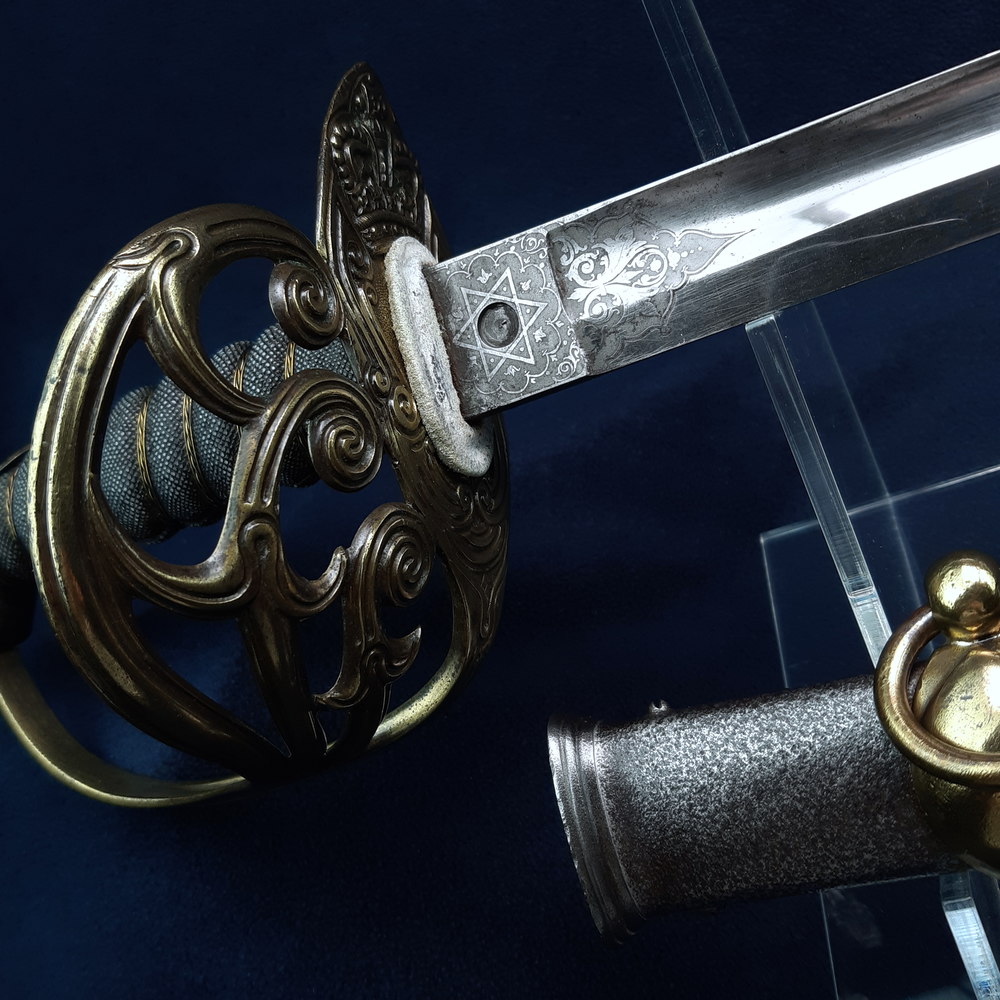
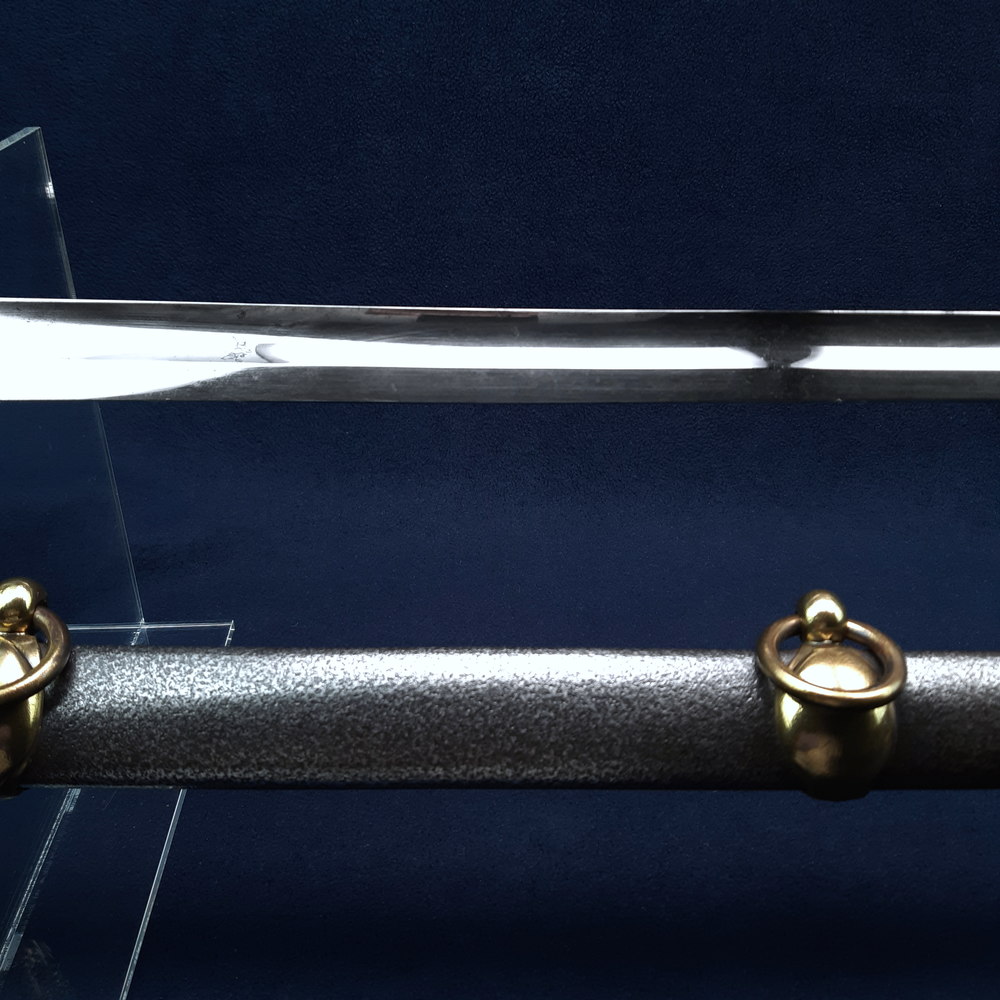
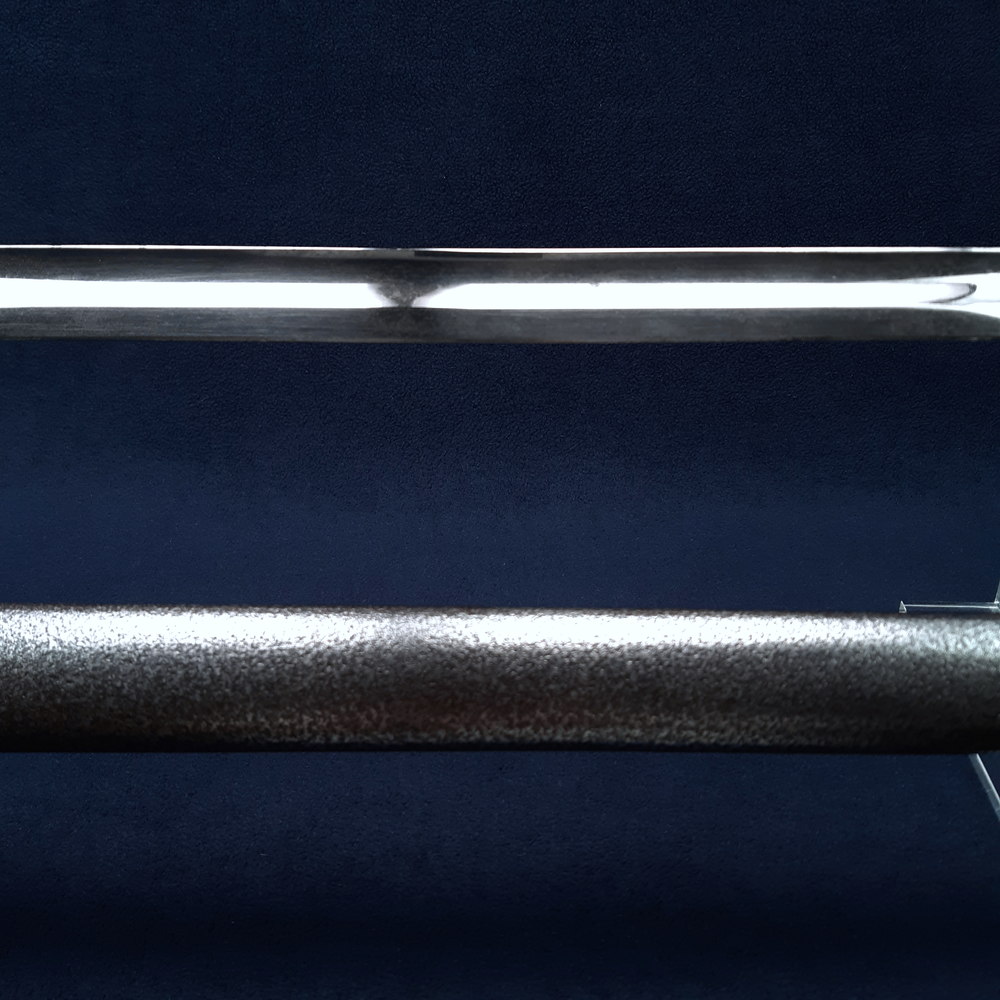
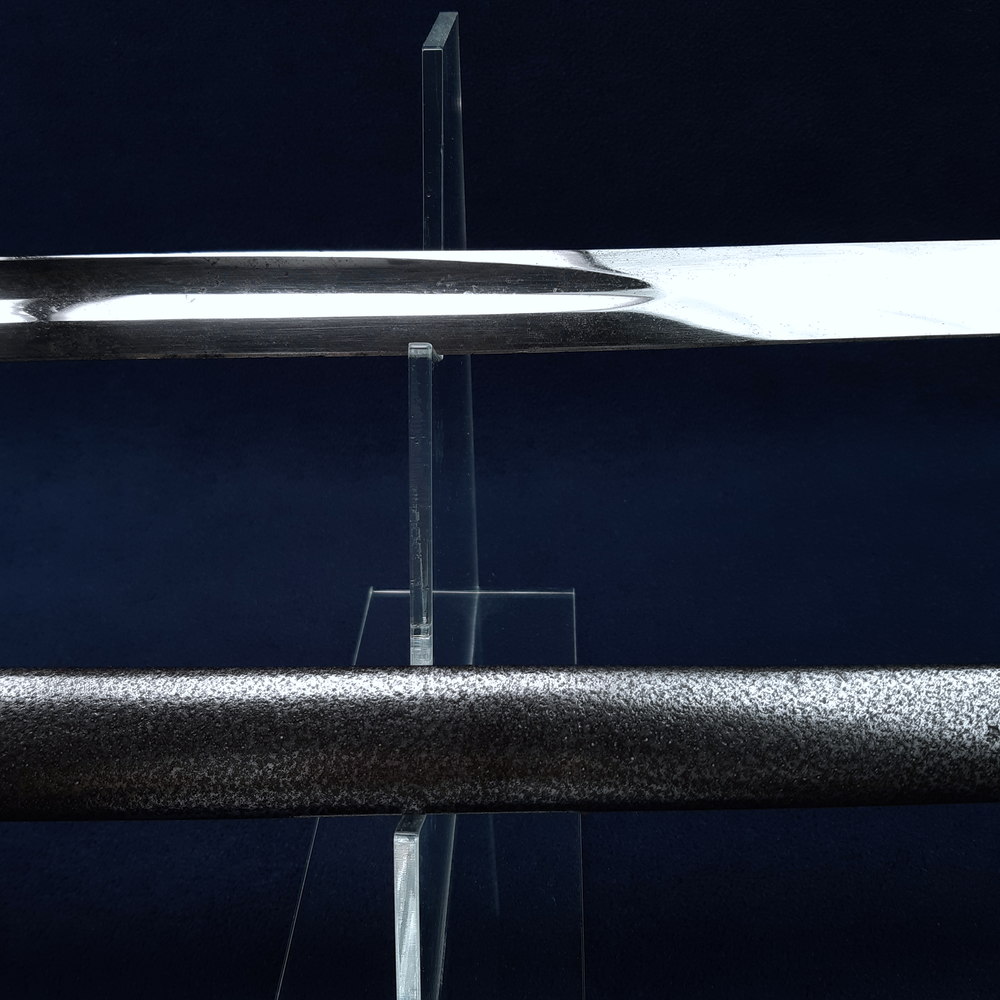
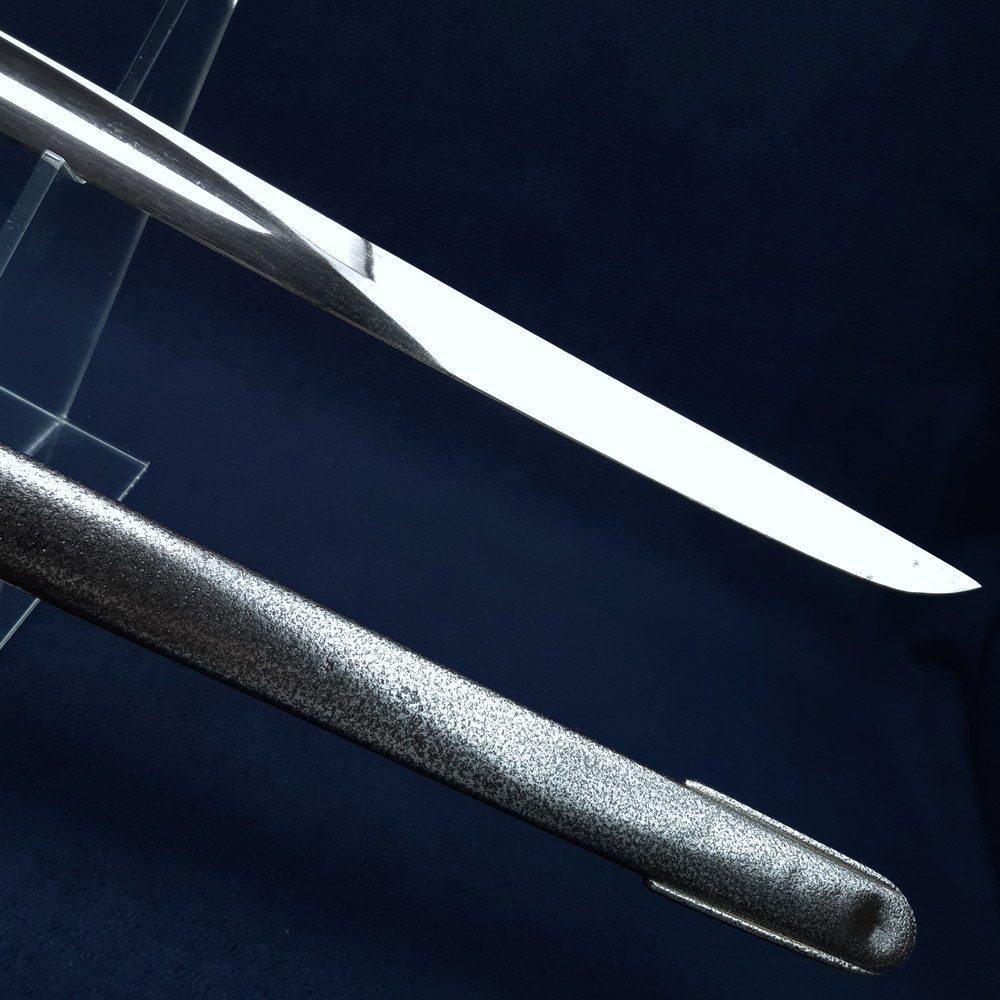
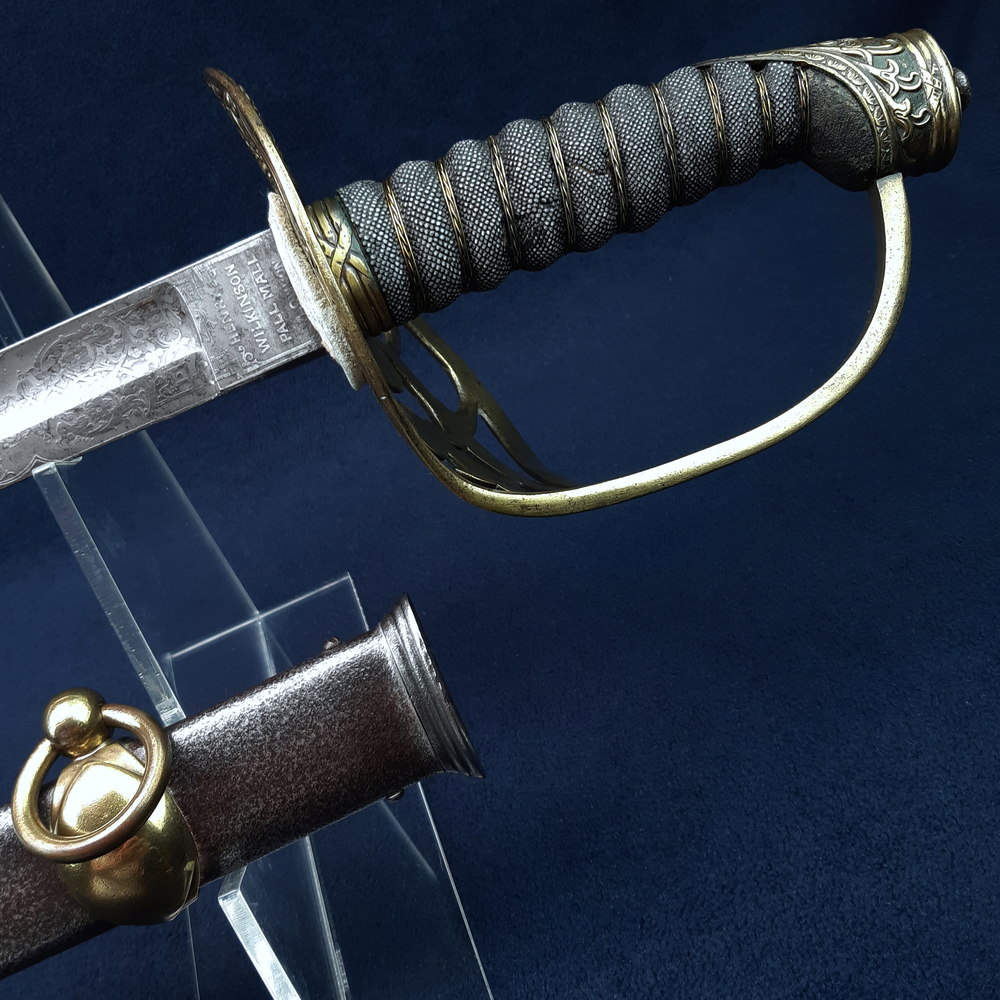
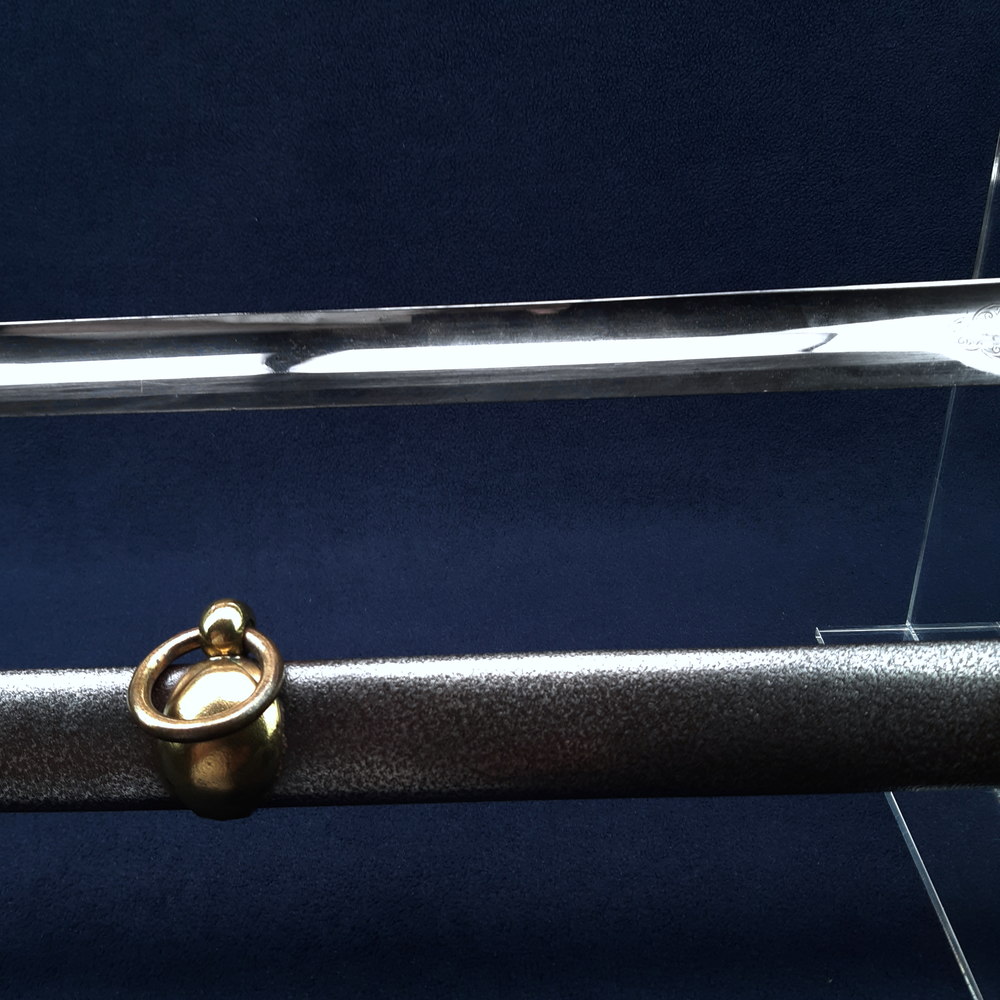
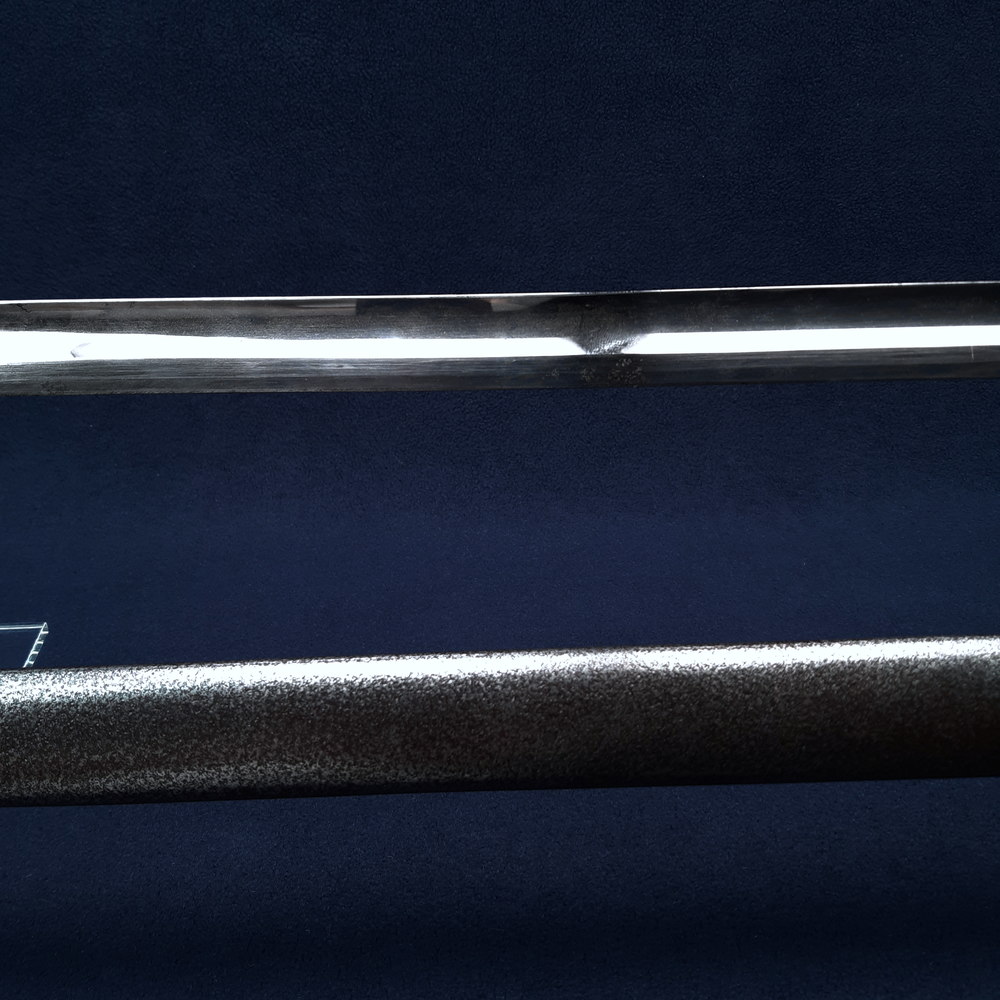
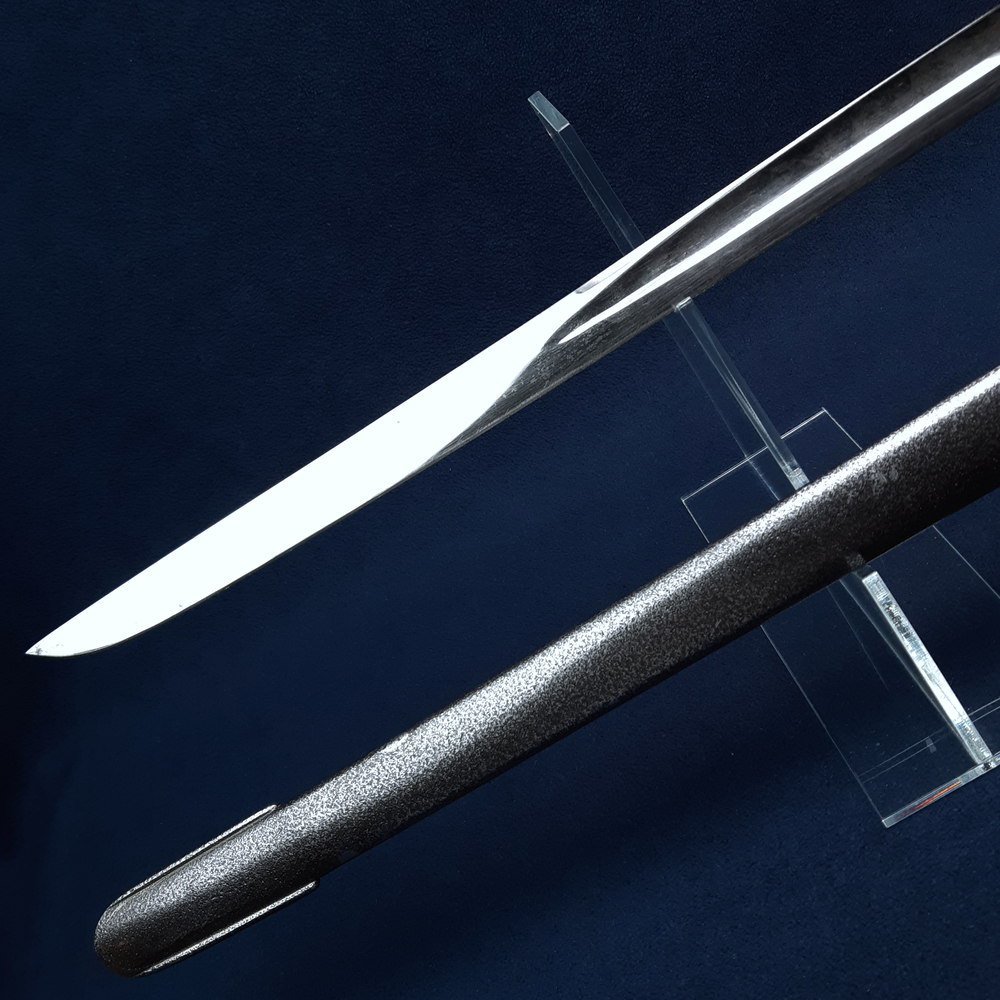
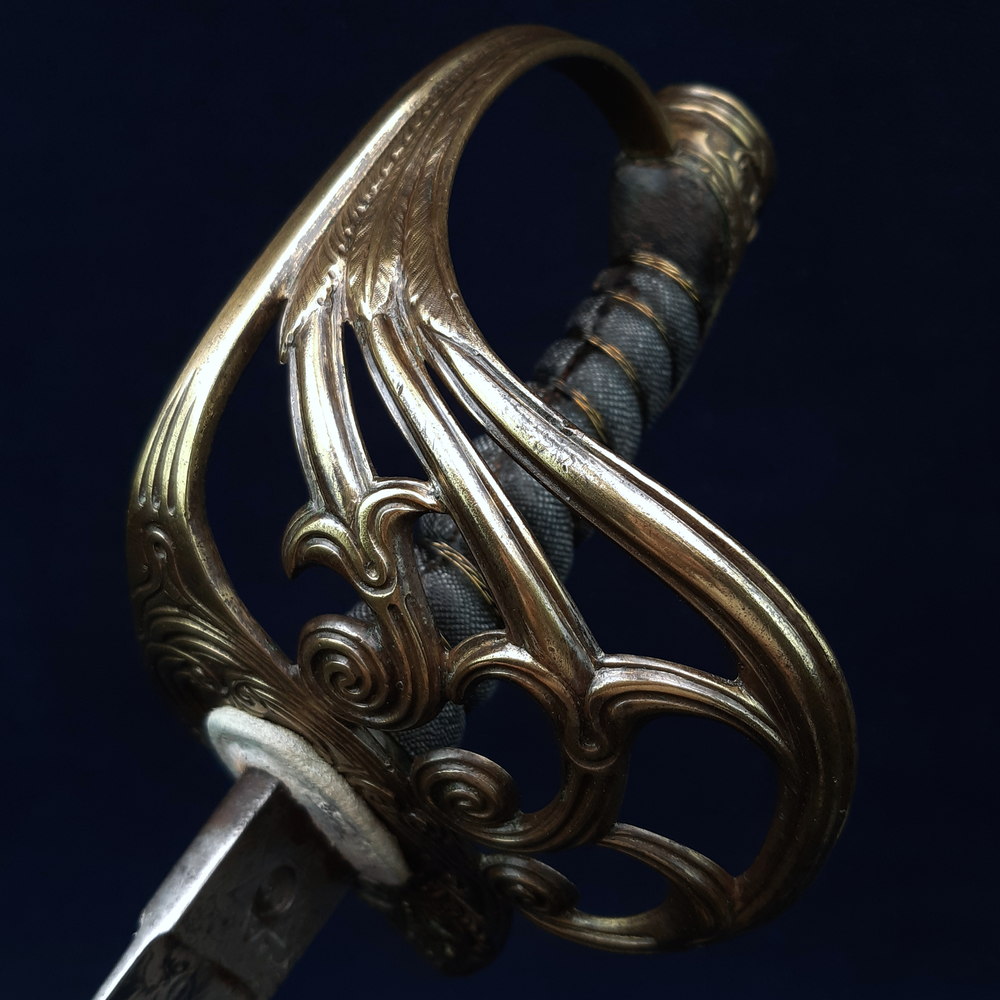
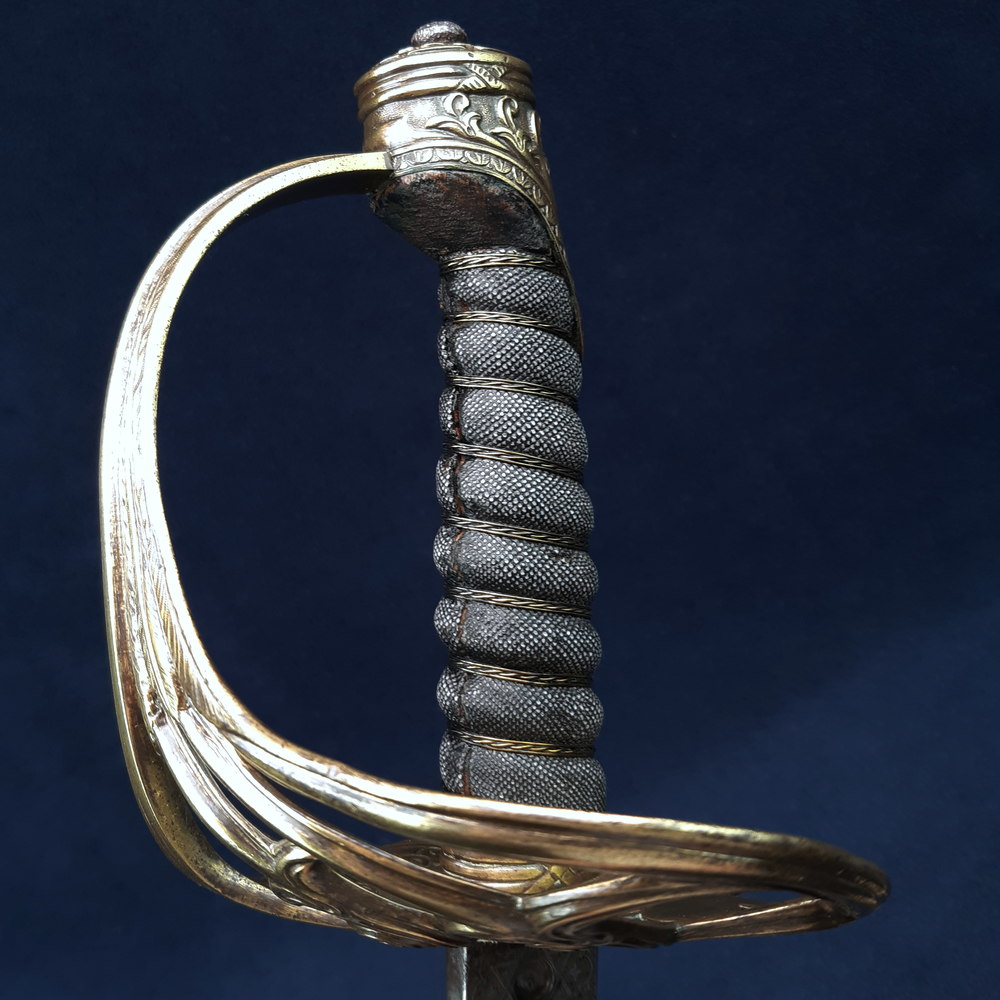
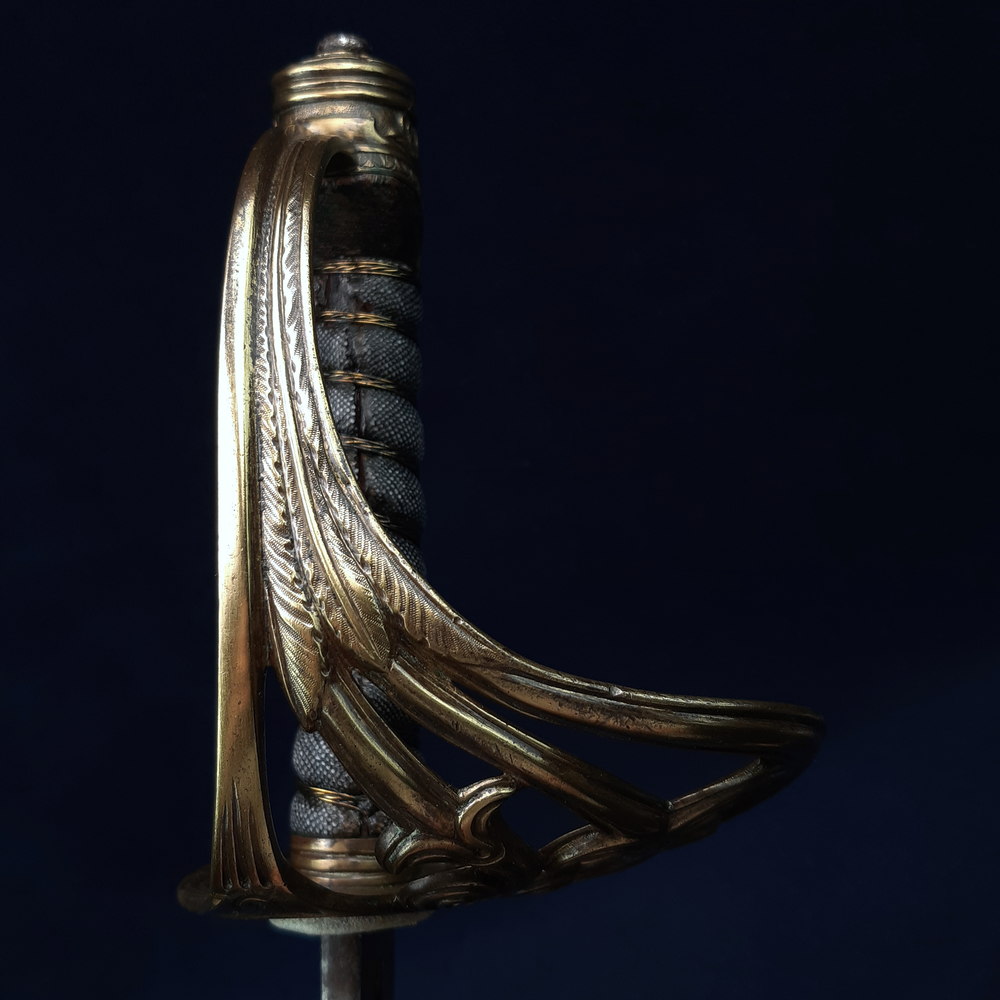
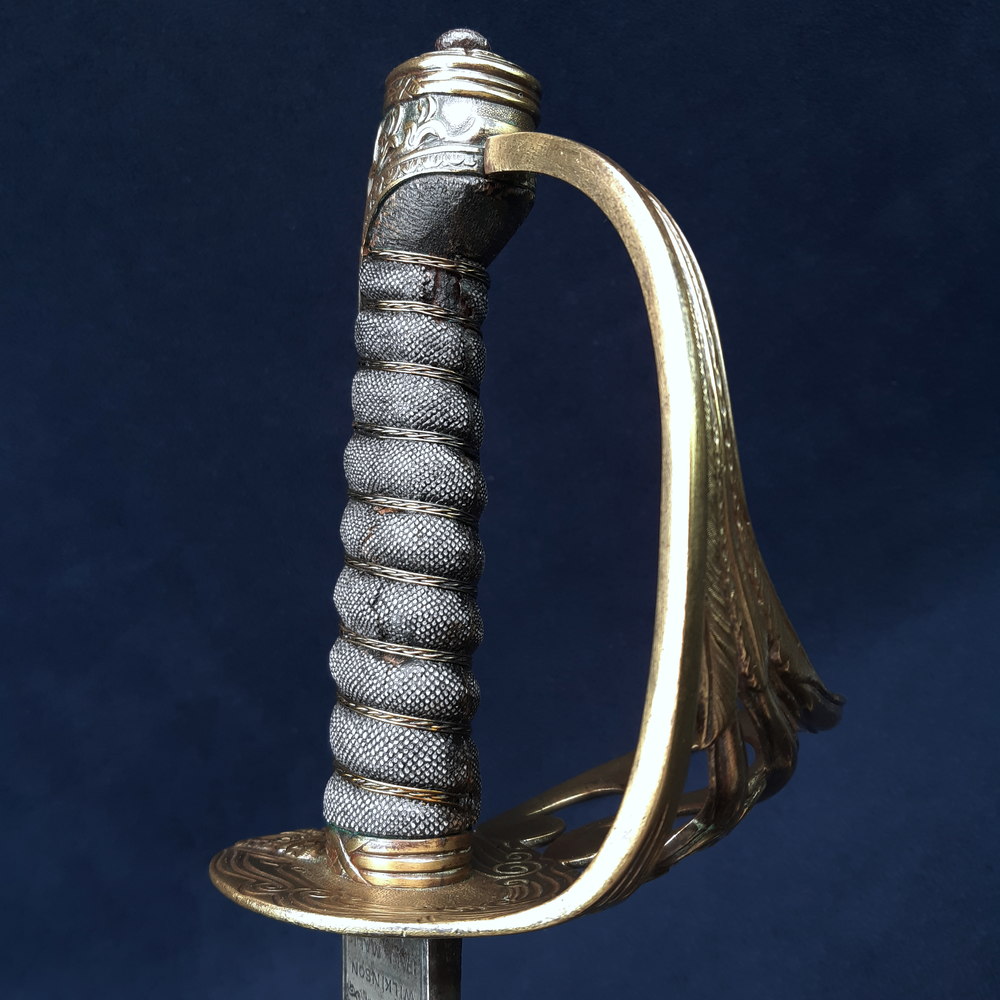
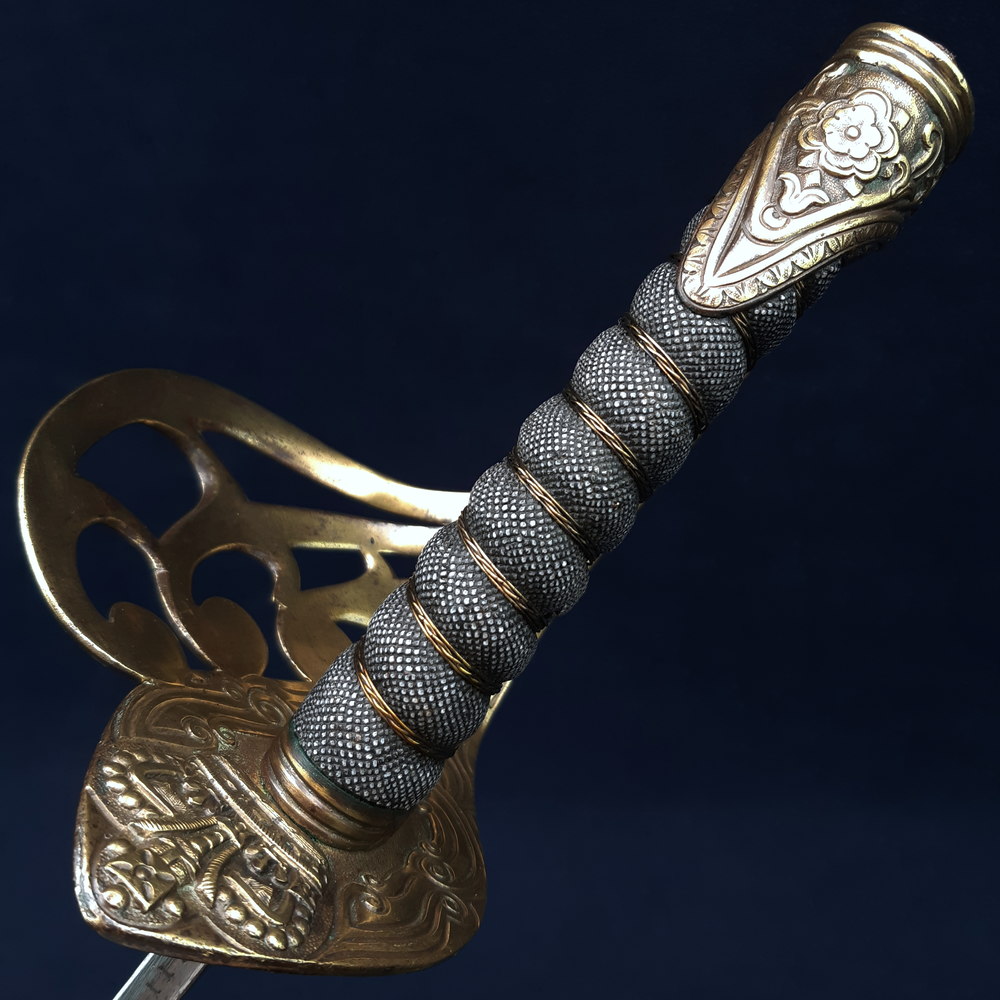
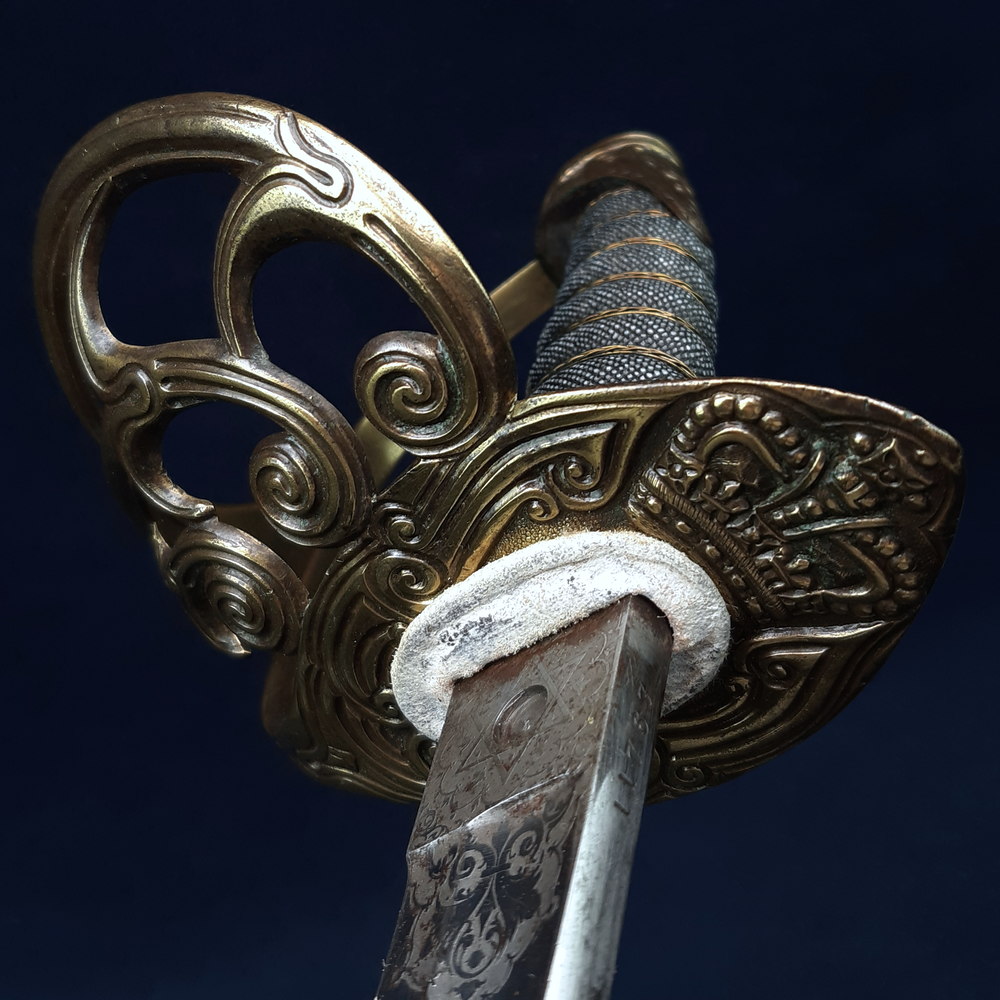
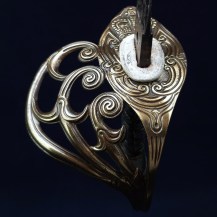
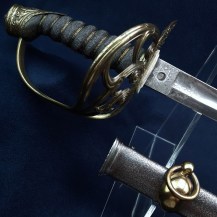
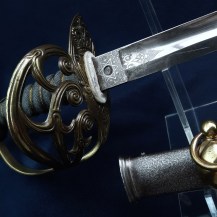
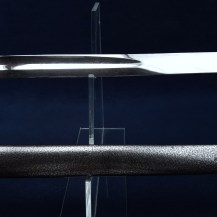
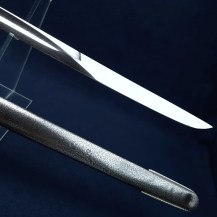
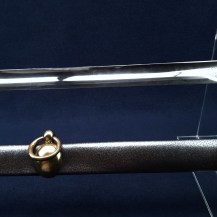
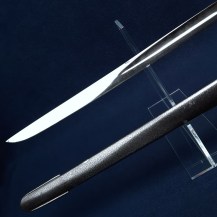
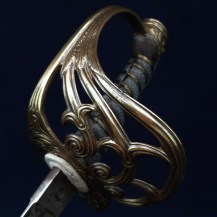
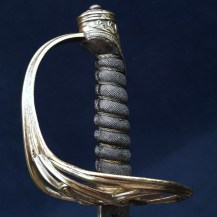
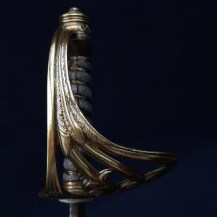
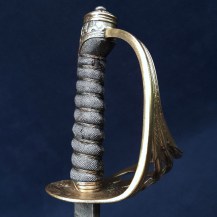
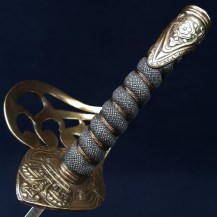
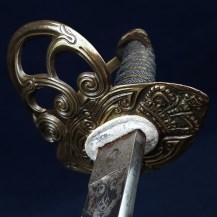
Straight blade with single fuller and hatchet point. Brass hilt with three side bars, the whole cast inside and out with motifs of spiralling foliage, feathers placed on the branching section of the hilt bars, and the St Edward’s Crown, correct for the reign of Queen Victoria. Spiral ribbed grip of wood covered with black shagreen bound with wire, ribbed brass ferrule and ornate brass pommel cap. Leather washer Blancoed to be white. Steel scabbard with two large smooth oval brass bands with hanging rings, steel shoe at the chape. Blade 36 inches in length, 1¼ inches wide at the shoulder, the sword 42½ inches overall.
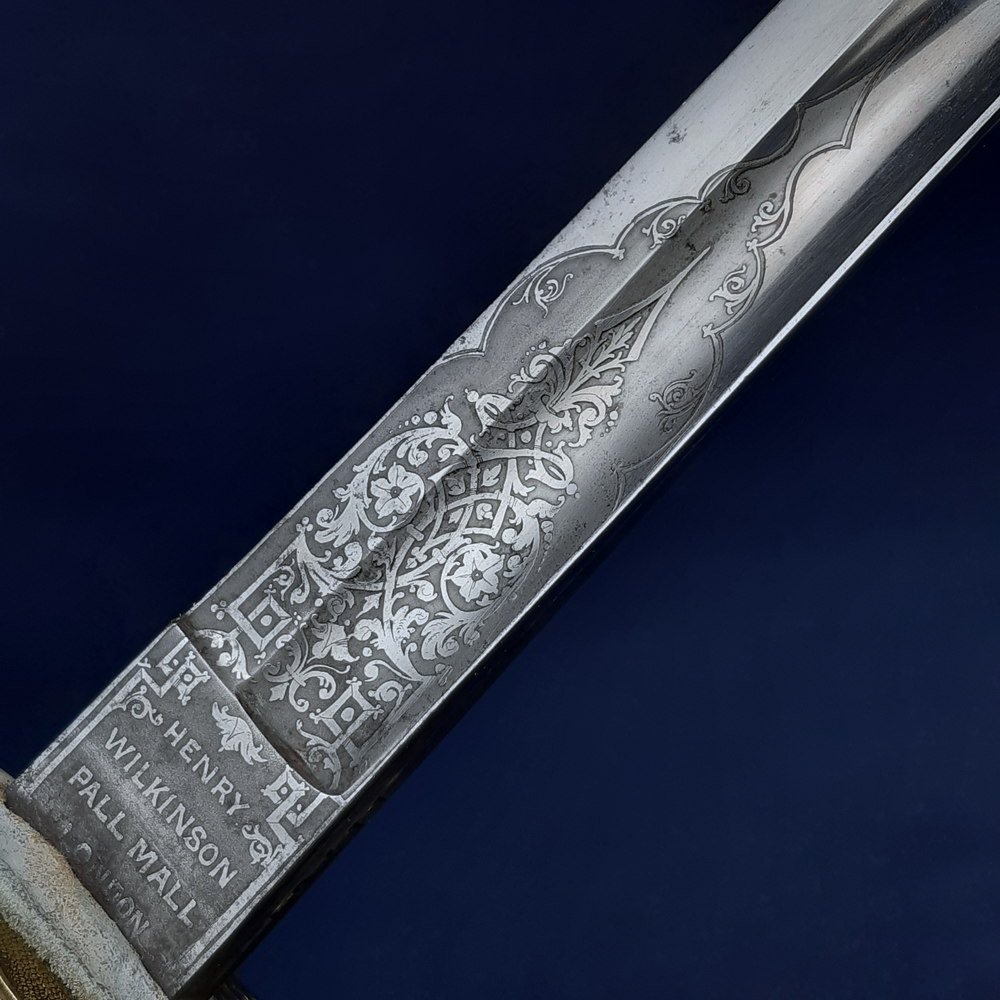
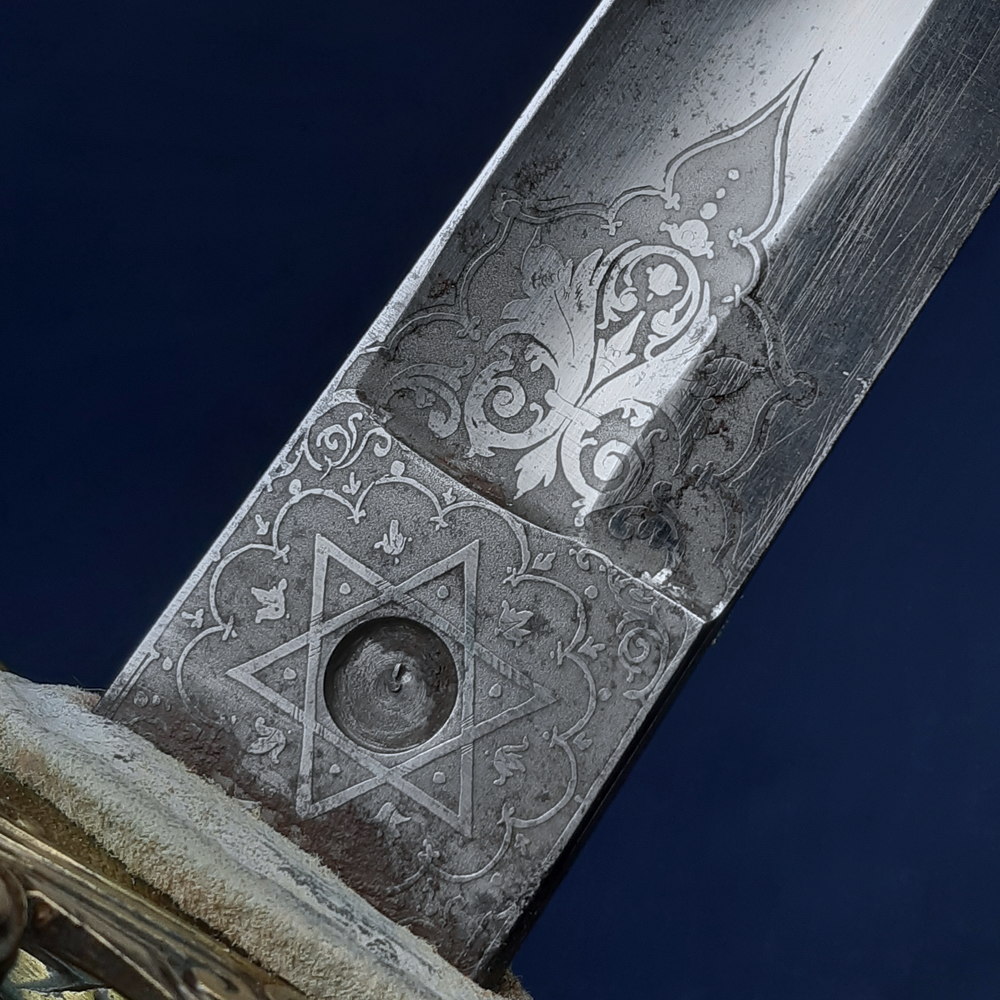
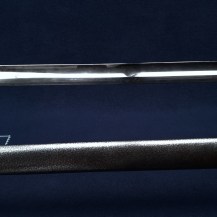
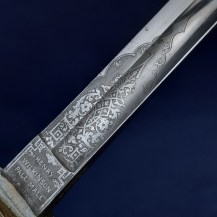
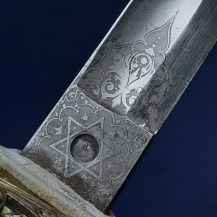
The blade is etched at the forte on one side with the maker’s mark ‘HENRY WILKINSON PALL MALL LONDON’ and foliate motifs. At the ricasso on the other side should be a circular brass proof slug set within an etched six-pointed star – the proof slug itself has been lost leaving an empty depression. Around and above this are etched further folate motifs.
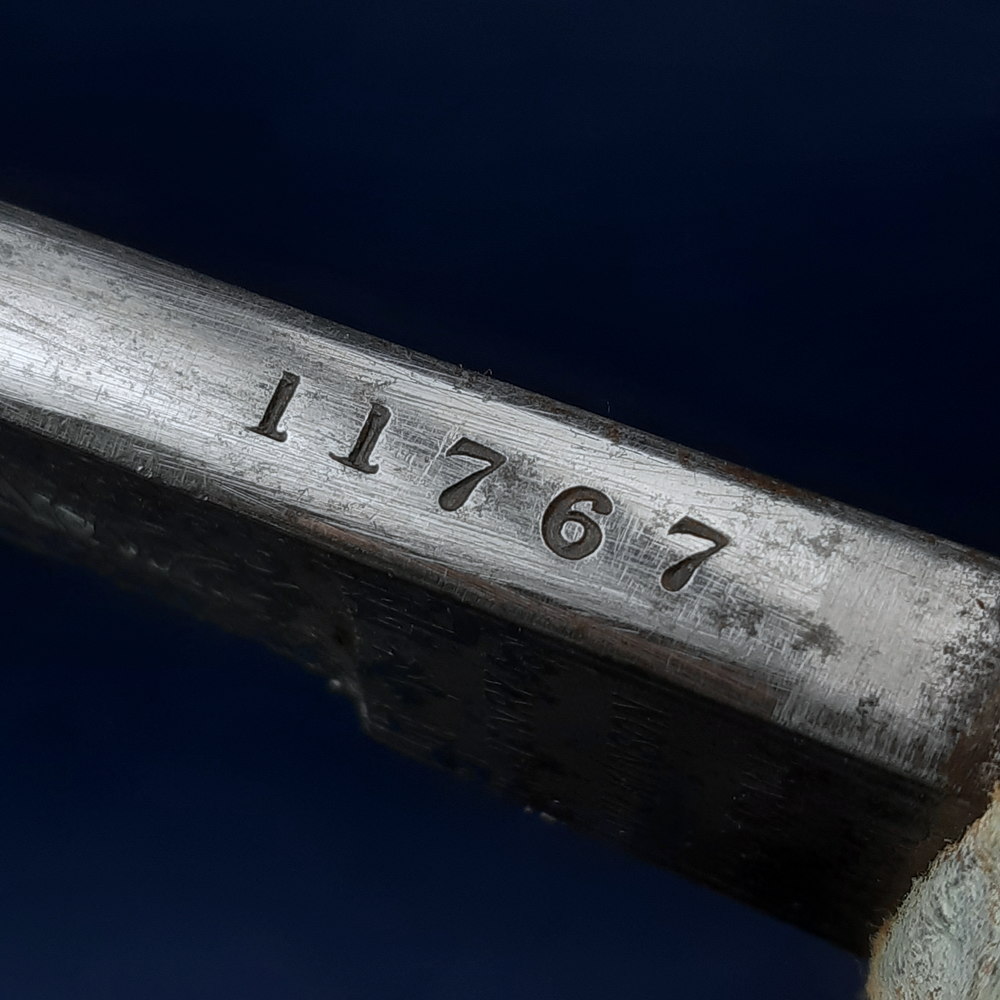
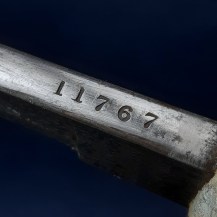
The spine of the blade is stamped with the serial number ‘11767’. Wilkinson company records indicate that sword 11767 was a 'Regulation Blues Sword' (Blues being a reference to the Royal Horse Guards, nicknamed as such from their earliest days because of their blue uniforms) sold to ‘Woodroffe Esq.’ (Esquire, a courtesy title for members of the gentry) on the 18th February 1862.
George William Plukenett Woodroffe was born in July 1842. His father Skynner George Woodroffe served as a Lieutenant with the Queen's Own Worcestershire Regiment of Yeomanry Cavalry from 1841 until his death in February 1843, aged 33. George's mother Emily remarried to Walker Skirrow Jr in 1853.
George purchased a commission as a Cornet in the Royal Regiment of Horse Guards on 7th January 1862. This matches up well with the sword’s sale date and there are no other candidates with that surname in the RHG at that time.
George’s military career appears to have been short – he sold his commission and retired from the service on the 26th May 1865, totaling three years and four months. The RHG undertook no deployments during this time, only their usual guard and ceremonial duties, punctuated by the demolition and reconstruction of their barracks at Windsor in 1864 on the instruction of Queen Victoria (who had discovered them to be unhygienic) and early experimentation with what became the game of polo. While uneventful, the brevity of George’s career may have helped preserve his sword in its current good condition.
In May 1866 George married Alice Maud Townshend, and in 1868 he partnered with stockbroker Henry Evans Gordon to form Gordon, Woodroffe and Co, East Indian and Colonial Merchants, which he remained involved with for the rest of his life. He is listed at various times residing at Winkfield Manor in Berkshire, Eastcott House in Surrey, and Cambridge Park House in Twickenham.
In 1918 he contributed £105 towards the King Edward's Hospital Fund – a charity to support London’s voluntary hospitals, the only healthcare option for the poor at the time.
George died in December 1919, aged 77, while living in Queen Anne's Mansions, the tallest block of flats in London.
For a man who was only briefly a soldier George seems to have founded a thoroughly military family: his first daughter Clara married Major Edward Barrington Crake of the Rifle Brigade, and his second daughter Maud married Captain James Lionel Dugdale of the Princess of Wales's Own Yorkshire Hussars Yeomanry.
George’s only son was Brigadier-General Charles Richard Woodroffe CMG CVO CBE, of the Royal Artillery, who during WW1 served on the Western Front as Deputy Assistant Quartermaster General at General Headquarters from 1914-1915, then as Deputy Adjutant & Quartermaster General with the British Mission to the French Grand Quartier General from 1917-1918. His service liasing with the French was rewarded with the Croix d’Officier in 1916 and the Croix de Guerre in 1918. Charles accompanied the Prince of Wales as military secretary during his visit to Japan in 1922, for which he was awarded CVO (Commander rank of the Royal Victorian Order).
George’s grandson by Charles was Lt-Col. John William Richard Woodroffe, Royal Artillery, who was the first husband of Jean Woodroffe (nee Francis) CVO, second lady-in-waiting to Queen Elizabeth II.
His grandson by Maud was Thomas Lionel Dugdale, who was MP for Richmond (Yorkshire) from 1929 to 1959, served with the Scots Greys in WW1 and in Egypt with the Yorkshire Hussars in WW2, became Minister for Agriculture and later Chairman of the Conservative Party, and was made 1st Baron Crathorne in the House of Lords.
Since their inception the regiments of Life Guards and Royal Horse Guards which collectively made up the Household Cavalry carried different swords than the regiments of the regular cavalry. This stemmed from their unique status as bodyguards to the sovereign, which placed them beyond the effective control of the Army bureaucracy for most of their existence. Until 1882 they designed, ordered and carried swords on their own initiative, not necessarily producing better weapons but enhancing their prestige and social status.
Swords like this one were carried by officers of the Royal Horse Guards, also known as The Blues, when in Dress order and probably in the Undress order as well (Undress wear of it was confirmed in 1846). Its distinctive chunky and ornate brass hilt is very European in style, influenced primarily by French heavy cavalry swords of the First Empire and Restoration periods, collectors have thus referred to it as the ‘Continental hilt’. This model is thought to have been carried from at least 1832 and was noted in the 1834 Dress Regulations with the very vague specification:
“Sword – gilt guard, pommel and shell; black fish-skin gripe twisted with yellow wire; straight cut and thrust blade, full one inch wide at shoulder, and thirty-nine long. Scabbard – steel.”
Actual examples frequently differ from this spec – for instance the guards do not appear to have been gilded and blades are consistently wider than 1 inch. Overall the 1834 Regulations seem to be very confused and unreliable with regards to the swords of the Royal Horse Guards. See The British Cavalry Sword by Dellar, p210-211 for more discussion of the Regulations and this type in general.
A similar sword was carried by the officers of the 2nd Life Guards but these can be distinguished by the decoration on the hilt and pommel cap: the 2nd Life Guards sword put a grenade badge in these spots while the Royal Horse Guards used a crown for the hilt and a Tudor rose on the pommel cap.
Over time it appears the officers of the RHG moved away from the Continental hilt towards their own version of the ’12-stud’ hilt swords carried by the 1st Life Guards: one known example is dated 1854 (Dellar p211). As usual this was totally informal. Both types probably coexisted for a period but the changeover was formalized in the 1874 Dress Regulations, in which the 12-stud sword became standard carry for all Household Cavalry, with minor variations for regimental insignia. This was referred to as the 1874 Pattern or ‘State sword’.
This sword’s blade is 3 inches shorter than the above regulation. Its tip has the correct hatchet profile, the scabbard is sized to match and fits well, and this is not the only example I have seen at this length, so it was probably deliberately made that size. Perhaps to aid in wearing it when dismounted? Yet more contradiction of the Dress Regulations.
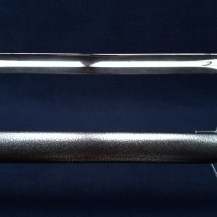
The sword is firmly peened with no movement to any parts. The blade has a near-mirror polish, with a few polishing marks and a few tiny spots of light patination and frosting. The edge is unsharpened with no edge damage or tip wear. All the sword’s brass parts have an even midtone patina, darker in recesses, with good retention of detail suggesting little in the way of repolishing. The flared segment of the grip near the pommel has lost its shagreen covering, and there is also one small area of loss in the next segment beside the grip’s seam. In both areas this exposes the wood core. Some small cracks to the shagreen elsewhere, scattered spots of scale loss and light handling wear overall. Despite these minor damages the grip remains solid overall with no lifting or movement and the wire binding of the grip is all present and tight.
The scabbard’s steel body section has moderate cleaned pitting peppered overall, one dent at the chape on one side which does not interfere with sheathing and drawing. Its brass parts are consistent with those of the hilt or a fraction brighter, with no dents. The screws at the throat are all present.
